DEVELOPMENT ASSOCIATES, INC.
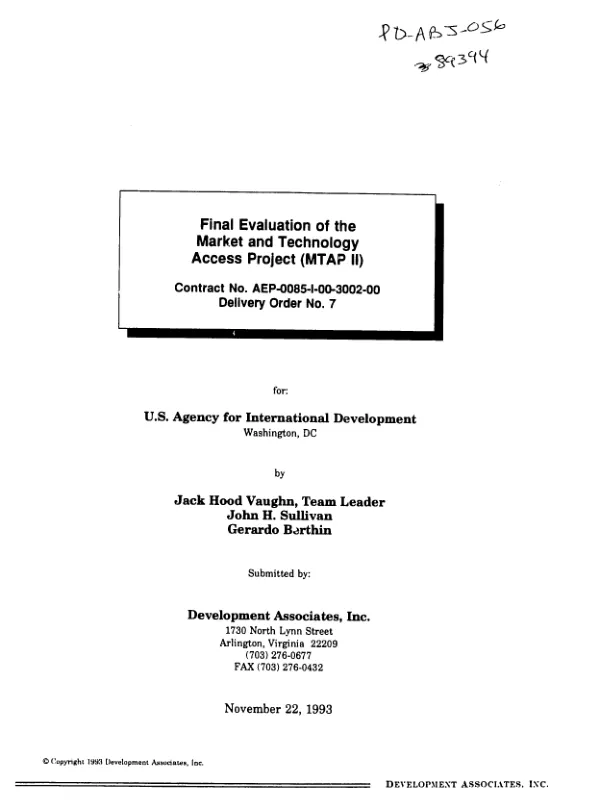
Final evaluation of the market and technology access project (MTAP II)
Final evaluation of Phase II (1988-1993) of a project to develop U.S.-LDC trade and technology linkages (MTAP II).
Vaughn, Jack Hood|Sullivan, John H.|Berthin, Gerardo · 1993
Sign in to readA free account is required to download.
Abstract
The project included two components: research and TA by the InterAmerican Management Consulting Corporation (IMCC); and sponsorship by the National Association of State Development Agencies (NASDA) of collaborative trade and investment efforts between individual U.S. states and developing countries. In general, the problems that hindered Phase I were not remedied during Phase II, which did not create new funding strategies, offer more varied and expansive projects, and/or match developing country technology and investment needs with U.S. technical services and support. In the language of sports, IMCC left the playing field after 5 years without ever having scored, and its overall performance was rated only 4 on a scale of 10 by the evaluators. Work plans were weak, frequently changed, and rarely adhered to; there was little evidence of research or evaluation; efforts were tenuously related to project objectives; and the dissemination/network development component was a major failure. Further, IMCC contract objectives were in a constant state of flux due to the changing emphases of the S&T and PRE Bureaus (i.e., Mission buy-ins vs. commercial transactions), frequent USAID project management changes, USAID's inability to enforce the contract, and the vague nature of the contract itself, which, though amended 30 times, never included specific requirements for quantifying or highlighting achievements, thus creating a great dilemma for the evaluation team. A particular failure was the IMCC program in Guatemala, which accounted for nearly 42% of all buy-ins. IMCC's first effort in this country -- an export promotion effort with GEXPRONT costing hundreds of thousands of USAID dollars -- yielded little that the Mission could not have accomplished by hiring a field consultant directly. Its second effort, a forestry initiative known as INFORDE, supported a one-person project which was frustrated by personality conflicts between the individual in question and USAID/G, with no effort made by either IMCC or the Mission to correct the situation. By contrast, the NASDA program was relatively successful. NASDA fulfilled all main objectives and almost all specific tasks of the cooperative agreement, and was particularly successful in heightening states' awareness of developing country markets and dissipating skepticism about their potential. The Business Seed Fund yielded 40 approved projects which generated commercial activity estimated at $10 million, while also providing jobs and new investment, strengthening the private sector, introducing new technology, and improving developing countries' export potential; the Environmental Technology Fund generated 37 projects involving over 100 U.S. firms in 20 countries as well as 30 sponsoring organizations; and the Governor-Ambassador Business Development Initiative organized 15 business opportunity seminars and hosted 3 governor-led, ambassador-hosted business missions to ASEAN. However, both the Business and the Technology Funds had excessively high rates of project rejection, mainly because of an inconsistent and erratic approval system. The key lessons learned concern management. In multi-part programs like MTAP II USAID should pinpoint management accountability at the contractor's home office, in the field, and in USAID/W. Regular evaluations and timely, accurate, and substantial reporting are vital. Also, the size and composition of the contractor's team should be an important criteria in selecting contractors for nontraditional export promotion programs. Programs involving agriculture and forest products, for example, require knowledge of a number of areas such as pre- and post-harvest, marketing, pricing, environment, and financing. Other lessons learned are as follows. (1) Projects like MTAP II require better communications with USAID posts and embassies so that U.S. officials abroad can work more closely with grant recipients and more fully understand program objectives. They also require more publicity, aggressive promotion, and flexibility. (2) More incentives should be provided to U.S. firms and sponsors to participate in follow-up activities to develop opportunities created by MTAP. Future efforts should be longer-term and should assure continuity. (3) Continued USAID support for private ventures should be encouraged, although some fears and suspicions of this approach remain in USAID.