USAID DEC
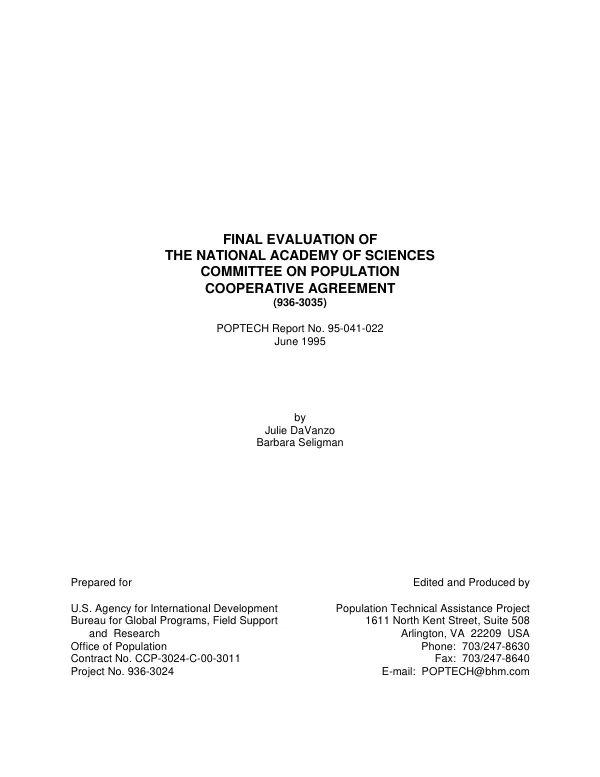
Final evaluation of the National Academy of Sciences Committee on population cooperative agreement (936-3035)
Sign inBASIC HEALTH MANAGEMENT INTERNATIONAL (BHM)
Final evaluation of the National Academy of Sciences Committee on population cooperative agreement (936-3035)
Final evaluation of two cooperative agreements (1985-1995) with the National Academy of Sciences Committee on Population (NAS/CPOP) to support research on population issues of interest to the international community.
DaVanzo, Julie|Seligman, Barbara · 1995
Sign in to readA free account is required to download.
Abstract
The cooperative agreements (CAs) with NAS/CPOP have provided many dividends for USAID/POP. Because of NAS/CPOP's prestige, its work has raised consciousness about population issues and has provided scientific legitimization for some key premises underlying USAID/POP activities in ways that no other CA could. Furthermore, USAID's support for NAS/POP is highly leveraged by contributions of other donors and because committee members volunteer their time. Another of CPOP's unique strengths is its political neutrality. CPOP has implemented activities on topics of great interest to USAID and issued reports which are considered to be important scientific contributions to the population field. These include large, interdisciplinary studies of population growth and economic development, family planning program effectiveness, the health consequences of contraceptive use and controlled fertility, contraceptive development, and population dynamics in sub-Saharan Africa. A panel on reproductive health has just gotten underway. NAS/CPOP's studies have had varying impacts on knowledge, depending primarily on the extent to they have been distributed to the public and the health policy and research communities. "Developing New Contraceptives" has raised awareness of issues, most notably product liability, that had not previously been considered important. "Contraception and Reproduction" improved the knowledge of the population community, and served as a springboard for many derivative products. Every final report of the Demographic Health Surveys projects II and III includes a table of the percentage of women and births by risk group and corresponding neonatal, infant, and child mortality rates. The report, "Population Growth and Economic Development" shows that the relationships between population growth and economic development are not as clear-cut as previously believed. "Organizing for Effective Family Planning Programs" is used as a reference by the Office of Population staff and was used to prepare the EVALUATION project. On the other hand, the CA has had some drawbacks. The scientific rigor with which CPOP undertakes its studies means that it sometimes takes 18-36 months for results to be published, and that study conclusions are often not clear-cut and therefore not so useful for the study sponsor. Because its members are volunteers, the Committee is more suited to the synthesis of existing research than to original research. Data analysis may not make the best use of CPOP staff resources; other mechanisms, such as commissioning papers, consultancies, and subcontracts, could be used for this purpose. In addition, the smaller studies, especially expert meeting and workshop proceedings, are not as well-known as the larger ones, and there is little awareness of the availability of study reports despite the fact that they are official National Research Council (NRC) publications and have undergone standard review procedures.
Related documents