USAID DEC
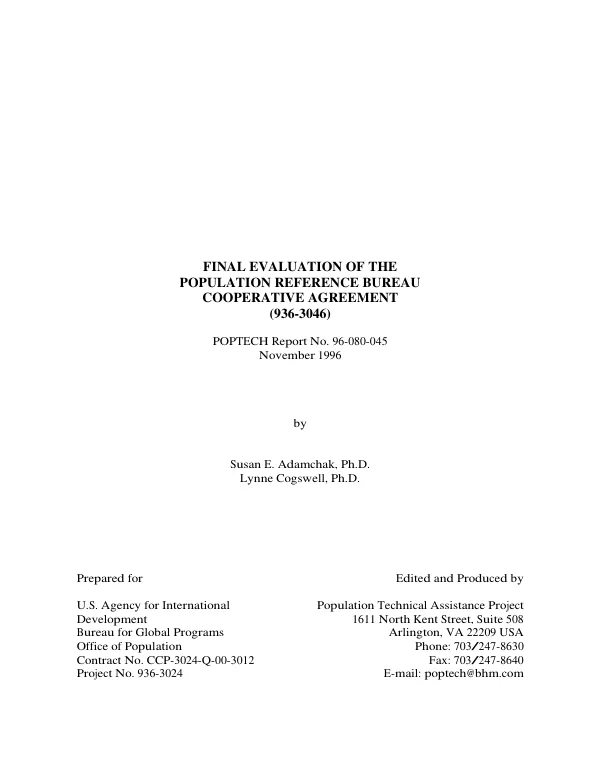
Final evaluation of the Population Reference Bureau cooperative agreement (936-3046) CCN-0007-G-01-3169-00
Sign inBASIC HEALTH MANAGEMENT INTERNATIONAL (BHM)
Final evaluation of the Population Reference Bureau cooperative agreement (936-3046) CCN-0007-G-01-3169-00
Final evaluation of a cooperative agreement (9/93-11/96) with the Population Reference Bureau (PRB) to produce and disseminate new materials tailored to developing country audiences, provide TA, and support extensive media outreach.
Adamchak, Susan E.|Cogswell, Lynne · 1996
Sign in to readA free account is required to download.
Abstract
The project has met and exceeded its goals, in less time and with fewer staff than anticipated. The mix of activities has been appropriate and complementary. Technical collaboration with other organizations has been highly valued, appropriate, and successful. Illustrative accomplishments are as follows. PRB has produced, mostly in-house, and disseminated to over 70 countries around the world print and nonprint materials, mostly in English, French, and Spanish which emphasize the goals of USAID's Center for Population, Health and Nutrition, such as reproductive health, youth, women's status, family planning programs, and population policy. More tools need to be developed for evaluating these materials' impact on policy reform. Since 1987, PRB has trained 119 fellows (U.S.-based developing country graduate students) from 42 countries to understand the links between academic research and policy information needs in their home countries and to communicate their research findings effectively to policy audiences. More than half are working or studying in population. A highly regarded internship program supports two interns at the Office of Population in the Center for Population, Health and Nutrition and one at PRB. The Communicating Population and Health Research to Policymakers summer seminar is the first known short-term training program devoted to policy-level communications; 14 senior researchers and policy specialists took part in the 1996 session. PRB has worked with a group of women magazine editors ("Women's Edition"), in producing substantial supplements to popular developing country women's magazines on topics related to women's health, including reproductive health, violence against women, male participation in reproductive health and family planning, women and education, and adolescent reproductive health. These supplements have reached over 3 million readers in 9 countries. PRB has worked with the Center for Applied Research on Population and Development on a similar effort in Mali to enhance partnerships between senior print and broadcast journalists and health institutions. PRB undertook small-scale TA efforts to improve the policy communication capacities of national institutions in India, Madagascar, and Nicaragua. This TA has been favorably received. Other activities have included responses to nearly 500 ad hoc requests (most of them for country briefing packets); hosting international visitors and preparing meetings in Washington DC; and informational presentations to government agencies, foreign embassies, etc. in the Washington area. Seven comparative advantages have strengthened PRB's performance: an exclusive focus on policy communications, the ability to transform research and data into information that people can understand and use, wide coverage of topics and communication through multiple channels, a focus on institutional development through training and TA, links to U.S. domestic audiences, use of the media to inform public policy discussions and decision, and an extensive database and documentation center. USAID should consolidate the existing activities of Cooperative Agreement and provide the funding needed for the staff required to implement the activities. PRB has had to operate at below optimal staffing levels and to rely on consultants to implement some activities, such as the Women's Edition. Three main actions are proposed for a future agreement: move beyond dissemination to focus on use of information; develop tools, handbooks, or frameworks that can be transferred to other institutions; and use technology to extend the reach of activities.
Related documents