USAID DEC
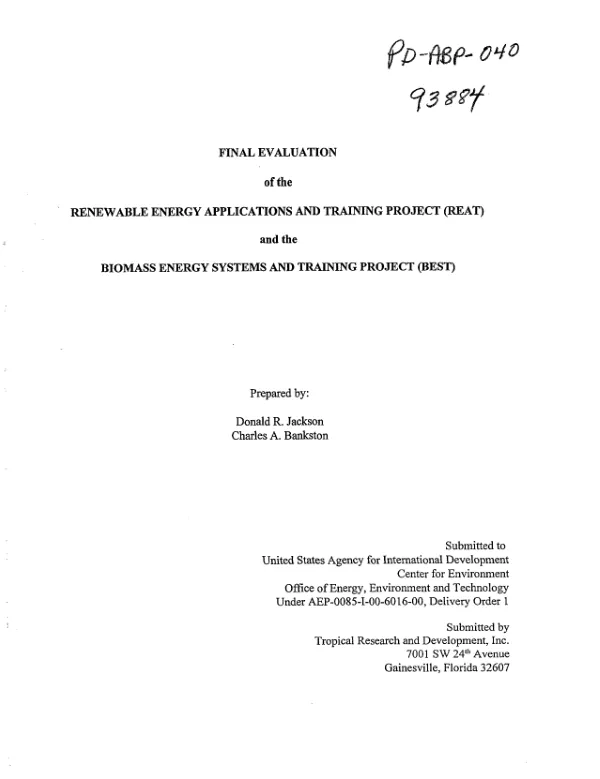
Final evaluation of the renewable energy applications and training project (REAT) and the biomass energy systems and training project (BEST)
Sign inTROPICAL RESEARCH AND DEVELOPMENT, INC.
Final evaluation of the renewable energy applications and training project (REAT) and the biomass energy systems and training project (BEST)
Final evaluation of two projects to promote renewable energy (RE) use in developing countries: (1) RE Applications and Training (REAT) (1985-PACD of 9/97), implemented by the United States Export Council for Renewable Energy (US/ECRE), a consortium of RE trade associations; and (2) Biomass Energy Systems and Training (BEST) (1989-PACD 11/97), implemented by Winrock International.
Jackson, Donald R.|Bankston, Charles A. · 1997
Sign in to readA free account is required to download.
Abstract
Both projects have changed in shape and direction over the years, allowing them to serve as flexible instruments of policy implementation. Key to both projects has been the development of a portfolio of "bankable" projects attractive to investors, the private banking community, and multilateral lending agencies. It is in this area that the projects have met their most difficult challenges. Both projects heavily favor working in tandem with the private sector -- REAT more so than BEST -- in USAID-assisted developing countries as well as the United States. Whether an intended objective or not, integrating the energy needs of developing countries with the technologies and experience available from U.S. manufacturers and suppliers is a significant achievement of these projects. All in all, the beneficiary pool from both is quite broad, extending from remote villages who receive electricity for the first time, to governments that are better managed and paid for through rational energy policies, to U.S. manufacturers and suppliers of RE technology and expertise, and to the world community that benefits from a less-polluted environment. Gaps in quantity and quality of information made the evaluation most difficult. Specific accomplishments are noted below. US/ECRE implemented REAT through member associations or outside consultants or cooperators, five in particular. (1) The Center for Renewable Energy and Sustainable Technology (CREST) produces educational multimedia CD-ROMs and operates Solstice, an Internet service for the sustainable energy field. (2) The International Fund for Renewable Energy and Energy Efficiency (IFREE) supports access to funding for RE and energy efficiency projects under its "Pre-Investment Funding" and "Financial Engineering and Innovation" Programs. (3) The Renewable Energy and Efficiency Training Institute (REETI) facilitates the transfer of training and technology expertise from U.S. industry to international markets and institutions in Africa, Asia, Latin America, and the United States, with a focus on solar, wind, biomass, geothermal, microhydro, hydrogen, and energy efficiency technologies. Training is conducted in partnership with the international public and private sector RE and energy efficiency communities and is conducted by highly qualified U.S. industry representatives recruited for their special expertise in this area. (4) Volunteers in Technical Assistance (VITA) has collaborated with US/ECRE in demonstrating the value of low orbit satellites for RE technology transfer to developing countries. The system has been used to transmit information via e-mail and to monitor and control remote hybrid RE power stations in Indonesia. (5) Winrock International (see next section). During the first 4 years, BEST focused on applied research into transferring and commercially replicating U.S.-based biomass technologies in USAID-assisted countries. The first task was performed in "working laboratories" that blended U.S. and developing country technologies. The second task was not as successful; the concept of producing power commercially for sale to a national or regional grid was often not well received. In 1993 BEST shifted emphasis to the commercial development of existing technologies, and from megawatt- to kilowatt-sized technologies in an attempt to reach more isolated rural dwellers. It was at this time that Winrock began to establish formal links to the U.S. private sector through US/ECRE and its member trade associations and began implementing biomass activities under both the BEST and the REAT projects. By 1995, BEST had reached two critical indicators called for in the Project Paper: more than 200 MW of electrical capacity based on biomass cogeneration had been installed in USAID-assisted countries; and bilateral, multilateral, and private financial institutions were managing lending programs that allocate hundreds of millions of dollars for investment in biomass cogeneration systems. BEST also supported the formation of RE Support Offices (REPSOs) in Costa Rica, Indonesia, Philippines, India, and Brazil to provide an in-country institutional base to sustain and expand the impact of the BEST project. In addition, the REPSOs implemented a promotional exercise consisting of pre-investment support grants for cost-shared feasibility and pre-feasibility studies, preparation of RE Trade Guides, workshops, trade fair expositions, and the identification of potential biomass and other RE projects. Other BEST activities included a Multilateral Development Bank Initiative, which resulted in the preparation of five power export projects based on biomass energy; a Utility Initiative; a Carbon Inventory; a Cane Energy Development Program; and an Information Dissemination Program. On the down side, a 1993 decision of the Office of Procurement ruled out using Mission funds to augment a non-competitively awarded cooperative agreement limited the amount of financing available for BEST, though by how much it is impossible to say. A lengthy approval process for feasibility studies also limited the project.