USAID DEC
Final evaluation of the St. Vincent integrated management production and marketing project
Sign inUSAID. BUR. FOR LATIN AMERICA AND THE CARIBBEAN. REGIONAL DEVELOPMENT OFC.
Final evaluation of the St. Vincent integrated management production and marketing project
Final external evaluation of a project to upgrade the capacity of the Organization for Rural Development (ORD), a small farmer organization formed in St.
Pines, Jim; Pilgrim, Coleridge · 1988
Sign in to readA free account is required to download.
Abstract
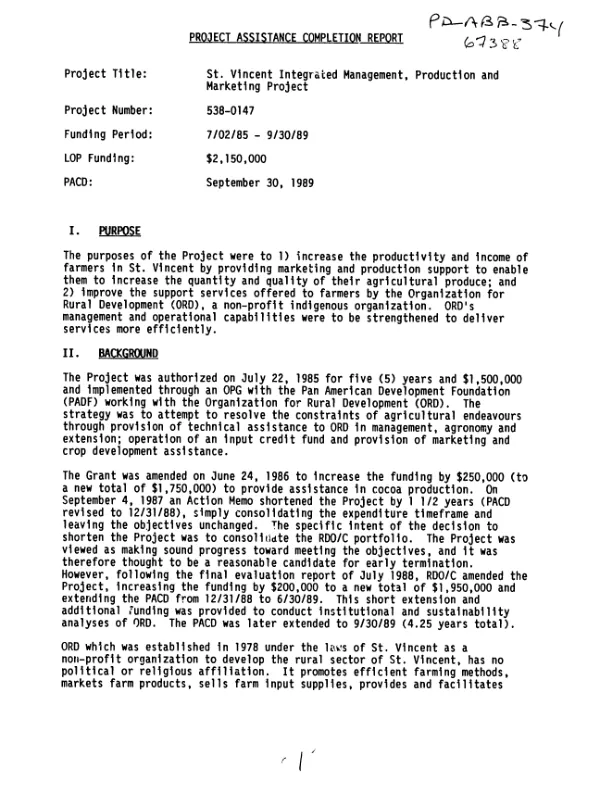
Vincent in 1978. Evaluation covers the period 7/85 to 5/88. ORD"s progress has been very satisfactory, given the Organization"s lack of experience, the risks inherent in agriculture, and the difficulties of entering the commercial world. ORD now has in place, and has to a great degree institutionalized, all of the management systems essential for effective operation at its expected future level. Financial reporting, membership records, and the flow of sales and production data are all being handled well, and ORD deals effectively with its suppliers, customers, and banks. In fact, the private and public agencies interviewed regard ORD quite favorably (although still holding some reservations about its goals exceeding its capacities). Also, ORD and the Ministry of Trade, Industry, and Agriculture are now working together reasonably harmoniously after early difficulties. ORD"s support for small farmer production and marketing is expected to increase farmers" production and sales over time, given sufficient future funding. Despite this generally good record, some organizational weaknesses still exist, especially a failure to collate and effectively use information to manage and control operations. ORD"s lack of experienced managers with appropriate responsibility and authority compounds these planning and control problems. Another problem is that ORD continues to view itself as a service organization - a view which has hampered acceptance of some of the more rigorous controls and concerns necessary for business success. The most troublesome aspect of the project has been its unrealistic initial projections and the compression of a planned 5-year time frame into 3.5 years, leaving ORD with a financial gap that threatens the maintenance of current operations. An A.I.D. bridge grant would ease the transition to self-sufficiency. The project teaches that similar projects should: acknowledge that building a profitable business operation, especially with an inexperienced, service-oriented group, inevitably takes longer than donor agencies anticipate; underestimate income and overestimate costs in order to provide a safety margin; initiate and enforce desired financial controls early; insist that a chief of operations or general manager be in place from start-up; include commercially oriented decisionmaking as a key aspect of training and TA; and provide readily quantifiable benchmarks against which to measure progress.
![Project assistance completion report [: Caribbean agricultural Trading Company]](https://covers.devme.ai/gen/9647.webp)
![Project assistance completion report [: Caribbean agricultural Trading Company]](https://covers.devme.ai/gen/26105.webp)