MANAGEMENT SYSTEMS INTERNATIONAL, INC. (MSI)
Final evaluation of the Swaziland Business Growth Trust : final report
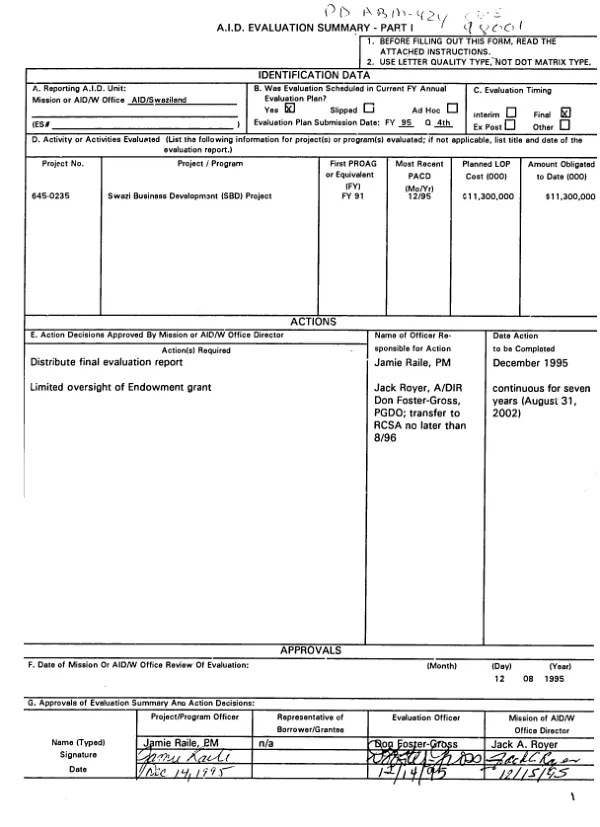
Final evaluation of a project (8/91-12/95) to create the Swazi Business Growth Trust (SBGT) as a mechanism for stimulating the development of small and medium enterprises (SMEs) in Swaziland.
Walker, Patricia; Harding, Al E. R. · 1995
Sign in to readA free account is required to download.
Abstract
The project has been a success. SBGT itself became the primary lender when the original plan to provide credit through commercial banks proved inappropriate. Major outputs include over 2,700 participants in some type of SBGT training and over 1,300 loans issued to 505 individual first-time borrowers (at least two-thirds of whom have received repeat loans). Most clients are women in retail or service trades. Although SBGT is a nonprofit entity, it gave birth to two for-profit subsidiaries: the Growth Trust Corporation Limited, (GTC) which implements the credit program, and the Growth Trust Commercial Corporation Limited, which operates SBGT"s franchising and commercial activities. Another innovation is GTC"s use of a "smart card" for monitoring loans. While Class A (small business) lending has provided the greatest outputs, SBGT has evolved to include a Class B lending program for larger, more traditional loans (this program is experiencing delinquency problems); an affordable home financing and construction assistance scheme; agricultural credit; financing and business support for the small-scale transportation sector; a fully integrated small business training and advisory capacity; and franchising services. Training is a major SBGT service and distinguishes its package of financial services from that offered by banks and other institutions. Training of Class A clients has been more comprehensive and effective than that for Class B clients. Loan processing procedures for Class A clients have also been more effective than those for Class B. The success of this project can be attributed in part to SBGT"s business-like nature and private sector-oriented board, even as it performs a developmental function. SBGT has played a proactive role in searching for business opportunities for SMEs, with government support. SBGT"s financial sustainability is promising. A combination of concessional loans and grants (principally Swazi) of about E 15.0 million have been either placed in the Trust or committed during the past 6 months as SBGT moves from being a U.S.-administered institution to being a Swazi business development institution. Lessons learned include the following. (1) Successful projects are run by good managers who have vision, commitment, and ability to adapt changing conditions or emerging realities. Flexibility of design abets this process. (2) Financial practices which appear to Westerners as intuitive, right, and universal may in fact be culture-specific. More effort than is generally assumed may be needed to educate the general public, political and business leaders, and potential and actual borrowers about credit. (3) Combining a cooperative agreement and an institutional contract to establish a new institution worked well. (4) Creating a sustainable, local institution with a developmental focus is a multi-faceted task requiring much experimentation. (5) Given the necessary resources, creative energy, and community support, it is possible to develop a small business service enterprise from inception to a near sustainable level in a relatively short time. (6) For SME entrepreneurs, education is just as important as credit. (7) The project used an action memo, rather than the arduous process of a project amendment, to change its implementation approach after it is realized that commercial banks were not appropriate lenders. The action memo accomplished the task rather quickly.
![Widening harmonized access to microfinance (WHAM) [: final evaluation]](https://covers.devme.ai/gen/28399.webp)
![Widening harmonized access to microfinance (WHAM) [: final evaluation]](https://covers.devme.ai/gen/4484.webp)