USAID DEC
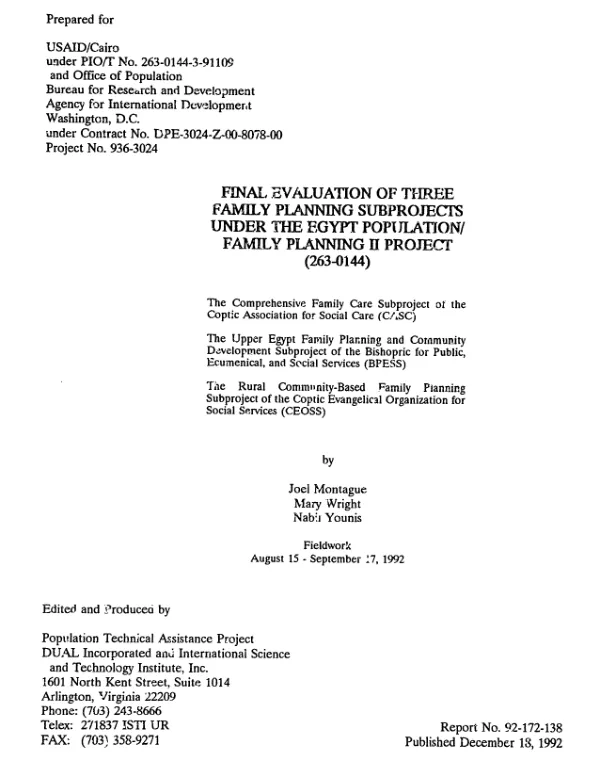
Final evaluation of three family planning subprojects under the Egypt population/family planning II project (263-0144)
Sign inDUAL & ASSOCIATES, INC.
Final evaluation of three family planning subprojects under the Egypt population/family planning II project (263-0144)
Evaluates three family planning (FP) subprojects (SP's) in Egypt: the Comprehensive Family Care SP of the Coptic Association for Social Care (CASC); the Upper Egypt FP and Community Development SP of the Bishopric for Public, Ecumenical, and Social Services (BPESS); and the Rural Community-based FP SP of the Coptic Evangelical Organization for Social Services (CEOSS).
Montague, Joel|Wright, Mary|Younis, Nabil · 1992
Sign in to readA free account is required to download.
Abstract
The CASC approach features family life education; the BPESS approach links women's development, literacy, and income generation with FP; and the CEOSS SP provides FP within a comprehensive community development framework. Although all three SP's have been hampered by bureaucratic and financial delays, they are now underway and have met some of their objectives. CASC has met 52% of its target for new contraceptive acceptors, BPESS 58%, and CEOSS 66%. Systems have improved in CASC, and CEOSS has done excellent work in training, informational meetings, and outreach and follow-up. BPESS's work in literacy training appears to be statistically associated with the number of new FP acceptors. On the other hand, little progress can be reported with respect to revenue generation and sustainability. Because funding and constraints were so great it is difficult to make generalizations about what has worked and why. Nevertheless, the following lessons can be drawn. (1) Local social, cultural, and religious environments create special parameters. Projects in Egypt need more time, more flexibility, and a far more secure commitment of financial resources. Project designs should include quantification of local inputs whether in cash or kind. (2) Projects in remote or isolated areas require a certain degree of autonomy over their own resources. At the same time, they require adequate financial, technical, and logistic support. (3) From the very start, donors should instill a sense of project ownership into PVO's. They should not intervene too directly in ongoing operations or impose excessive and/or changing bureaucratic requirements on the agencies. (4) Both CASC and BPESS have relatively simple informal management systems at the service delivery level, which may in some cases be more appropriate and effective than more formal systems. (5) Additional emphasis needs to be given to sustainability. Although this was a major USAID focus in the BPESS and the CEOSS SP's, it is obvious that this was not fully understood by the two agencies. (Author abstract, modified)
Related documents
Documents in this collection
 1993
1993USAID DEC
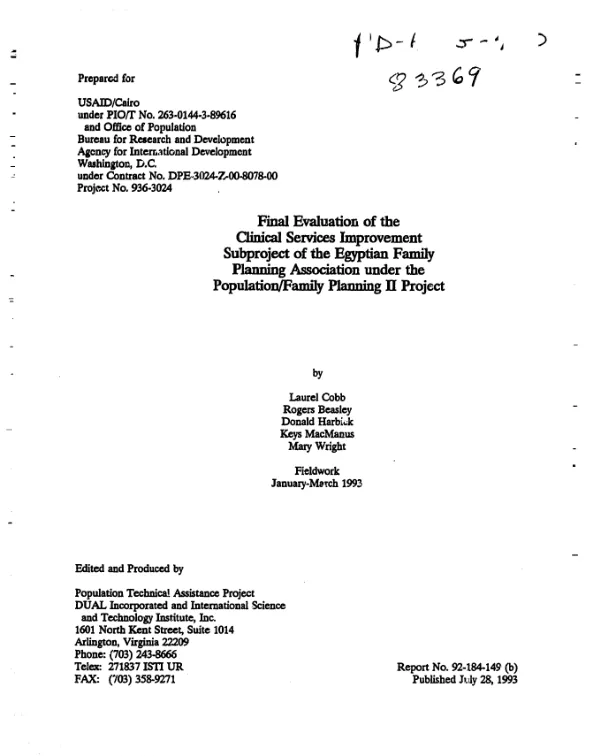
Final evaluation of the clinical services improvement subproject of the Egyptian Family Planning Association under the population/family planning II project
Open record 1993
1993USAID DEC