USAID DEC
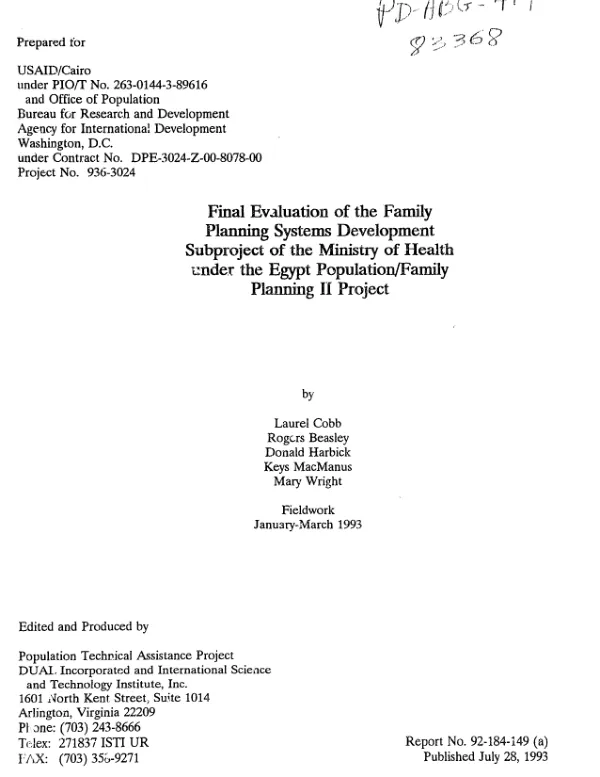
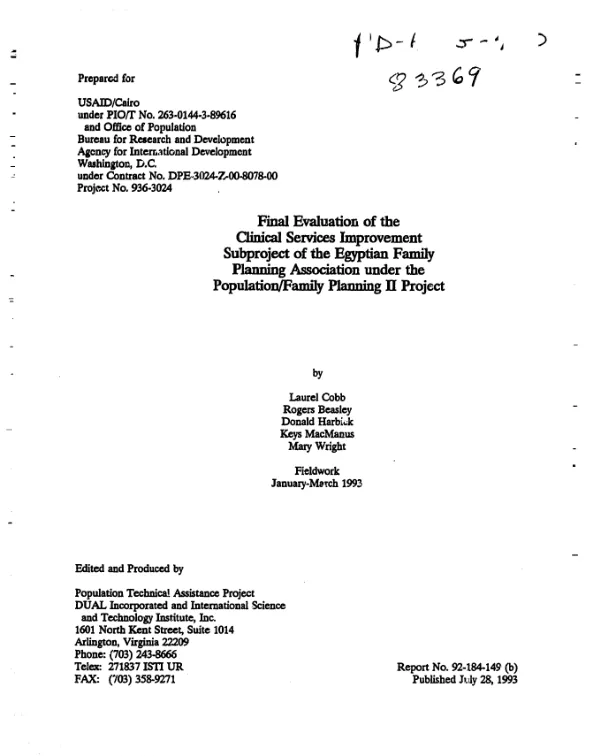
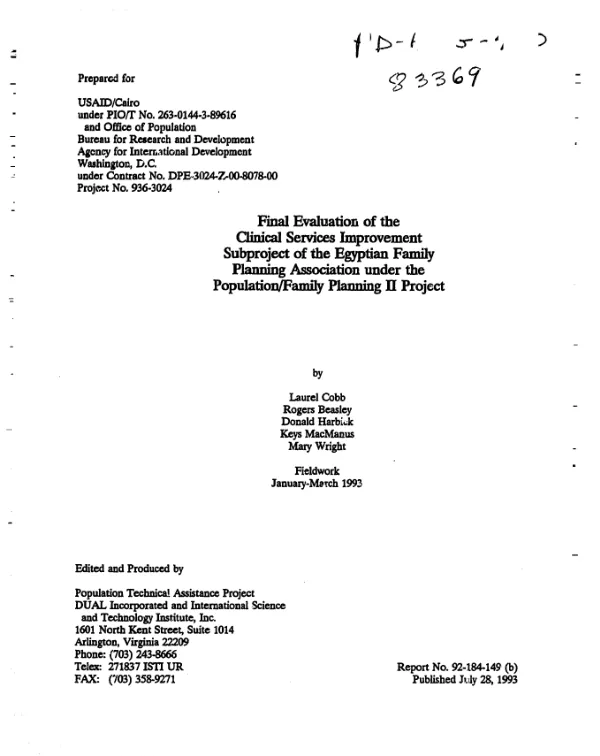
Final evaluation of the clinical services improvement subproject of the Egyptian Family Planning Association under the population/family planning II project
Sign inDUAL & ASSOCIATES, INC.
Final evaluation of the clinical services improvement subproject of the Egyptian Family Planning Association under the population/family planning II project
Final evaluation of a subproject (under the Population/Family Planning II project 263-0144) to upgrade the quality and quantity of family planning (FP) services in the Egyptian FP Association (EFPA), the country's foremost FP private voluntary organization (PVO).
Cobb, Laurel|Beasley, Rogers · 1993
Sign in to readA free account is required to download.
Abstract
The evaluation covers the period 6/87-3/93. Through the end of 1992, the subproject (SP) had established 17 primary centers and 95 subcenters in 17 governorates; served 298,091 new FP clients; and provided another 311,731 related services. The SP's principal contribution has been the establishment of high-quality centers which have spearheaded a national emphasis on the quality of FP services. Although the quality of the SP services has been excellent, the cost of such quality has been high, relative to MOH costs. The SP's establishing, equipping, and furnishing of clinics and offices has been extravagant and has included equipment not essential to FP or other related services. The SP centers are also very underutilized for FP. It is unclear why the offered high-quality services are so underutilized. Institutional and management turmoil is one possible explanation; market demand is another. No professional research was undertaken to develop a market profile on proposed FP products, places, prices, or promotion. In its struggle to be successful in an increasingly competitive FP market, the SP has resorted to negative advertising and dissemination of false information which have the potential to create medical barriers to FP rather than promote greater acceptance and use of the program as a whole. USAID should fund market research conducted by an independent, qualified firm to determine if there is a long-term market for the SP. Unless the research shows that there is a clear and sufficient market niche for the SP to be self-financing, USAID should phase out all funding for the SP over the next two years. The SP should immediately cease its negative advertising and false information. Constraints include the fact that the SP evolved in incremental steps rather than being designed as a strategic whole; and that the SP assumed that its principal competitor, the MOH, offered limited FP services and that they were of poor quality. In fact, the MOH was rapidly expanding and improving its services in the same cities and at the same time the SP was developing. The following lessons were learned. (1) A single project, although not itself successful, may have a highly positive impact upon the total FP program. (2) Continual project modifications can gradually shift the purpose of a project such that the assumptions of demand which supported the original project are not valid for the revised project. In the case of the SP, market research was unnecessary for the original purpose of upgrading the EFPA; however, an analysis of the market, in terms of product, place, price, and promotion, should have preceded the creation of a new FP PVO meant to be self-financing. (Author abstract)
Related documents
Documents in this collection
 1993
1993USAID DEC
Final evaluation of the clinical services improvement subproject of the Egyptian Family Planning Association under the population/family planning II project
Open record 1992
1992USAID DEC