USAID DEC
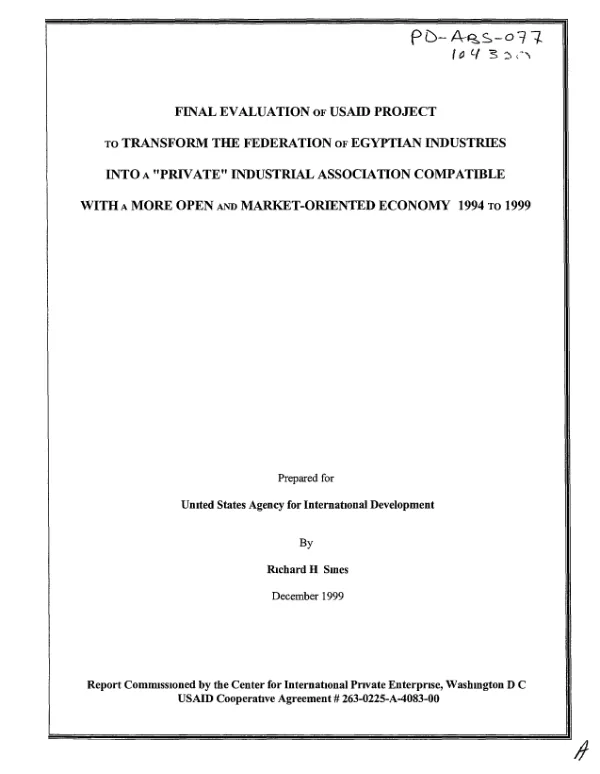
Final evaluation of USAID project to transform the Federation of Egyptian Industries into a 'private' industrial association compatible with a more open and market-oriented economy : 1994 to 1999
Sign inCENTER FOR INTERNATIONAL PRIVATE ENTERPRISE (CIPE)
Final evaluation of USAID project to transform the Federation of Egyptian Industries into a 'private' industrial association compatible with a more open and market-oriented economy : 1994 to 1999
Final evaluation of a project (1994-99) to privatize the Federation of Egyptian Industries (FEI).
Sines, Richard H. · 1999
Sign in to readA free account is required to download.
Abstract
The Center for International Private Enterprise (CIPE) was the implementing agency The project had a weak beginning due to a lack of private sector business association experience in Egypt, CIPE's inexperience with state-controlled business associations, and the initial absence of a knowledgeable CIPE manager. As a result of these and other factors, the project collapsed completely in 1/97, when all almost all the USAID-funded CIPE Egyptian professional staff were fired. The catharsis of the firings led to a replacement of the CIPE country director and a change in CIPE project management in Washington. The new FEI leadership hired new and highly qualified staff, improved the institutional arrangement by creating a Project Management Unit, and gave greater control to the FEI, leaving CIPE to act essentially as a facilitator of FEI initiatives. Since these changes, the project has facilitated FEI's rapid (but still transitional) institutional improvement. A highlight of the renewed project was the development, with training and TA from CIPE, of a "Business Agenda 2000" stating FEI's formal positions on major issues facing Egyptian industry, and the publication of the agenda at a highly attended conference in 5/99. Currently, the FEI is the major representative of all Egyptian industry, and its strong and increasingly important advisory role with the Government of Egypt is expected to increase given the economic orientation of the new Prime Minister. FEI has a strong relationship with the United States, is one of the most effective lobbies for positive private-sector reforms, and provides extremely valuable services, including lobbying for policy reforms, training staffs of private sector business associations, supporting efforts in marketing and exporting, and strengthening management skills. FEI also has a new program to develop skills accreditation in conjunction with partnerships with developed country counterparts, an economic and commercial computerized information gathering system, and a program to help members comply with the Environmental Law of 2/98. The FEI provides substantial services to smaller- and medium-sized businesses, including those owned and operated by women. For example, the leadership of the 2-year-old Egyptian Business Women Association (EBWA), which represents some 150 businesswomen, called FEI their most important resource at this critical early point in the association's development. The EBWA leadership also said they intend to join FEI as a dues- paying associate member when it is formally allowed. The FEI is taking full advantage of the economic orientation of the new Prime Minister and Cabinet to push for an acceleration of economic policy reforms that will improve the overall business climate and in particular make it easier for new U.S. investments and for existing U.S. businesses. While FEI has not yet been privatized, it certainly acts like a private sector business association and provides key services similar to a private sector business association. The Chairman of the Board expects FEI to be privatized by June 2000. Passage of the new law has been postponed because of political uproar and FEI's spent political capital on positive reform efforts taking place within the Egyptian Chambers of Commerce. If the FEI law is passed, this project will have led to the privatization of not only the FEI, with its estimated 15,000 industrial firms, but also the Egyptian Chamber of Commerce with its 3 million members, which will also be augmented with the admission of women members for the first time in Egyptian history. In sum, the FEI is now one of the most dynamic business associations in Egypt. Its importance for U.S. business, for example, was reflected by the new Executive Director of the American Chamber of Commerce, who said that AmCham's effectiveness would be substantially curtailed if FEI, their partner in reform, cut back its services and lobbying efforts and was allowed to regress to its pre-CIPE state. Cutting back U.S. support at this critical point in FEI transition could lead to a collapse of this still transforming and vulnerable business association. The major recommendation is to continue USAID support of FEI, which soon expects to be self-sustaining. Other donors, including the European Community and in particular Germany, are already positioning themselves to fill the expected vacuum that would occur with curtailment of the CIPE program. Numerous lessons learned are detailed.
Related documents
Documents in this collection
 1999
1999USAID DEC
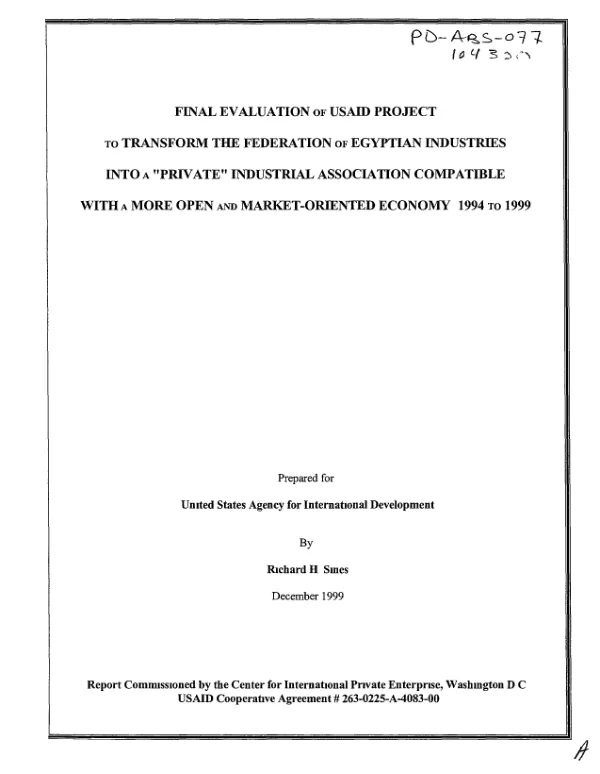
Final evaluation of USAID project to transform the Federation of Egyptian Industries into a "private" industrial association compatible with a more open and market-oriented economy : 1994 to 1999
Open record 1996
1996USAID DEC
![Final [report] : impact analysis study -- USAID/Egypt commodity import program](https://covers.devme.ai/gen/23498.webp)