USAID DEC
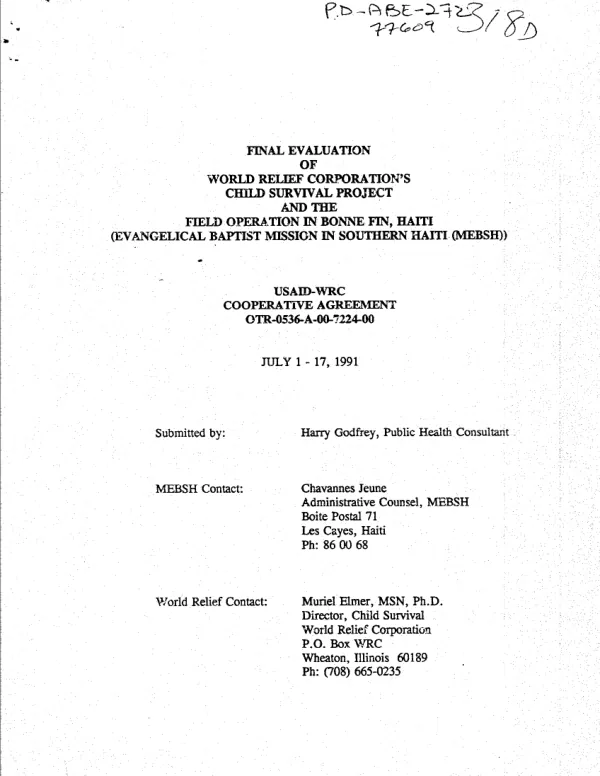
Final evaluation of World Relief Corporation's child survival project and the field operation in Bonne Fin, Haiti (Evangelical Baptist Mission in Southern Haiti (MEBSH)
Sign inWORLD RELIEF CORP.
Final evaluation of World Relief Corporation's child survival project and the field operation in Bonne Fin, Haiti (Evangelical Baptist Mission in Southern Haiti (MEBSH)
Final evaluation of an OPG to World Relief Corporation (WRC) to support a child survival (CS) project undertaken by the Evangelical Baptist Mission in Southern Haiti (MBESH) in Bonne Fin, Haiti.
Godfrey, Harry · 1991
Sign in to readA free account is required to download.
Abstract
The grant was originally to be carried out between 6/1/87-5/30/90, but because of delays in starting, was extended through 9/30/91. The MBESH/CS project has achieved or surpassed most of the objectives set forth in the cooperative agreement. A health infrastructure is in place that will be a solid foundation for future CS initiatives in the region. The training program for health promoters and traditional birth attendants which has been established is excellent, and significant levels of community participation have been generated. Some specific achievements include the following: 5 auxiliary nurses and 4 community animators trained; a health committee established in each of the 4 health zones, and in the 2 largest zones, sub-committees also established; 42 health posts established; 75 health promoters trained; and a computerized health management information system under development. Vaccination coverage is still rather low, because most of the health posts became operational towards the end of the project, and have not yet had time to complete a full cycle of coverage; for example, most children have yet to receive their third dose of DTP/polio. That health post accessibility is good is demonstrated by the fact that over 70% of children under one have received their first dose of DTP/polio. As WRC and MBESH were both new to CS grants (and to each other), the project got off to a difficult start. Communications between WRC's Illinois headquarters and field operations were sometimes slow. However, WRC and MBESH developed into a good team, and the experience they have gained makes them excellent candidates for additional CS grants. Also, by forming a partnership with an established indigenous health services organization, WRC was able to avoid many start-up costs. Lessons learned included the following. (1) Baseline data must be collected before the establishment of services to be of any value in establishing priorities. (2) It is advisable to engage a qualified bookkeeper at an early stage in projects with complex financial arrangements. (3) For a project which involves the development of as many infrastructural components as this one, 3 years is not really enough time to have a significant impact on the health status of the target population. (4) Community participation, and particularly, developing a feeling of community ownership for project activities, is time consuming but critical for the sustainability of CS projects. (5) Country nationals should assume leadership roles in health projects as soon as qualified persons can be identified and trained.
Related documents
![Final evaluation : ADRA [Adventist Development and Relief Agency]/Rwanda -- child survival project : 1985-1989](https://covers.devme.ai/gen/6085.webp)
![Final evaluation : ADRA [Adventist Development and Relief Agency]/Rwanda -- child survival project : 1985-1989](https://covers.devme.ai/gen/47707.webp)