ARAVALI
Final evaluation : Rajasthan water harvesting project
Final evaluation of a project (6-9/00) to reduce vulnerability to water shortages due to drought in Rajasthan, India, by rehabilitating and constructing rainwater harvesting (RWH) structures.
Sign in to readA free account is required to download.
Abstract
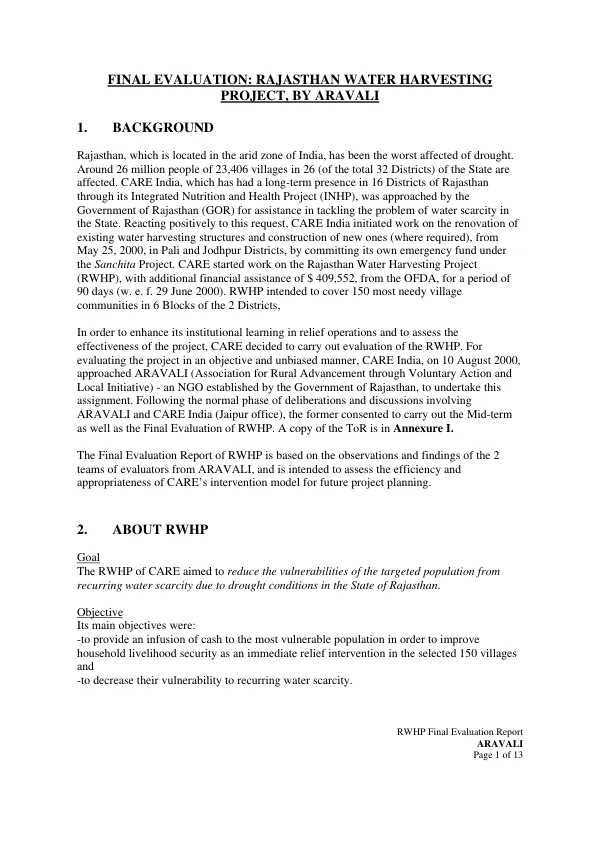
CARE was the implementing agency. The project was successfully implemented in all six blocks of Pali and Jodhpur districts, benefitting more than the targeted 150 villages. While it impossible to say that the RWH structures constructed under the project led to increased water availability in the project areas, as there were no rains after the project, the structures would be extremely useful for harvesting rainwater in the future. On the economic level, the benefitted community used the wages generated through the cash-for-work component to purchase foodstuffs and fodder, repay loans, and engage in other survival-related activities. Here too the project met its objectives. Full transparency was maintained at all levels. CARE kept the NGO partners aware of project details, and the latter did the same vis-a-vis the community. In particular, the concepts of cash- for-work and payment according to work measurement were clarified to the community; site and activity selection were carried out openly and in consultation with the community; and wages were paid in the presence of CARE, NGO officials, and the entire village community. The project was also well coordinated. CARE sought technical and research information from the Central Arid Zone Research Institute (CAZRI) of Jodhpur, the State Remote Sensing Application Center (SRSAC) of Jodhpur, and the Government of Rajasthan's Department of Watershed and Soil Conservation. The collectors of Pali and Jodhpur were also kept informed of the project progress. The staff engaged by CARE and its partner NGOs for the project was well qualified and adequate. The technical consultants hired by CARE compensated for the lack of technical competency among the NGO staff, though the latter's rapport with the community aided in achieving project objectives. More CARE officers could have been deployed in Jodhpur District, given the vast spread of the project area. The vast spread of project sites in Jodhpur also made the 4.6% administrative budget seem insufficient, as a large proportion of this money was spent in visiting and monitoring the scattered sites. In Pali, on the other hand, all the sites were located within a 75 km radius, making monitoring easier and the administrative budget for the NGOs sufficient. In terms of impact, the project stalled migration in the short term by providing timely employment opportunities in Pali and Jodhpur. In one of the villages visited by the evaluation team, Lapi of Pali District, only 30% of households migrated to Gujarat and Mumbai in search of labor; the normal migration rate in such drought conditions is 70%. The project is also expected to have an indirect positive impact on agriculture in the area by recharging the ground water via the dug wells situated downstream. Villagers are confident that in normal rain years project structures would hold water for at least 8 months. One structure is expected to recharge about 15-20 wells. Also, a portion of the cash earned has been used to purchase seeds or repay old agricultural loans. The most immediate impact of the project has been on community mobilization. Local leadership was effectively used during the cash-for-work component to mobilize and organize the local community for labor. People took up work not merely for cash but also with an understanding of the long-term importance of RWH. Panchayats in Pali District also rose to the occasion and their members guided, supervised, and monitored project progress at the village level. The project has shown that building water harvesting structures as part of relief projects would help meet the twin objectives of short-term cash generation and long-term water resource management. Also, the efficiency with which the entire project was implemented has created a model for future relief programs. In its present form, the project can be replicated at other sites.
![Final evaluation of 'emergency program to assist the vulnerable people in Liban [i.e Liben] Woreda, Borena Zone of Oromia Regional State [and] Filtu Woreda, Liben Zone of Somali Regional State'](https://covers.devme.ai/gen/5421.webp)
![Final evaluation of "emergency program to assist the vulnerable people in Liban [i.e Liben] Woreda, Borena Zone of Oromia Regional State [and] Filtu Woreda, Liben Zone of Somali Regional State"](https://covers.devme.ai/gen/44245.webp)