USAID DEC
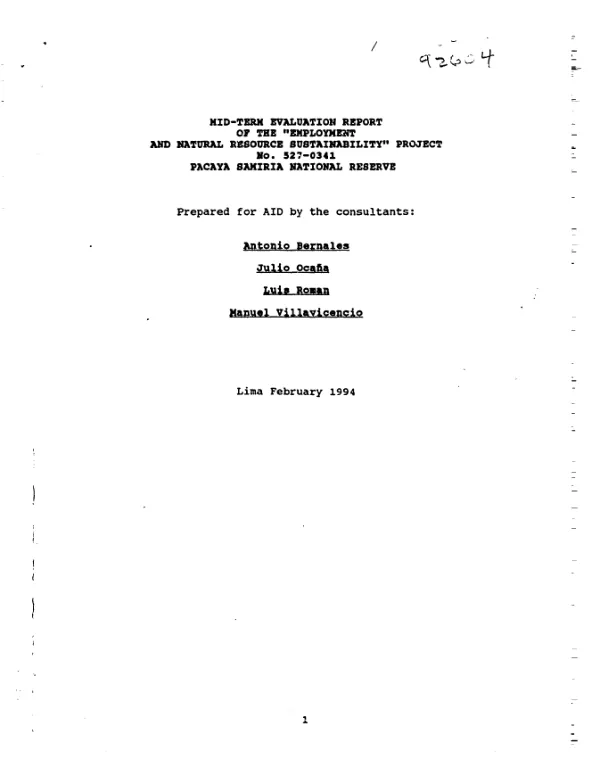
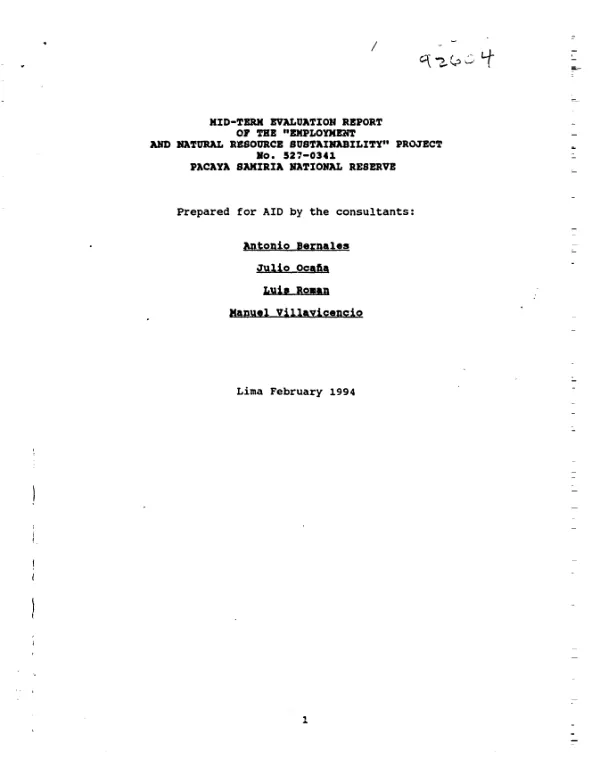
Final evaluation report : employment and natural resource sustainability -- project no. 527-0341 : Pacaya Samiria National Reserve
Sign inPRONATURALEZA
Final evaluation report : employment and natural resource sustainability -- project no. 527-0341 : Pacaya Samiria National Reserve
Final evaluation of a project (1991-97) to promote conservation and sustainable development in Peru's Pacaya Samiria National Reserve (PSNR).
Mendezoa, Mauro|Roman, Luis|Suarez, Haydee
Sign in to readA free account is required to download.

Abstract
The project was implemented by The Nature Conservancy (TNC) and the Peruvian Foundation for the Conservation of Nature (PRONATURALEZA). Despite the short implementation period and other problems, the project, on balance, was a success, with significant achievements. There is evidence of a change not only in attitude but also in the management and utilization of the PSNR. Different development agents and the local population seem to have gained a better understanding of the PSNR's importance and of the need to develop adequate resource management experiences and instruments. Also, local institutions are capable of responding to the project's current "low intensity" stage, and the community groups (CECODES), though fewer, will continue to support development activities and to assist guard posts and park rangers at least until December of this year. While it is difficult to ensure that the project will have an impact on the recovery of strategic species such as taricaya turtles and black alligators due to the lack of baseline information and continuous monitoring, efforts to promote awareness of the importance of these species and to disseminate recovery and management techniques have led other institutions and the people in general to do the same. The general opinion among local institutions is that the project has helped improve the management of the PSNR by providing direct area administration assistance, and has conducted significant research on natural resource management and local economic development. On the down side, the project's uncertain financial situation makes it clear that no adequate plans or provisions have been made for its imminent conclusion. Also, since both PRONATURALEZA and TNC are more experienced in conservation than in community development, socioeconomic efforts were not as successful as was the management of the PSNR resources. Specifically, income-generating activities were not properly weighted within the context of a market economy nor in terms of technological opportunities and proposals. Neither was sufficient care taken in developing and evaluating participatory methodologies to guarantee local involvement in activity design/implementation, decisionmaking, and management. Additionally, efforts to implement planning and project monitoring activities never materialized. Priority was placed on programming. Finally, the logframe prepared halfway through the project is overly ambitious and the indicators respond neither to the scenario analysis, the implementation time, nor project resources. Numerous lessons were learned: (1) The project's most obvious achievements were not the activities in which the greatest efforts and funds were invested, but those in which the working methodology was correctly implemented and in which local people were involved, e.g., the management of turtles, palm trees, and community fishing. (2) When designing a project, it is important to analyze the implementation periods for expected impacts, not merely activities and goals. (3) Planning instruments should be simple and dynamic in order to guarantee adaptation to new scenarios. (4) Implementing activities with local people requires a flexible and realistic strategy, specifying at the very least: the approximate number of dwellers directly or indirectly involved and the approximate number of people influenced by the project's activities; the location of towns or communities that can be used as demonstration centers for these activities; and periodic participatory evaluation techniques for quickly identifying local opinion regarding the progress of the activities. (5) The fact that technicians and local population live together, as occurs in the CECODES, is no guarantee that their relations will be fruitful. Sometimes it is necessary to preserve a distance between the two in order to avoid internal pressures or to prevent technicians from becoming motivated by personal commitments rather than technical criteria.
Related documents