USAID DEC
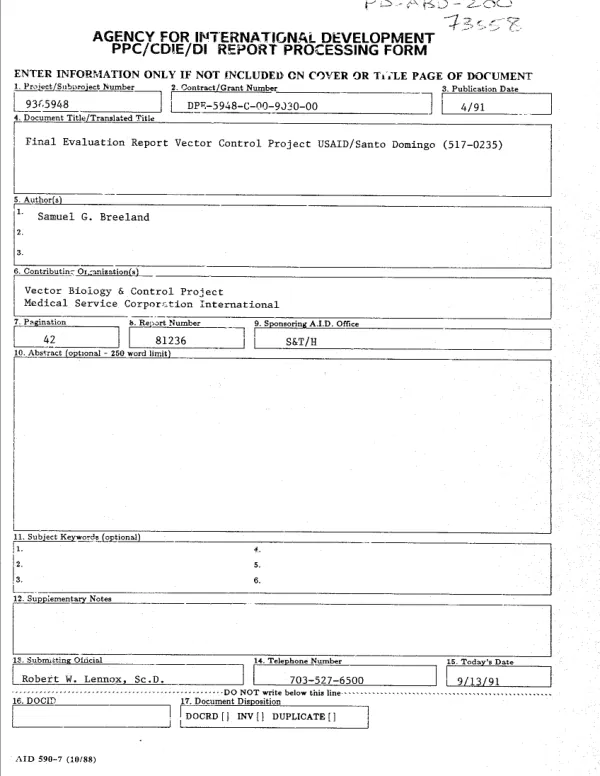
Final evaluation report : USAID health systems management project (9517-0153 [i.e. 517-0153]) -- disease control component, Dominican Republic
Sign inMEDICAL SERVICE CORP. INTERNATIONAL
Final evaluation report : USAID health systems management project (9517-0153 [i.e. 517-0153]) -- disease control component, Dominican Republic
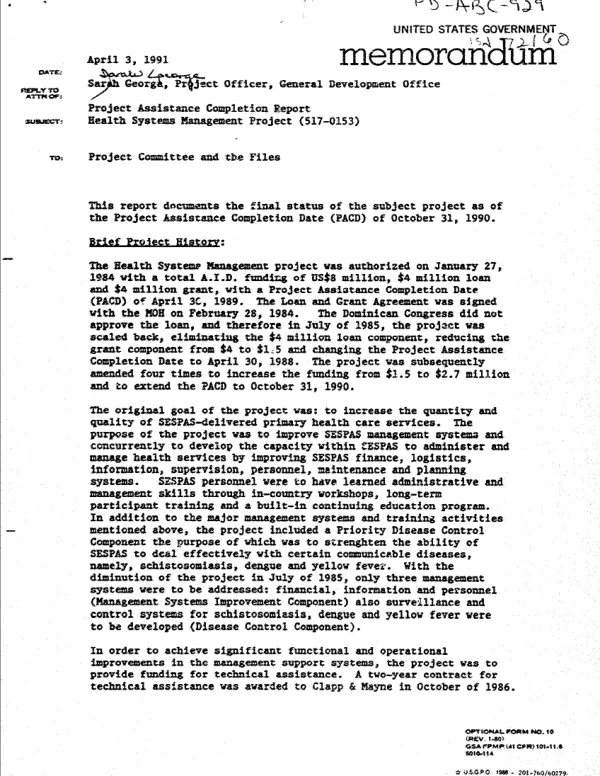
Final evaluation of a project component to establish surveillance systems to monitor transmission of dengue and schistosomiasis in the Dominican Republic.
Breeland, Samuel G. · 1991
Sign in to readA free account is required to download.
![Final evaluation report : USAID health systems management project (9517-0153 [i.e. 517-0153]) -- disease control component, Dominican Republic](https://covers.devme.ai/gen/8621.webp)
Abstract
The evaluation covered the period 2/84-10/90. Inputs were well used and resulted in successful completion of planned outputs, including a national laboratory service for dengue and a regional one (Region V) for schistosomiasis. The Secretaria de Estado de Salud Publica y Asistencia Social (SESPAS) has an improved capacity to diagnose, report, and control these vector-borne diseases, and protocols and plans are in place to respond to routine and emergency control of the diseases. Training activities related to dengue surveillance exceeded targets, with 10 health workers trained out of country (vs. 6 planned) and 765 trained in country (vs. 100 planned). Information on dengue was disseminated through epidemiological bulletins, departmental serial publications, and national and regional conferences. The surveillance system established under the project has enabled SESPAS to discover widespread dengue transmission and the first confirmed cases of dengue hemorrhagic fever in the country. This information has convinced SESPAS and U.S. Centers for Disease Control experts that something must be done to prepare the country for a possible epidemic. Training in schistosomiasis control was completed for laboratory technicians and physicians, but physician training for schistosomiasis referral was not carried out, partially because of a delay in local currency disbursement. The schistosomiasis component has completed serological sample studies, conducted public health education activities, improved sanitation in areas of high endemicity, and conducted vector control activities. The outlook for continued attention to schistosomiasis control is generally positive, but the government could use help in purchasing chemicals and in its constant training and retraining of laboratory technicians (due to large personnel turnovers). Increased physician education and involvement is needed for both dengue and schistosomiasis surveillance and control.
Related documents
![Final evaluation report : USAID health systems management project (9517-0153 [i.e. 517-0153]) -- disease control component, Dominican Republic](https://covers.devme.ai/gen/37109.webp)