MEDICAL SERVICE CORP. INTERNATIONAL
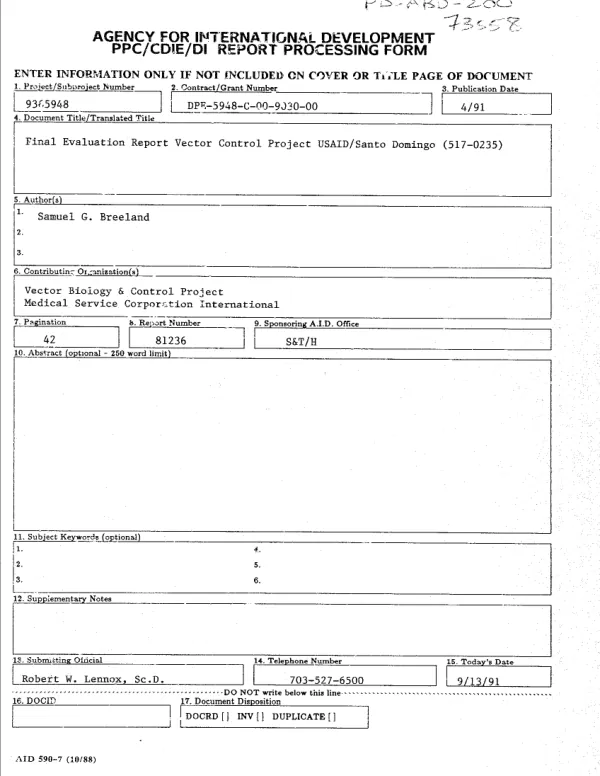
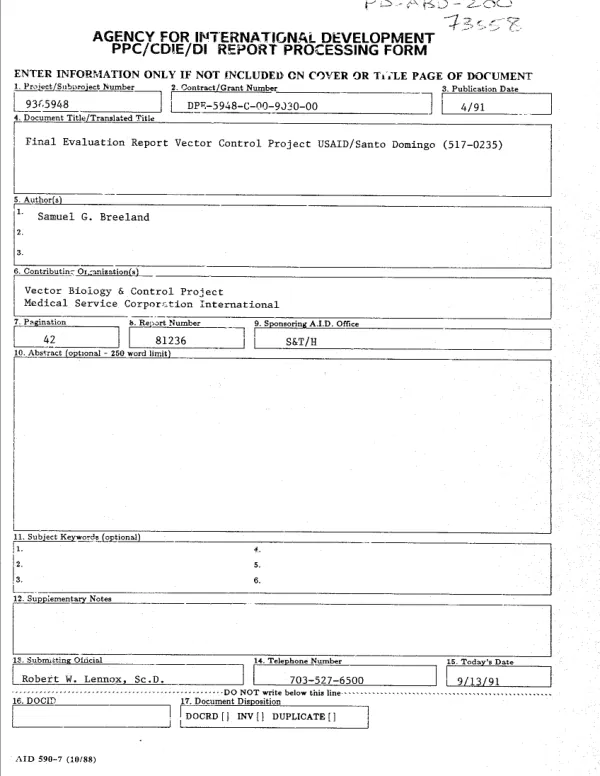
Final evaluation report : vector control project, USAID/Santo Domingo (517-0235)
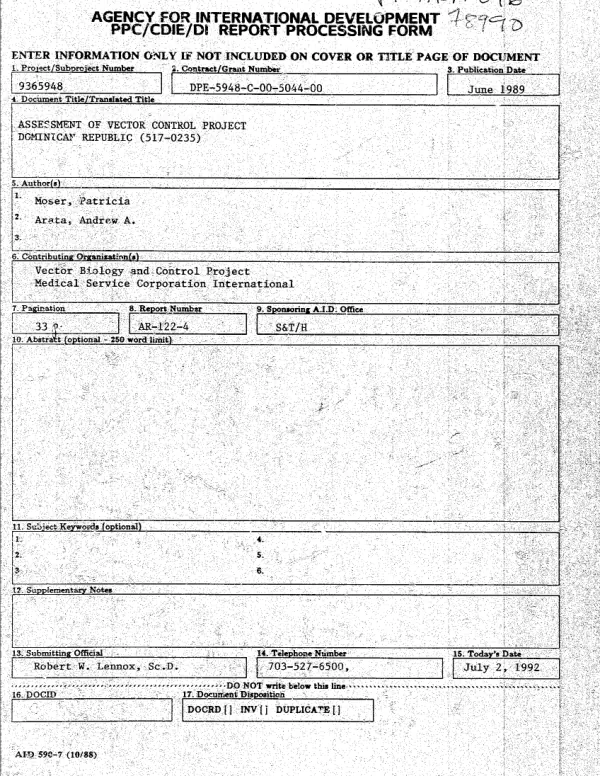
Final evaluation of a project to test ecologically sound, low-cost interventions to control malaria and dengue in the Dominican Republic.
Breeland, Samuel G. · 1991
Sign in to readA free account is required to download.
Abstract
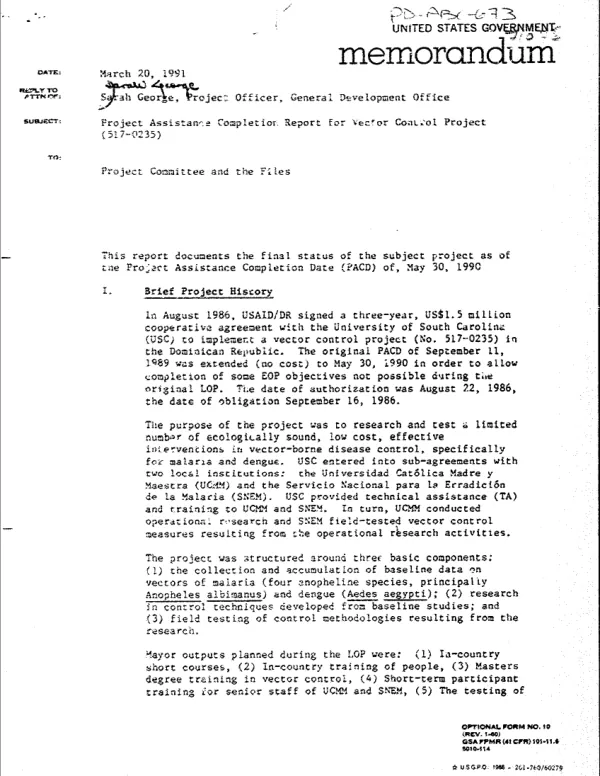
The evaluation covers the period 8/86-5/90. The University of South Carolina, the primary implementing agency, signed sub-agreements with the Universidad Catolica Madre y Maestra (UCMM) and the Servicio Nacional para la Erradicacion de la Malaria (SNEM). UCMM conducted operational research, while SNEM used research findings to field-test vector control measures. The project faced many constraints, including a serious lack of collaboration between SNEM and UCMM at mid-term; a difficult fiscal and personnel environment at SNEM; poor repair and maintenance of SNEM-owned commodities; UCMM faculty with heavy workloads; slow release of P.L. 480 funds; and long lag-times between purchasing and receiving equipment. Despite these problems, the project succeeded in establishing: (1) a vector control research facility at UCMM and faculty capabilities in research and training in this field; (2) a SNEM capacity to apply vector control techniques and operational research protocols; and (3) an institutional plan to establish a lasting link between UCMM and SNEM. include: in-country training of 302 persons in 14 short courses; completion of a M.S. degree for one UCMM faculty members and partial completion of one for a SNEM vector control specialist; participant training of 16 professional staff members of UCMM and SNEM; and establishment of insectaries at both UCMM and SNEM. The project also tested two malaria control interventions: truck-mounted spraying and B.t.i. larvicidal applications. Six interventions were tested for dengue: (1) truck-mounted ULV spraying; (2) indoor residual spraying of curtains; (3) area aerial spraying with ULV malathion; (4) use of larvivorous fish in household water-storage tanks; (5) thermal fogging; and (6) a community participation project. The project produced a variety of guidelines and recommendations for routine and emergency control of malaria and dengue. In sum, both UCMM and SNEM seem to have the capacity and the willingness to continue their respective activities in research and vector control. For UCMM, this a voluntary involvement, which should be fostered. For SNEM, it is a mandate and a responsibility, but fiscal problems and the low priority given to malaria research are likely to remain as major constraints. Postproject support is needed mainly in commodities.
Related documents
![Final evaluation report : USAID health systems management project (9517-0153 [i.e. 517-0153]) -- disease control component, Dominican Republic](https://covers.devme.ai/gen/8621.webp)
![Final evaluation report : USAID health systems management project (9517-0153 [i.e. 517-0153]) -- disease control component, Dominican Republic](https://covers.devme.ai/gen/37109.webp)