USAID DEC
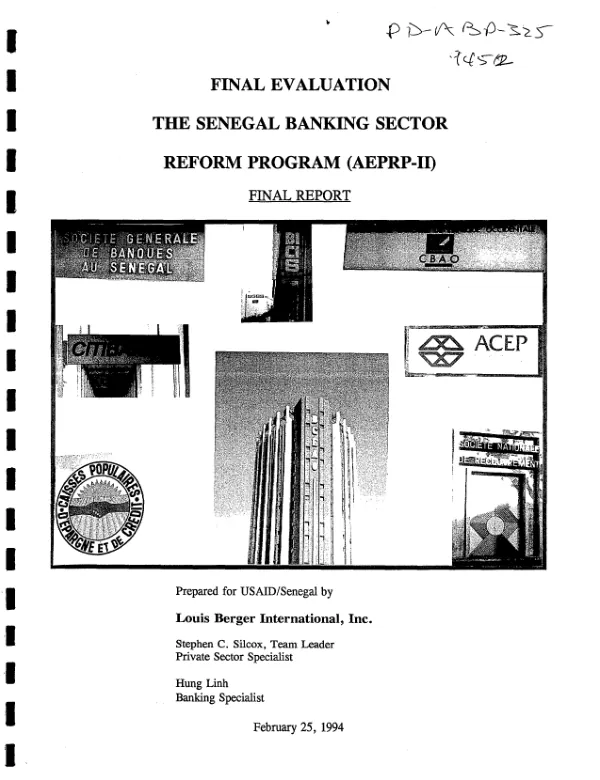
Final evaluation : the Senegal banking sector reform program (AEPRP-II) : final report
Sign inLOUIS BERGER INTERNATIONAL, INC. (LBII)
Final evaluation : the Senegal banking sector reform program (AEPRP-II) : final report
Final evaluation of a program/project (1/90-1/95) to reform the Senegalese banking sector and deepen and broaden access to credit, particularly by small and medium-scale enterprises (SMEs) and farmers.
Silcox, Stephen C.|Linh, Hung · 1994
Sign in to readA free account is required to download.
Abstract
The program was an overall success. Conditions precedent were met prior to the disbursement of all five tranches. The program achieved its purpose and most of the objectives relating to the restructuring of the banking sector; it also made considerable progress in increasing access to credit for SMEs and agriculture, particularly with regard to establishing credit unions. Specific successes were as follows. (1) The banking sector has been consolidated and the remaining private banks, for the most part, are solvent, more liquid, profitable, and better managed. (2) Banking supervision has improved through the creation of a regional banking control commission. (3) Reserve requirements have replaced credit ceilings as a means of control of credit exposure by individual banks. (4) Government ownership of and interference in the banking sector have lessened significantly. (5) The foundation for a legal and institutional framework for credit unions has been laid, thus providing a basis for an appreciable increase in the future availability of and access to credit for SMEs and agriculture in the future. (6) Donor coordination was excellent; USAID's role in the program was particularly effective. Principal shortcomings were as follows. (1) The reform of the banking sector does not appear to have been a major cause of the general improvement in the economy that occurred during the project, although without this reform the general improvement would have been impossible. More efforts are needed to adjust the structure of the economy in other areas if a general improvement is to be accomplished. (2) The program has not significantly increased either sectoral or term diversification of credit from commercial banks or access to credit for SMEs and agriculture from the formal banking sector. However, some critical assumptions made in program design regarding lending to this sector were flawed. (3) Mobilization of private sector deposits has not succeeded due to the capital flight caused by an uncertain domestic economic environment. (4) Although a considerable amount of the bad debts of the liquidated banks were recovered and the conditions precedent were met, a substantial amount of bad debt remains uncollected and prospects for recovering the remaining debts are not good. (5) The banking sector monitoring system to be used by the Government of Senegal (GOS) was not implemented. However, the evaluation team believes that the concept of the monitoring system had some major design problems. The following lessons were learned. (1) Program grants tied to conditions precedent can be very effective in changing government policies, if they are perceived to be in the government's interest. (2) Effective donor coordination is critical to the success of major structural reforms of the economy. Donors should perceive their roles as being complementary to each other, with each donor focusing on a special aspect of the reform. (3) Effective monitoring of the process of change by USAID, as well as participation in day-to-day meetings and communication were extremely important in restructuring the banking sector. The use of five separate disbursements tied to specific conditions was particularly effective. (4) Exploring alternative mechanisms for financial intermediation outside the formal banking system is essential for improving access to credit to SMEs and agriculture. (5) Banking sector reforms and restructuring by itself cannot effectively change the structure of an economy. Attributing overall changes in the economy to banking sector improvements alone is very difficult, if not impossible. (6) Improving access to credit through private commercial banks, especially to sectors perceived as being highly risky, cannot be accomplished by improving the financial viability of banks. (Author abstract, modified)