USAID. MISSION TO COSTA RICA
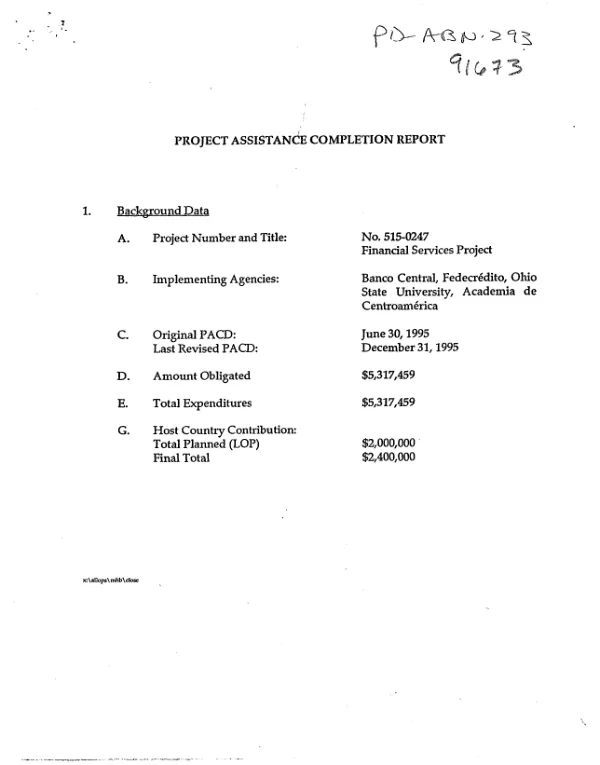
Project assistance completion report : financial services project no. 515-0247
PACR of a project (10/91-12/95) to promote access to financial services by small- and medium-scale savers and borrowers in Costa Rica.
Sign in to readA free account is required to download.
Abstract
The project was implemented by Banco Central, Fedecredito (BCF), Ohio State University (OSU), and Academia de Centroamerica (AC). Project accomplishments included the following. Under the policy analysis and reform component, OSU supported policy debate leading to the replacement of the crawling-peg foreign exchange regime by a freely floating exchange rate, and the liberalization of the capital account of the balance of payments -- one of the most important policy reforms in Costa Rica in recent years. AC supported the passage in 1995 of the new Central Bank legislation, which will strengthen the Bank's autonomy and capacity for exercising prudential supervision, as well as efforts of the Special Commission for Financial Reform to draft legislation to eliminate discriminatory regulations and to alter the rules governing state-owned banks, foreign banks, credit unions, and other financial entities. AC also supported several policy studies and sponsored a training program for Central Bank staff and a feasibility study for establishing an Integrated System of Financial Services for a national payment system, expected to be implemented in 10/96. Under the prudential supervision component, OSU and ASU supported the creation of a new regulatory body, transforming the General Auditor of Financial Entities (AGEF) into the General Superintendent of Financial Institutions (SUGEF) and extending its responsibilities and jurisdiction to all financial intermediaries. BCF supported the passage in 4/94 of the Supervision of Savings and Loan Cooperatives reform law for new credit union legislation and created an internal organizational unit, AUDICOOP, to provide auditing and prudential supervision services to member cooperatives, which rate its services highly. Under the financial management and innovation component, OSU provided diagnostic studies and TA to the Asociacion Constarricense de Desarrollo (ACORDE), a second-level organization for NGOs, and the Fundacion Integral Campesina (FINCA), which has a network of 180 community banks and is a major supplier of financial services to rural microenterprises, as well as to Avance Microempresarial, an urban NGO with a large credit portfolio. Also, OSU helped the Government of Costa Rica design and implement an institutional mechanism for disbursing a large IDB loan for microenterprise credit, and designed Certificados de Aportacion Patrimonial, which is now implemented in 20 FINCA community banks. AC provided training and TA to community banks and evaluated the capacity of the Juntas Rurales (small farmer directive boards on the National Bank rural branches) to analyze an innovative service in credit. BCF designed a Directed Integrated Technical Assistance Model to improve its efficiency in serving cooperatives and implemented a Program for Total Restructuring (RETO) enabling 22 cooperatives to participate in the Zurqui Initiative, which enhances cooperatives' competitive capacity by providing integrated financial products such as credit and debit cards, nationwide linkages among cooperatives, aggressive marketing, and a public image of financial soundness. BCF also complemented RETO with a Structural Strengthening Fund to help cooperatives resolve their institutional and bad debt reserve deficiencies. Systems and control software for cooperatives' liquid assets were created, enabling a nationwide check on the credits and debits of the services rendered in the inter-cooperative interchange of products. Finally, BCF-financed information technicians adapted and implemented Banca 2000, a financial management software for cooperatives. The following lessons were learned. (1) Due to a 5/94 change in administration, the Central Bank Law drafted in the later part of 1993 was not approved until 11/96. Projects with strong political aspects should be programmed to begin and end within the same administration whenever possible to avoid rehashing issues and loss of time. (2) The project's first few years were used to create consciousness about the need for reform and to guide the legislators in drafting that reform. However, the procedure became more directed when, on a practical level, AC hired consultants to draft the reform laws for discussion by the Special Commission members. Having a written draft legislation to work with made a big difference in producing a product within a restricted time period. (3) The project's overhead committee was never functional. It is unrealistic to expect a high-ranking official such as the Central Bank President to provide project leadership and continuity, especially in projects such as this, which dealt with specific institutions on a micro-level. (4) In countries with highly developed democratic institutions and traditions such as Costa Rica, the pace of change can be excruciatingly slow to create the conditions where a genuine consensus can be achieved. Projects with such goals should be aware of the time restraints for project implementation. (5) Between the Project Paper and Grant Agreement, the project's prudential regulation and financial innovation components, originally conceived as highly conceptual and sector-wide in scope, became narrowly redefined towards providing TA to particular financial sector institutions. This narrowing of scope made project coordination more difficult, as implementors tried to coordinate two dissimilar project segments. (6) Microenterprise efforts were not very extensive, possibly because AC was overwhelmed by the financial reform and supervision assistance components. A direct grant with another PVO would have been more effective. (7) Project objectives were very global, making it difficult to monitor implementation and measure achievement. (8) Delay in submitting audit reports is a common problem, especially if project agreements coincide with the end of the country's fiscal year. Requiring semiannual audits in the Agreement would obviate this problem.