USAID DEC
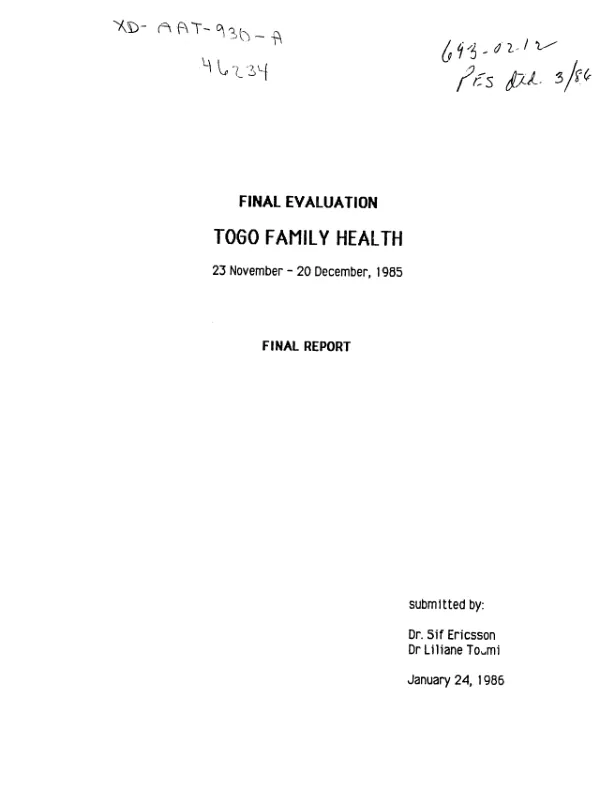
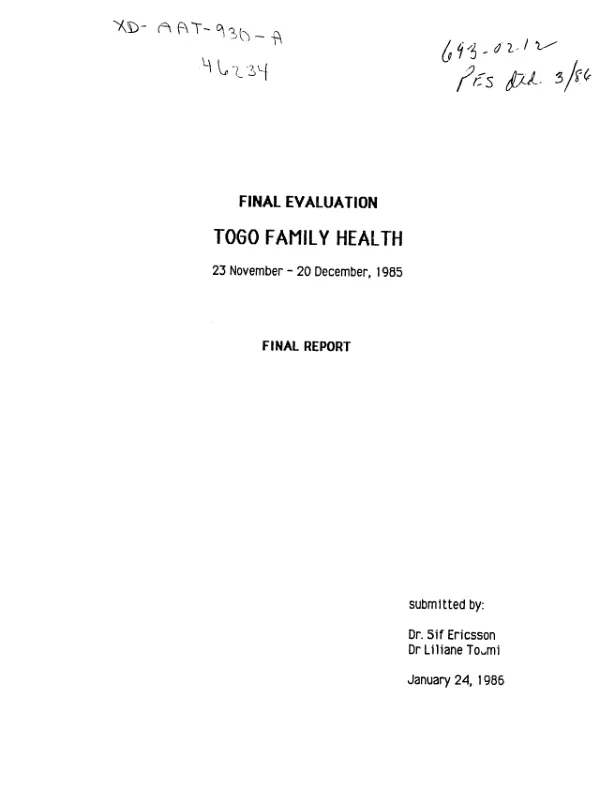
Final evaluation : Togo family health, 23 November - 20 December, 1985; final report
Sign inUSAID. MISSION TO TOGO
Final evaluation : Togo family health, 23 November - 20 December, 1985; final report
Presents final external evaluation of project to construct a family health center (FHC) and expand family planning (FP) services in Togo.
Ericsson, Sif|Toumi, Liliane · 1986
Sign in to readA free account is required to download.
Abstract
Evaluation covers the period 10/83-12/85 and is based on document review and visits to 7 clinics. The FHC was completed by 7/82 (not 1/80, as planned) and equipped by 7/83. Family Planning International Assistance (FPIA) has developed curricula for physicians, midwives, nurses, and social workers and trained 121 Ministry of Health (MOH) personnel in these categories; another 85 persons will be trained before the FPIA grant expires in 11/86, still far below target. Course content and methods seem appropriate, although facilitators need training to improve their use of interactive teaching methods and broaden their understanding of FP. There is a general lack of audiovisual aids and support materials, and the library is little used by the facilitators due to a paucity of French materials and "how-to" materials. The MOH has designated 11 facilities (4 in Lome, the remainder up-country) as FP centers; there have been 1,992 contraceptive acceptors at these centers. The Association Togolaise pour le Bien-Entre Familial (ATBEF), which also offers FP services at its private clinic, provides contraceptives to the FP facilities and to other MOH centers. Thus, FP services are available - if not through the project - in all 21 MOH districts. ATBEF statistics show that about 2% of Togolese women of child-bearing age use modern methods. (The project design projected 10% prevalence within 5 years of FHC's full operation.) As demand for FP services is expected to increase, regular inservice training for health workers is recommended. Medical supervision at FP facilities is adequate, but no supply management system exists; reliance on ATBEF has led to periodic stockouts of contraceptives, especially of spermicides, the preferred method. (IUD's and condoms are also used, but the pill is used by very few and diaphragms not at all.) The project has not provided sex education materials to schools or engaged in FP promotion, the latter due to a lack of trained personnel (since contraceptive use in Togo requires the husband's permission, male promoters are especially needed). The project needs a plan to guarantee FP delivery in existing and future centers; included should be a system for collecting statistics (which currently depends on irregular vists by project staff) and for effective use of administrative staff. The project manager and the rest of the staff would benefit from management training. Also, FPIA has not transferred funds in a timely manner or provided sufficient technical and managerial assistance. It may be necessary to explore alternative sources of assistance.
Related documents
![Project assistance completion report : [Togo] Family Health Center](https://covers.devme.ai/gen/67182.webp)
![Project assistance completion report : [Togo] Family Health Center](https://covers.devme.ai/gen/8097.webp)