USAID DEC
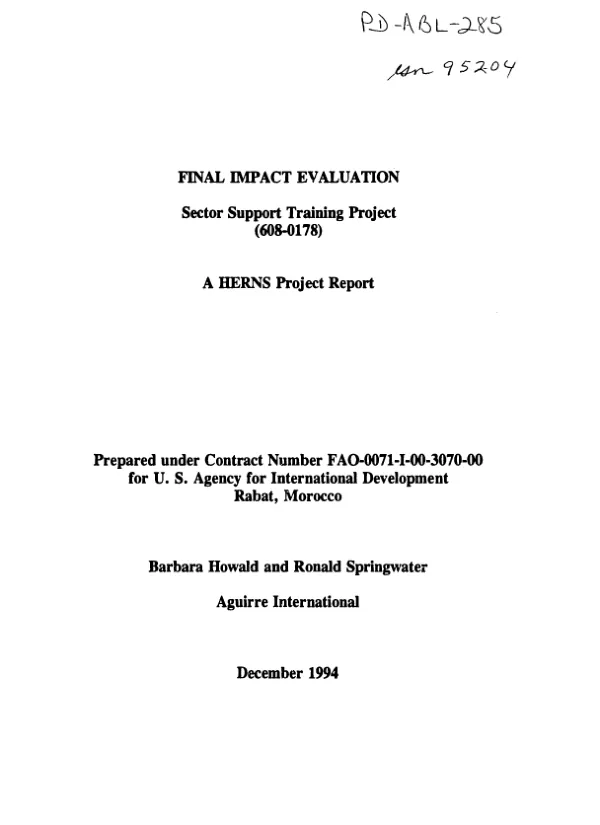
Final impact evaluation : sector support training project (608-0178) -- a HERNS project report
Sign inAGUIRRE INTERNATIONAL
Final impact evaluation : sector support training project (608-0178) -- a HERNS project report
Evaluates participant training project in Morocco to upgrade the managerial, analytical, and technological expertise of public and private sector Moroccans involved in planning and implementing Morocco"s social and economic programs.
Howald, Barbara; Springwater, Ronald · 1994
Sign in to readA free account is required to download.
Abstract
Final evaluation covers the period 1983-12/94. Project achievements have been superior. The number of successfully completed U.S. training programs exceeded the project goal, with 247 long-term academic degrees and 762 short-term seminars, workshops, and courses. Women made up 26% of participants, the private sector accounted for 21%, and 30% of the trainees attended Historically Black Colleges and Universities (HBCUs) vs. goals of 30%, 10%, and 10%, respectively. The completion rate of 98% for those who commenced long-term graduate studies in the United States represents one of the very best records ever achieved in USAID academic participant training. This success has been attributed to the selection process and to appropriate pre-departure English language training. Long-term participants considerably increased their understanding of U.S. family life, cultural and racial diversity, the role of women, democratic institutions, free market systems, volunteerism in community activities, and leadership styles. Short-term trainees increased their understanding most in the area of diversity. Upon returning, some trainees sensed a lack of support from employers and colleagues, whom they felt were distrustful or envious. However, the U.S. training was viewed as improving trainees" communication, interpersonal, and public speaking skills. Few instances were found in which returnees felt that they were able to achieve better results because of colleagues having trained with them. Most alumni are not active in post-training follow-on activities, and USAID is unclear as to how best to support returned trainees. The project structure was appropriate and flexible, but effective mechanisms for training utilization were not in place at the employer level. In fact, employers" involvement was low, clearly a problem since they are major stakeholders. The project was primarily a scholarship program.