AGUIRRE INTERNATIONAL
The HERNS project : training for development -- USAID/Bolivia evaluation
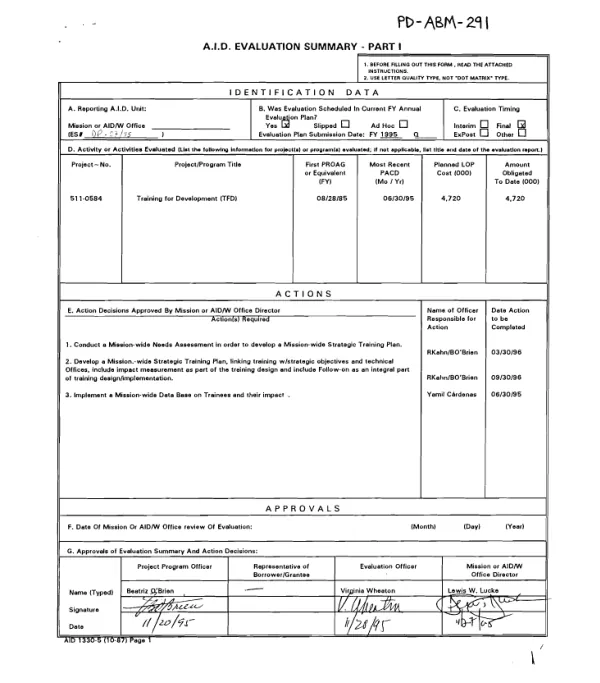
Final evaluation of a project (1985-6/95) to provide long- and short-term training to public and private sector Bolivian personnel who occupy or might in the future occupy policy level and leadership positions.
Estes, Valerie · 1995
Sign in to readA free account is required to download.
Abstract
The project exceeded its targets; 633 vs. a targeted 443 persons were trained, of whom 69% were men and 31% (vs. a targeted 40%) women. A total of 172 persons received short-term training, 63 long-term training, 60 democracy awareness training, and 338 local currency-funded in-country training. Long-term training covered primarily business, economics, finance, and public administration (83%), and secondarily agriculture and environmental studies (10%) and social science (7%). Short-term training covered business, economics, finance, and administration (14%); physical science (38%); and social science (43%). In-country training in business administration was administered by the Instituto de Desarrollo Empresarial y de Administracion (IDEA). Trainees hold positions in regional, national, and local government as executives and technical specialists. An impressively high percentage of trainees ranked project training as "useful" or "very useful." In addition, 82% of long-term, 75% of short-term, and 77% of in-country trainees stated that they have been able to use training in their job. Trainees are replicating their training in a number of formal settings, from workplaces to seminars, and in informal settings, including professional networks for economic and democratic reform. Five case studies of alumni and their contributions to Bolivia are included in the report. The following lessons were learned. (1) Human resource development projects should not be a separate sectoral activity but a development tool which supports the efforts of the technical offices and are part of a Mission-wide training strategy. (2) One of the difficulties in measuring training outcomes is that the PRISM system is a top-down system which focuses on strategic objectives and program outcome levels. Although very useful for focusing on results, the measurable indicators are often at the macro- rather than the activity level (where training impacts need to be measured). It is recommended that USAID/B develop a Mission-wide strategy and implementation system for measuring the contributions of trainees and assessing their links to program outcomes. A central data base on trainees and their impacts would be an essential adjunct of any Mission-wide training strategy. (3) A more equitable distribution by sex and by region should be promoted through new recruitment and selection strategies, quotas, and targets that have been updated according to Bolivia's most recent census. (4) Follow-on training, which has been demonstrated by studies to enhance training effectiveness, should be included as an integral part of training design and implementation. (5) USAID/B should increase the efficiency and effectiveness of overall training resources by promoting the multiplier effects, e.g., by organizing region-wide training groups.