USAID DEC
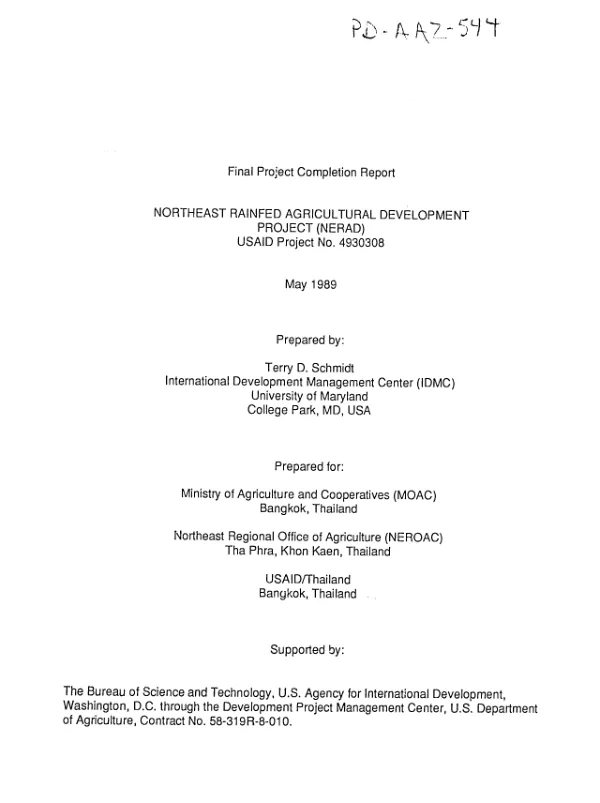
Final project completion report : Northeast rainfed agricultural development project (NERAD), USAID project no. 4930308
Sign inUNIVERSITY OF MARYLAND AT COLLEGE PARK. COLLEGES OF AGRICULTURE AND LIFE SCIENCES. OFC. OF INTERNATIONAL PROGRAMS. INTERNATIONAL DEVELOPMENT MANAGEMENT CENTER
Final project completion report : Northeast rainfed agricultural development project (NERAD), USAID project no. 4930308
Final report on the Northeast Rainfed Agricultural Development (NERAD) project (8/81-2/89) in Thailand.
Schmidt, Terry D. · 1989
Sign in to readA free account is required to download.
Abstract
NERAD had a slow and shaky beginning and a strong and successful finish. The shaky beginning was in part caused by a poorly written Project Paper. The project objectives were highly ambitious and subject to multiple interpretations. While there was ambiguity at the purpose and goal level, the input activities and budget were described with 29 pages of detail. This overspecificity caused the PP to be regarded as a "blueprint" for the first couple of years. This reduced the flexibility the project needed and the extent to which project management could influence the implementing agencies. The strong finish occurred because in its last 3.5 years, the project focused on identifying, replicating and disseminating its findings. The project produced an impressive set of well-documented analyses, reports, handbooks, and other useful products, and during the last year, held 10 workshops to analyze lessons learned and transfer policy and technical implications to interested users. Interviews with key people in USAID/T and the implementing agencies led to the conclusion that NERAD has been reasonably successful. (Interviewees were asked to rate NERAD on a 1 (poor) to 10 (fantastic) scale, compared with other development projects in the region. This unscientific but illuminating survey revealed an average score of 7.5). Indicators and evidence of project success include the following: the Ministry of Agriculture and Cooperatives (MOAC) has requested 14 million baht ($560,000) to continue the NERAD approach using regular government funding; NERAD"s most promising innovations have been built into other donor projects, and into the operations and policies of selected MOAC departments; new discoveries were made about the conditions of Northeast soils, with major implications for the overall development strategy for the Northeast; a score of promising methodologies and technologies were developed, and documented in some 100 handbooks (which have enjoyed wide popularity, as evidenced by over 2,000 requests for 50,000 copies of these publications); many of NERAD"s most important features have been incorporated into USAlD/T"s upcoming Management of Natural Resources Project; and hundreds of local- and provincial-level agricultural personnel have been trained in the methodologies and technologies developed under the project. On the other hand, as one MOAC official noted, NERAC has identified many promising technologies, but few proven ones. Fundamental changes in the way that MOAC departments interact have not been institutionalized; while the behaviors and attitudes of many technical staff and some lower-level policymakers have been changed, the changes have not been totally accepted and it is not certain whether the integrative behaviors initiated by NERAD will continue after PACD. The institutional capacity of the Northeast Regional MOAC Office has not been notably strengthened, even though certain individuals have improved their skills and the justification for the regional MOAC centers has been strengthened. It is perhaps premature to judge the ultimate impact of NERAD. NERAD has set the basis for high potential payoffs for millions of farmers, but these payoffs will unfold long after the PACD and through other delivery mechanisms. At this stage, we can conclude that the leading indicators of probable success are present. (Author abstract)