USAID DEC
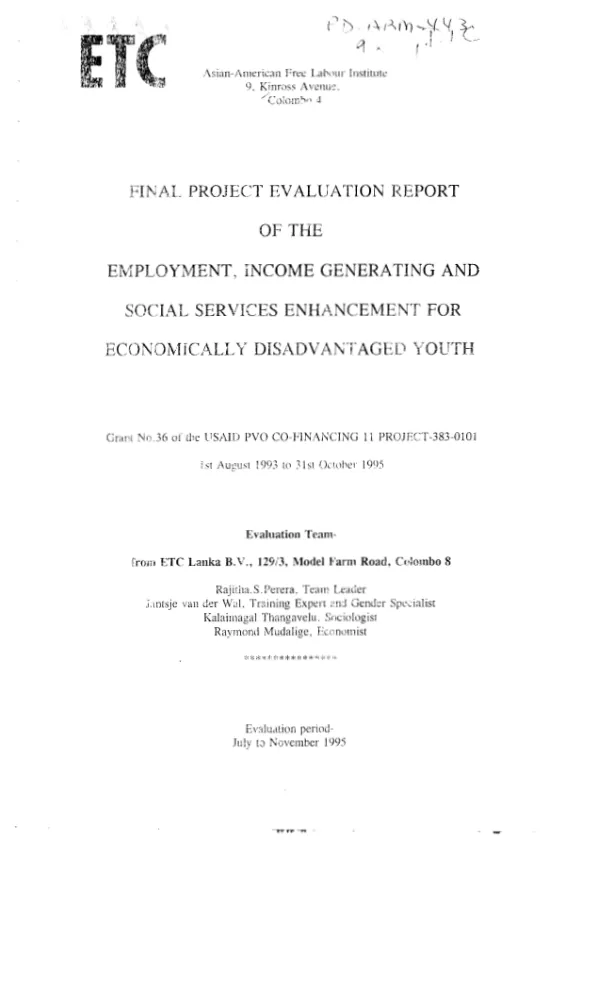
Final project evaluation report of the employment, income generating and social services enhancement for economically disadvantaged youth
Sign inASIAN-AMERICAN FREE LABOR INSTITUTE
Final project evaluation report of the employment, income generating and social services enhancement for economically disadvantaged youth
Final evaluation of a project (8/93-10/95), implemented by the Asian-American Free Labor Institute (AAFLI), to strengthen the capacity of Sri Lankan unions to serve young workers.
Perera, Rajitha S.|van der Wal, Jantsje · 1994
Sign in to readA free account is required to download.
Abstract
Though shortened from 3 to 2 years, the project met most beneficiary targets and evaluation indicators and generally achieved its purpose. It succeeded because it was based on existing union activities and responded to changes in context between its design in 1990 and implementation in 1993. Under the vocational training activity at the Congress Training Institute (CTI), 120 disadvantaged youth (vs. a target of 200) were provided with training. The job placement program was not implemented, due to change in management, inadequate staff, and poor boarding facilities. AAFLI realized the need to deviate from the objectives and give direct and indirect TA to develop CTI institutionally and to reconstitute the Congress Labour Organization, which had managed CTI earlier. AAFLI will continue to provide TA after project completion. The multi-union worker education program proved useful. Two U.S. consultants trained 35 trainers (26 men and 9 women) from 6 unions, in excess of target. Trainers from 5 of the unions conducted 136 seminars attended by 5,479 individuals (35% of them women), also exceeding target. The unions that developed an institutional approach (involving careful selection of trainers and participants, use of detailed curricula and participatory approaches, and program monitoring and evaluation) were more effective. This component also produced training materials in Sinhala and Tamil, which proved useful for the trainers, though difficult for participants, most of them local union leaders. The project did not develop a "pilot" center for union-supported, village-level youth organizations, as planned, but instead established four youth centers (at Koggala, Deniyaya, Badulla, and Maskeliya) which emphasized activities based on participants' needs. These activities included recreational activities, seminars, training of pre-school teachers, and skills development/income generation activities (e.g., for plantation women). No in-service training or staff development was provided, and program planning and recordkeeping were inadequate. The sustainability of some of the centers is in doubt. The revolving loan fund activity, in which union committee screened loans to be awarded by AAFLI, did not achieve its goal. Of the 158 loans disbursed, only 40% were given to the intended beneficiaries -- unemployed youth, a group which the unions considered too high-risk. However, those who did benefit from the project were also in need of loans. (If the objective is to give loans to unemployed youth, these should be carefully selected and referred to credit institutions, with the unions functioning as guarantors.) In any case, the loan maximum established at project inception (Rs. 13,000) proved to be too low to create self-employment and enable borrowers to rise above the poverty level. Finally, the counseling center, established at Seeduwa, was felt to fulfill a relevant need, although it reached only 470 of 2,000 targeted women. (Males were originally included in the target group, but were later excluded.) Income generating/skills development activities were popular, but counseling services, medical clinics, and English classes were poorly attended. However, the sharing of experiences at inter-zonal fellowship meetings and the advisory services given as a follow-up could be considered as a form of counseling. Also, the meetings, the newspaper, and the employment of a client at the center were used to empower the target population and increase their sense of ownership of the center. The center was not self-sustaining in the short term, but AAFLI and the unions have discussed alternatives. In terms of gender, the project as a whole benefited 2,655 females (43% of total) vs. a target of 3,310 (56% of total). The project was thus implicitly aware of gender issues, but was not designed to address them. A similar situation obtains at the union level, where a basic gender awareness coexists with a lack of gender-specific policies and strategies.
Related documents
![Sri Lanka : final evaluation of the shared control of natural resources [SCOR] sub-project -- final report](https://covers.devme.ai/gen/5940.webp)