USAID DEC
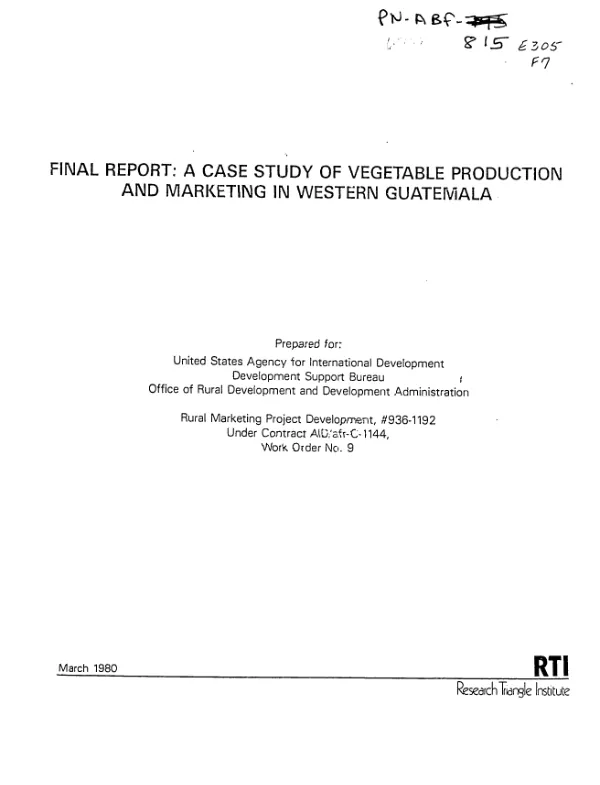
Final report : a case study of vegetable production and marketing in western Guatemala
Sign inRESEARCH TRIANGLE INSTITUTE (RTI)
Final report : a case study of vegetable production and marketing in western Guatemala
This report presents the results from a case study of rural marketing in the Western Highlands of Guatemala.
Franklin, David L.; Appleby, Gordon · 1980
Sign in to readA free account is required to download.
Abstract
The study focuses on the interactions of marketers and vegetable producers in Almolonga and Zunil -- two villages in the province of Quetzaltenango. Changes in income growth and distribution are examined within a framework which combines anthropological background and economic analysis. Results show that marketing is an important income source for low-income rural families, and the returns to marketing labor are close to the wage rate in agriculture. Marketing margins vary with the capital, risks, and, labor associated with different routes and marketplaces. Entry to marketing is relatively open and all routes are characterized by price competition. An important attribute of the vegetable marketing system is its compatibility, as an income-producing activity, with different types of landholding status, irrigation methods, and cropping cycles. Economic analysis estimates that two-thirds of the wholesale price of vegetables now accrues as a payment to labor from low- income rural families. Only 12% accrues to nonlabor marketing costs, and much of this is for transportation. Because of the low margins and the efficiency of marketing, as well as the demographic characteristics of marketers, interventions aimed at reducing marketing margins are likely to have deleterious effects on the incomes of low-income persons from Almolonga and Zunil. Simulation analysis was used to determine the importance of different sources of risk to the profits of Almolonga and Zunil vegetable farmers. These simulations show that within-month price variation, the risk which could best be reduced by a large marketing organization, is only significant for several crops and is no more important than the risks farmers face from seasonal price variations and yield variations. Therefore, interventions aimed at enhancing agricultural productivity would appear to have a greater potential to increase incomes. From examination of this case study and the literature, it is clear that broader market-related issues must be analyzed before the effects of changes in rural marketing systems can be understood. The reaction of margins to changes in different parts of the system and the effects of interventions on the employment and demographic structure of the area are important. Development of horizontal market links results in communication of economic information and an increase in specialization and diversification. Characteristics of marketing systems can have broad effects on the reorganization of all household production. The study strongly supports the concept that marketing development must be viewed in the context of production- consumption relationships, with special emphasis on the household"s allocation of time. (Author abstract)
Related documents