USAID DEC
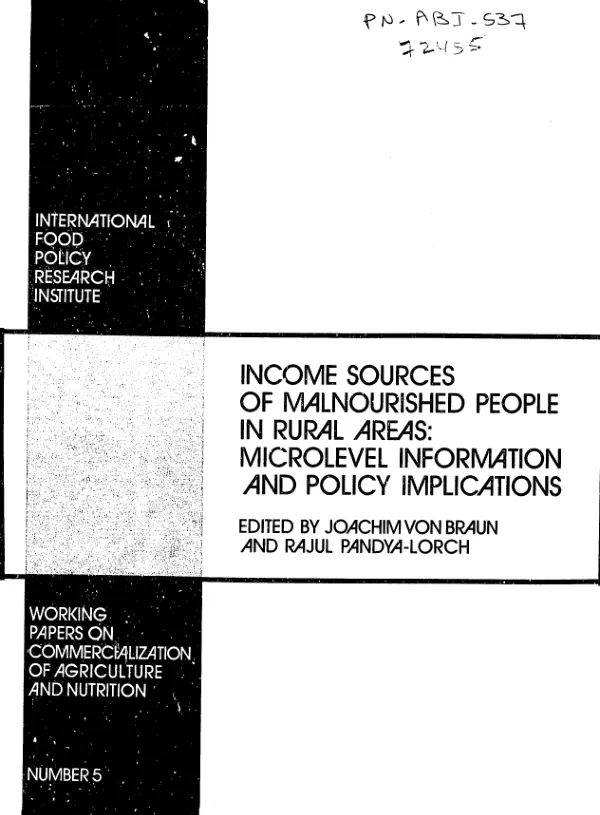
Income sources of malnourished people in rural areas : microlevel information and policy implications
Sign inINTERNATIONAL FOOD POLICY RESEARCH INSTITUTE (IFPRI)
Income sources of malnourished people in rural areas : microlevel information and policy implications
Strategies to alleviate the plight of the malnourished rural poor require adequate information on the diverse income sources of the poor (farm, nonfarm, and nonagricultural), as well as on the scale of these income sources and their relation to major economic sectors.
Von Braun, Joachim, ed.; Pandya-Lorch, Rajul, ed. · 1991
Sign in to readA free account is required to download.
Abstract
This report presents 13 case studies of household surveys on the income and employment sources of the malnourished rural poor in developing countries. The surveys cover a wide variety of socioeconomic characteristics and stages of agricultural development in countries across three continents -- Latin America (Brazil, Guatemala), Africa (The Gambia, Burkina Faso, Kenya, and Zambia), and Asia (Sri Lanka, Pakistan, Bangladesh, India, and the Philippines). Major findings and policy implications include the following. (1) Malnourished rural households have diverse sources of income that vary by economic setting. (2) Rural households do not depend for their income on agriculture alone; in half of the survey locations, the share of household income from nonagricultural sources was 50% or more. (3) Income diversification in stagnating rural economics is a means of coping with the risks associated with dependence on a sole income source; in growing rural economies it is driven by households capturing gains from specialization. (4) Female-headed households tend to have lower incomes but in some cases have higher calorie intakes than male-headed households. (5) In major developing countries, the share of agriculture in the economy declines rapidly as economies grow, but the share of agricultural income in rural income remains high. (6) Increasing rural income reduces malnutrition significantly in countries with very low per capita income. Comparative analysis of the 13 case studies suggests a focus on prevention of policy-induced market failures, improved market integration through infrastructure, provision of community services (including health and sanitation improvement), and rural growth promotion.