USAID DEC
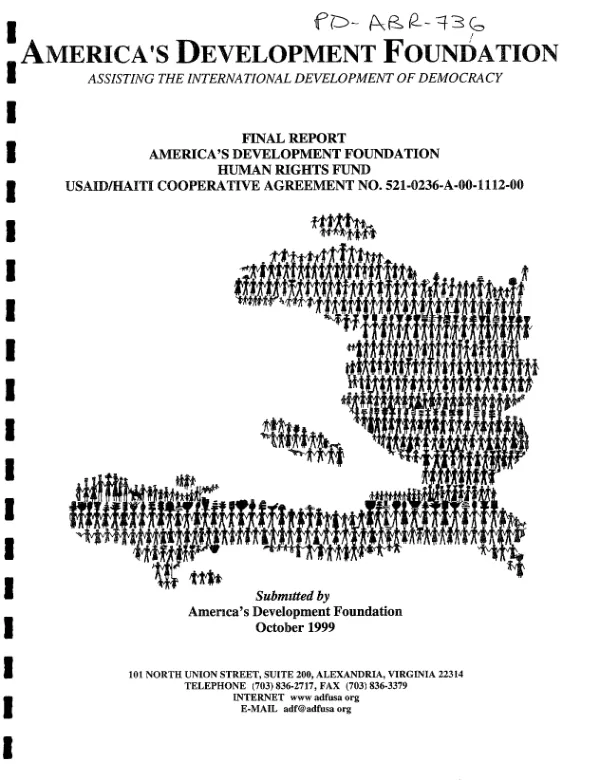
Final report : America"s Development Foundation -- human rights fund : USAID/Haiti cooperative agreement no. 521-0236-A-00-1112-00
Sign inAMERICA"S DEVELOPMENT FOUNDATION, INC.
Final report : America"s Development Foundation -- human rights fund : USAID/Haiti cooperative agreement no. 521-0236-A-00-1112-00
Final report of the contractor, America"s Development Foundation, on the Human Rights Fund (HRF) component of a project to promote democracy in Haiti.
1999
Sign in to readA free account is required to download.
Abstract
The report covers the most recent 14-month extension (7/98-8/99) of this activity. Significant progress was made in five of the six target areas. (1) Improvement of community-police relations was achieved, as indicated by: over 20 joint initiatives by the local Haitian National Police (HNP) and community civil society organizations in 5 of 8 target communities; improved communication between communities and the HNP; creation of an official institutional mechanism in Les Cayes and informal consultative mechanisms in Jacmel, La Vallee de Jacmel, and Gonaives; and a reduced incidence of HR abuses. (2) Public awareness of and action on HR increased significantly, as indicated by: a popularization campaign that reached over 1 million people, at least a third of them children and youth, providing opportunities for discussion of HR among local communities, the HNP, and civil society and HR organizations; a marked increase in advocacy to mobilize public opinion on HR; the formation of two new coalitions of HR organizations; an extensive effort by popular organizations to train the public in HR; increased professional participation in the monthly HR round- table discussions; and increased incidence of public discussion on HR in the print and broadcast media. (3) Increased availability of educational resources is indicated by: new publications in French or Creole, including revised translations in French and Creole of the Universal Declaration of Human Rights (UDHR) booklets, UDHR calendars in Creole, an HRF rehabilitation series focusing on trauma, and a manual for an HR education curriculum in schools; distribution of over 5,000 copies of HR publications in at least 6 departments; distribution of core HR materials to civil society and HR organizations throughout Haiti; and the assembling of 54 HR materials, 33 in Creole, 16 in French, and 35 in English. (4) Efforts to improve local capacity to monitor, document, and report on HR abuses were not successful. A planned HURIDOCS (HR Information and Documentation Systems, Intl.) workshop fell through when the training institution changed the software for its program and postponed its actions in Haiti. These funds were then applied to other purposes. (5) Treatment of victims of HR abuse improved, as indicated by: treatment of 612 victims; provision of medical or psychological treatment to 885 family members; referral of 92 clients to specialists; and assistance to 12 victims and their families in regaining economic security. (6) An increase in professional resources for treatment of victims is indicated by: expansion of the treatment network to 6 new communities with at least one community health worker (CHW) in each; the existence of 60 health professionals specializing in treating victims of HR abuse; 42 institutions, public and private, working with the rehabilitation program; and training of 26 CHW"s to provide victim rehabilitation services. Additional international advanced training for health professionals did not take place due to resource constraints. Key lessons learned were as follows: (1) There is a great deal of prejudice among Haitians against U.S. government programs. This takes time and effort to overcome and requires the ability to listen and be flexible. (2) The methodology used in the Community-Police Relations Program pilot program works. One of the program"s greatest legacies is the development of skills in mediation and negotiation. (3) Community-level challenges to improved community-police relations are multi- level. Progress in highly urban settings takes more time than in more provincial cities and communes. (4) Popularization campaigns are expensive and time-consuming, and their impacts are difficult to assess. HR and civil rights education is essential to changing people"s behaviors toward one another. Learning about HR can translate into greater respect for the rights of others. (5) Victim assistance should not be open-ended, but part of an overall process to help victims regain productive lives. The combination of individual and group therapy works well, and the inclusion of legal counseling and legal education in the program helps victims move on more quickly. The collaboration with specialist micro-credit organizations within the economic rehabilitation program works well. (6) Even within an established network of professionals, controls and competition are desirable. It is strongly recommended that USAID/Haiti continue to support NGO programs in human rights education, assistance to HR victims, and community-police relations, and also that it collaborate more closely and openly with its NGO partners.
Related documents
![Final report : increased citizen participation project : grant award no. 654-G-00-98-0059-00 [i.e. 654-G-00-98-00059-00]](https://covers.devme.ai/gen/105888.webp)
![Final report : civil society proposing policy alternatives [CSPPA] : cooperative agreement no. 656-A-00-98-00049-00](https://covers.devme.ai/gen/13994.webp)