USAID DEC
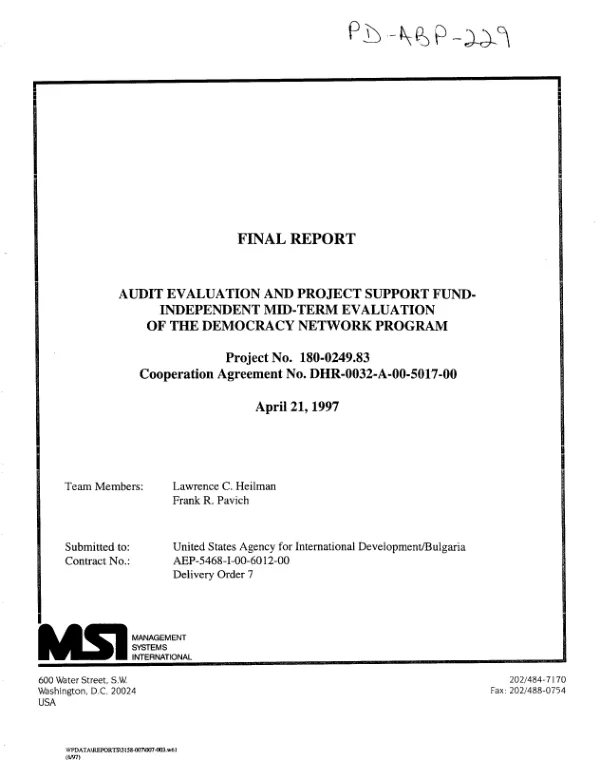
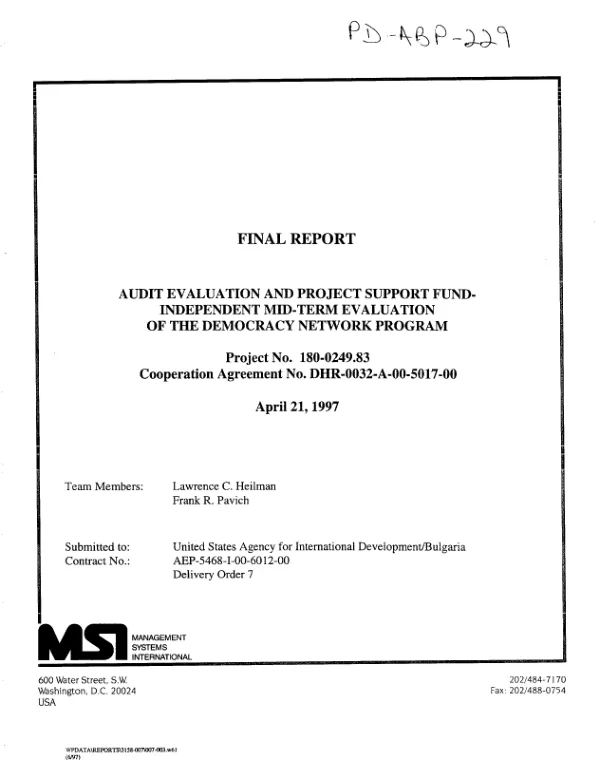
Final report : audit evaluation and project support fund-independent mid-term evaluation of the democracy network program -- project no. 180-0249.83, cooperation agreement no. DHR-0032-A-00-5017-00
Sign inMANAGEMENT SYSTEMS INTERNATIONAL, INC. (MSI)
Final report : audit evaluation and project support fund-independent mid-term evaluation of the democracy network program -- project no. 180-0249.83, cooperation agreement no. DHR-0032-A-00-5017-00
Midterm evaluation of the Bulgaria component of the Democracy Network (DemNet) Program, aimed at strengthening civil society in Bulgaria by supporting the efforts of indigenous NGOs in four sectors: civil society/democratic practices, economic development, the environment, and social safety nets.
Heilman, Lawrence C.|Pavich, Frank R. · 1997
Sign in to readA free account is required to download.
Abstract
The project is being implemented by the Institute for Sustainable Communities (ISC). The evaluation covers the first 20 months of the program (10/95-4/97). DemNet has completed one round of pilot grants. In this round, which was launched 10/2/95 and open only to NGOs working in the civil society/democratic practices sector, 18 organizations received funding for institutional strengthening or project activities. Another 30 NGOs were awarded with DemNet training seminars. A second round of grants was opened to NGOs working in the democratic practices and social safety net sectors. In 1/97, 33 such NGOs were nominated to receive funding for institutional strengthening and project activities, and another 10 to participate in the DemNet training program. Despite the criticisms leveled against ISC (e.g., that it should have mobilized faster, worked more closely with NGO leadership, and developed a strategy to mobilize a network of organizations that support grassroots democratic participation), its Bulgaria staff and management deserve credit for what has been accomplished under difficult circumstances. They have mobilized a Sofia-based team, assessed NGO sector needs, and structured a grants program and a training capacity targeted at the NGO community. Overall, ISC/Bulgaria has made a difference by strengthening Bulgaria's inexperienced NGO sector to a modest degree, gaining valuable experience in the NGO sector in the process. At this point, ISC/Bulgaria and USAID need to significantly adjust their program approach in order to better prioritize the award of grants and thereby maximize the program's contribution to building a civil society in Bulgaria. Focus should immediately be shifted to developing a network of locally based NGOs that can promote the resolution of community problems at the grassroots level, perhaps in municipalities where FLAG, the Local Government Initiative, Peace Corps and other USAID activities are already underway. Priority should be placed on regions or municipalities where the NGOs are already involved in the DemNet Program and are committed to policy advocacy, community involvement, team work, and partnerships, and have the capacity to operate democratically and sustainably. The election of NGOs to participate in the program should be done by the leaders of the municipality where they work, an approach which is used by the Partnership Foundation in its Sliven activity. The approach lends itself to the team building, training, and consensus building on which ISC should be focusing in the DemNet Program; to do this, ISC would first need to strengthen its TA and monitoring capacities. ISC should also consider contracting with other indigenous organizations to design democracy training activities, not because ISC lacks this capacity but because one of DemNet's goals is to institutionalize indigenous training capacity to strengthen civil society. Since 1989, citizen participation in the public policy decisionmaking process has increased dramatically over what was possible under the Communist regime. The growth in the number of NGOs in the past 6-7 years does, in part, demonstrate the public's eagerness to continue to play a stronger role in the public policy arena. The Democracy Strategic Objective (SO) 2.1 and the DemNet Program have been created to support this public will. ISC/Bulgaria has made efforts at each stage of their progress in country to adjust activities in accordance with SO 2.1. There is very close alignment between the ISC activity and SO 2.1, the approved Mission R-4, and the latest Six Month Work Plan prepared by ISC/Bulgaria. Given ISC's experience on the ground in Bulgaria, their growing client base and understanding of the NGO terrain, and given a willingness to work jointly with NGO partners and USAID/Bulgaria on establishing the standards for future directions and performance, they would be a good choice to implement the changes in strategy and approach over the next several months.
Related documents
Documents in this collection
 1997
1997USAID DEC
Final report : audit evaluation and project support fund-independent mid-term evaluation of the democracy network program -- project no. 180-0249.83, cooperation agreement no. DHR-0032-A-00-5017-00
Open record 1998
1998USAID DEC