USAID DEC
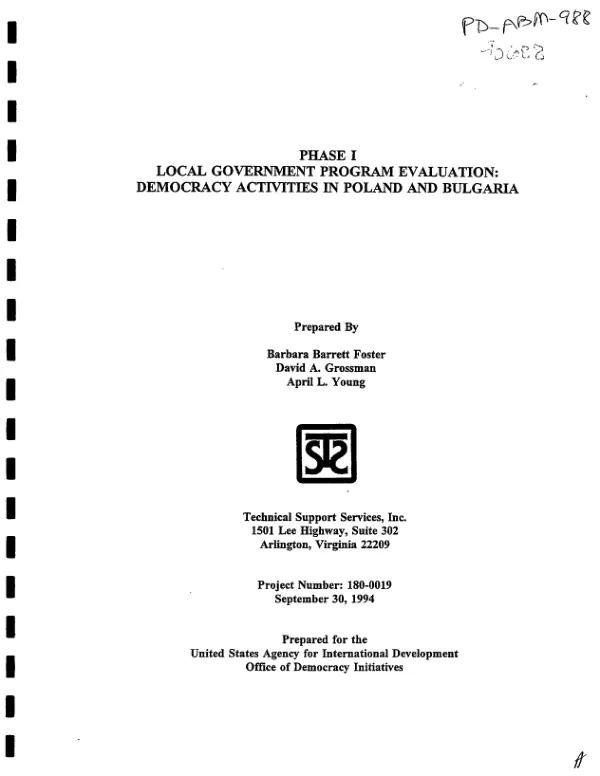
Phase I local government program evaluation : democracy activities in Poland and Bulgaria
Sign inTECHNICAL SUPPORT SERVICES, INC. (TSS)
Phase I local government program evaluation : democracy activities in Poland and Bulgaria
Evaluates four grants to support democracy in Central Europe by strengthening municipal governments.
Foster, Barbara Barrett|Grossman, David A.|Young, April L. · 1994
Sign in to readA free account is required to download.
Abstract
The grantees are the University of South Carolina (Bulgaria) and Rutgers University, International City Managers Association (ICMA), and Milwaukee County (Poland). Interim evaluation covers the period 1991-94. Local governments in Poland and Bulgaria have been strengthened by the grantees' activities. While progress toward complete decentralization is quite slow, examples of new-found strength and capacity in local governments can be found in each country (e.g., adoption of competitive bidding procedures). While the degree of strengthening has varied widely, the overall effect, considering the modest funding, staffing, and time involved, has been both positive and impressive. The lack of support from central government agencies during much of the project period in Poland and nearly all of the time in Bulgaria was a major limiting factor for most activities. Rutgers' program was the most effective, mainly because of the presence and growing capability of the indigenous Foundation in Support of Local Democracy (FSLD). The grants represent a range of approaches to meeting the training and TA needs of local government, including formal training programs, training of trainers, short-term advisors, assistance to municipal associations, and personnel exchanges and visits. Each approach has potential merit, but the overall impact varies with at least four factors in addition to the competency of the provider: receptiveness of the recipient; capability of the recipient; availability of a competent indigenous partner; and the national political environment. In addition, there is a "point in time" dimension to each form of assistance. Formal training in discrete aspects of local government administration is more effective after the local governments have been in place for 2 or more years. Similarly, the training-of-trainers program was significantly enhanced by placement in the heart of a successful indigenous organization, which could only exist in a relatively stable political environment. Short-term TA is very useful for newly elected officials within newly created municipal governments. Early assistance to municipal associations should include training on the most basic issues of democratic interest group politics, whereas later assistance can focus on the administrative and communications issues critical to transition and maturation of an advocacy organization. Personnel exchanges in the early stages of transition appear to expand the horizons of public officials in newly democratic environments, while at a later stage, content-driven (rather than exposure-driven) internships are more likely to prove effective. All types of assistance provided in these projects were effective under some circumstances. The one with the greatest potential for cost-effective impact, however, is intensive training of local officials where counterpart indigenous organizations are in place, as they are in Poland but are not as yet in Bulgaria. The next most cost-effective approach is having U.S. local-government experts give onsite advice and assistance for substantial periods of time. Aid to municipal associations is warranted especially where the national government is unsupportive of local government. Exchange programs, while potentially valuable for selected individuals, tend to be costly on a per unit basis and quite variable in impact. Future assistance in Poland should focus on further strengthening the extensive training and consulting base already present in FSLD and its nationwide system of training centers and schools. In Bulgaria, where the need is greater and there are apparently no strong counterparts or cooperative central agencies, an ongoing program of training and technical assistance is advised. In both countries, efforts should be made to enlist central government institutions in the decentralization and strengthening process, despite the poor political prospects for this initiative at present. (Author abstract, modified)