USAID DEC
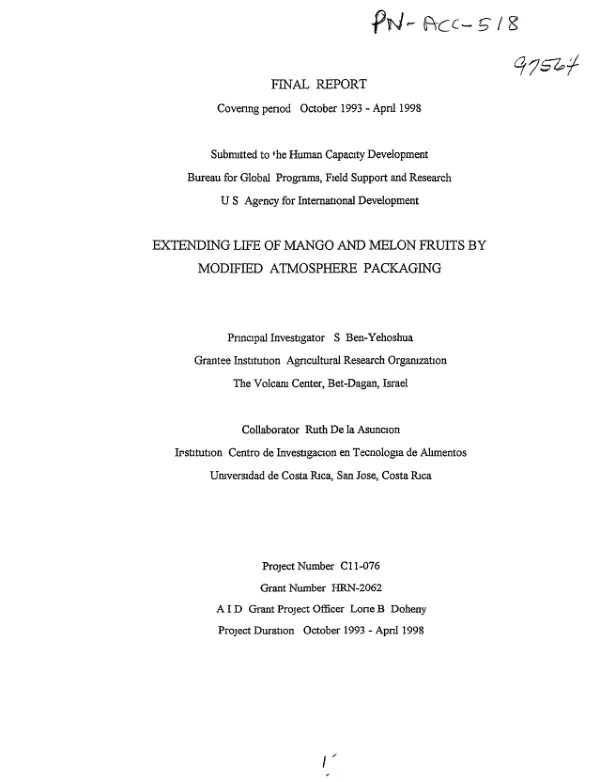
Final report covering period October 1993 - April 1998 : extending life of mango and melon fruits by modified atmosphere packaging
Sign inAGRICULTURAL RESEARCH ORGANIZATION. THE VOLCANI CENTER
Final report covering period October 1993 - April 1998 : extending life of mango and melon fruits by modified atmosphere packaging
Israeli and Costa Rican scientists conducted research to optimize the perforation level of packages containing heat- treated mangoes and melons in an effort to extend the storage life of these fruits without reducing their consumer appeal.
Ben-Yehoshua, S.; De la Asuncion, Ruth · 1998
Sign in to readA free account is required to download.
Abstract
Experiments were conducted in both countries, the Israelis working only with mango, the Costa Ricans with both mangoes and melons. The project"s major contribution is the establishment of a new postharvest research laboratory in Costa Rica"s Center of Food Technology Research (CITA) and the training of its leader. The keeping qualities of the two fruits were improved by hot water treatments followed by sealing the fruit with different films. Packaging Tommy Atkins mangoes in perforated films prevented disorders caused by non-perforated packages, such as impaired ripening, off-flavor development, and discoloration, while markedly alleviating physiological problems characteristic of non-sealed fruit such as inadequate life, desiccation, etc. A series of modified-atmosphere packages with different O2 and CO2 levels were obtained by varying the package perforation area. In all these perforated packages, the fruit was capable of ripening, but at rates that differed markedly depending on in-package atmosphere. This result opens a possibility of choosing the characteristics of the package in accordance with the desired duration of storage and transportation period, in order to obtain a fruit combining low weight loss, absence of shriveling, and good quality. The addition of Ca(OH)2-containing pouches (CO2 absorbers) to non- perforated packages allowed the fruit to attain the yellow peel color without a noticeable increase in weight loss. However, hastened decay development in such packages canceled their positive effects on mango color. A mathematical model was developed to study the influence of film perforation on O2 concentration and relative humidity in the atmosphere of the package containing fresh fruit. The model included equations describing fruit respiration and transpiration as well as permeation of oxygen and water vapor through the perforated film. Closed-system experiments with mango fruit revealed a linear dependence of respiration rate on O2 concentration. The model allowed analytical computation of the time course of in-package O2 concentration and relative humidity, and the results were in good agreement with experimentally measured values. Perforations had a much more pronounced effect on O2 concentration than on relative humidity. The model enables practical predictions for designing modified-atmosphere packaging. (Author abstract, modified)
Related documents