USAID DEC
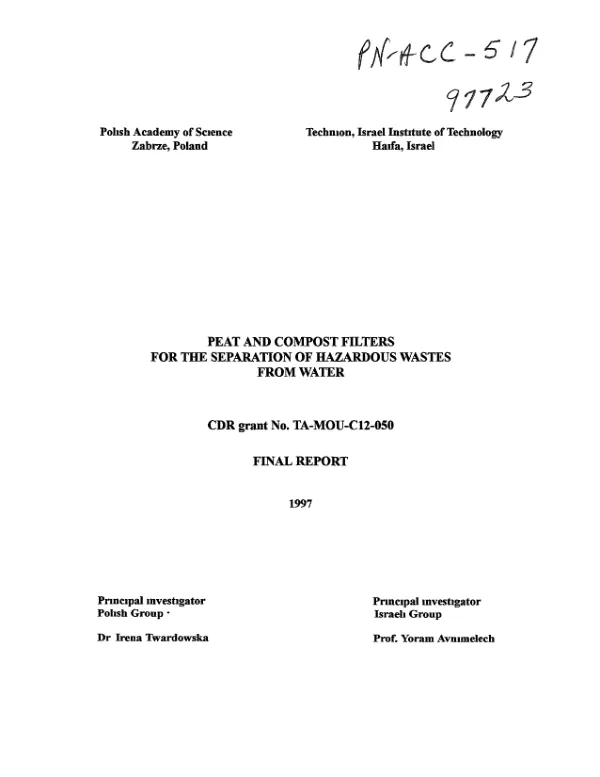
Peat and compost filters for the separation of hazardous wastes from water : final report
Sign inPOLISH ACADEMY OF SCIENCES. INSTITUTE OF ENVIRONMENTAL ENGINEERING
Peat and compost filters for the separation of hazardous wastes from water : final report
Industrial wastewater originating from large and modern industries is usually well treated, and the effluents meet stringent environmental standards.
Twardowska, Irena; Avnimelech, Yoram · 1970
Sign in to readA free account is required to download.
Abstract
The level of treatment is much lower in small-scale industries, or workshops. This research was aimed at developing a low cost, sturdy, simple, and reliable system for use in small metal finishing workshops, a system that will bring the effluents to a level at which they can be disposed safely into the municipal waste stream. Initial work revealed the high adsorptive capacity of residual humic compounds, i.e., composts and sewage sludge, toward metals. These materials are available in Israel and had better adsorption properties than peat in Poland. Adsorption of metals from pure solutions as well as from mixed actual industrial wastewater was studied. In addition, it was found that release of the adsorbed metals under acidic conditions is very effective. The first practical approach was to develop exchange columns that would be leached with the industrial wastewater in the adsorption phase and subsequently leached with acid to get the metals back in a concentrated stream. However, it proved difficult to maintain good hydraulic conductivity in the column, which became clogged due to gas formation, swelling, and dispersion of the different organic substrates tested. Different operations such as upstream flow patterns did not drastically improve the ability to use the column system. The final stage was to develop a batch operation reactor. The reactor worked properly in the laboratory and was brought to a scale operable in a small workshop. The experimental pilot reactor has a volume of 120 liters and was shown to effectively reduce the concentrations of metals in raw industrial wastewater from a metal finishing plant. The treated effluents can be released to the municipal wastewater system, and the metals are concentrated in an easily separated sludge that has a volume of less than 10% of the original wastewater. Includes references. (Author abstract, modified)
Related documents
Documents in this collection
 1995
1995USAID DEC
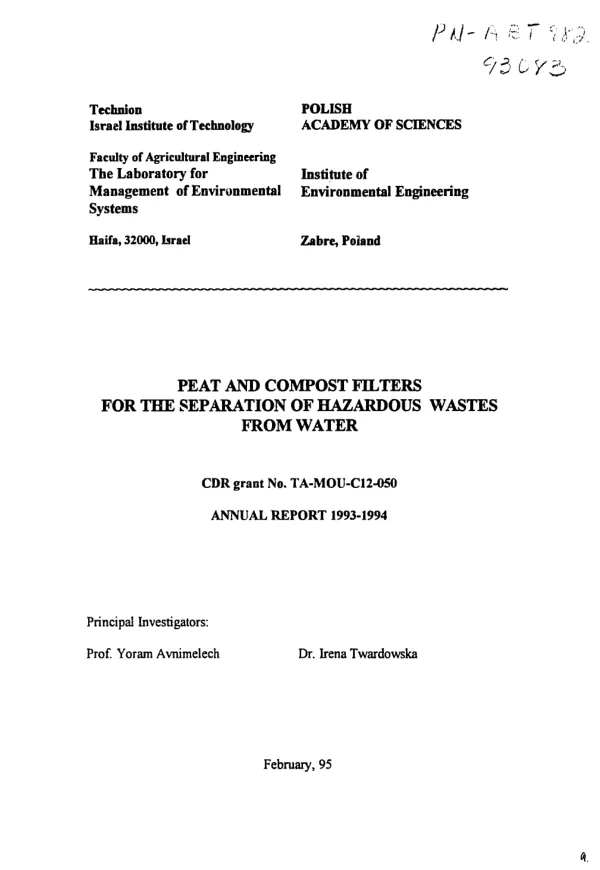
Peat and compost filters for the separation of hazardous wastes from water : CDR grant no. TA-MOU-C12-050 -- annual report 1993-1994
Open record 1998
1998USAID DEC