CATHOLIC RELIEF SERVICES (CRS)
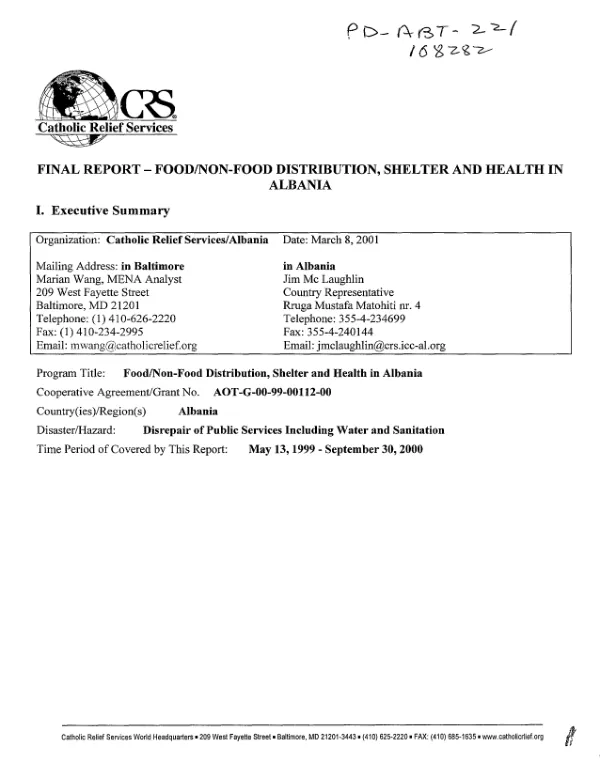
Final report : food/non-food distribution, shelter and health in Albania
Final report of Catholic Relief Services (CRS) on a water and sanitation program conducted as part of a project (5/99-9/00) to provide emergency food and non-food items to Kosovar refugees in Albania.
2001
Sign in to readA free account is required to download.
Abstract
Despite many setbacks, particularly delays in supplying pipes, the project was successful. The program built eight water supply projects in towns and villages, one hospital project that improved water supply to one ward, and one sanitation and well project that improved the water quality in an urban water supply system. In eight Albanian communities, there is water flowing in some of the best engineered and constructed water projects in the country. Sustainable operation and maintenance strategies were successfully put in place. In addition, a significant number of people in the beneficiary communities have a clear understanding of their water supply systems and the value thereof and have made a commitment to contribute financially to system maintenance. Lessons learned were as follows: (1) Projects of the scale that CRS developed, particularly the large rural projects, require more time and up-front development work than was available this year. A minimum of one full year should be allocated to large water projects. (2) Water and sanitation development projects in Albania should not be considered emergency interventions, which generate low expectations regarding technical standards and socioeconomic sustainability. Most emergency water and sanitation problems in Albania are a result of poor management combined with low cost recovery. If international organizations choose to build quick-impact emergency projects without considering long-term sustainability, the same problems will persist. (3) Water and sanitation development is needed in Albania. International donors have responded, especially in urban areas. In the smallest communities, there also appears to be significant work by some NGOs such as PLAN, but in the large villages and small towns there is a void. These communities are not large enough to attract the interests of the national government or international donors and investors, but are often too large for most NGOs to get involved. (4) NGOs should seek reimbursement for value-added taxes (VAT) prior to initiating projects and to the fiscal budgeting of the Government of Albania (GOA). The European Community Humanitarian Organization (ECHO) has secured GOA guarantees to reimburse all VAT on the projects it sponsors. Other donors should follow suit. (5) NGOs should collaborate better with local authorities. In the urgency to initiate CRS projects this year, collaboration with the local water enterprises and municipalities was often minimal, especially at the outset. This threatens project sustainability and undermines the development of civil society. NGOs run the risk of establishing institutions parallel to existing Albanian ones. In the future, NGOs should consider sponsoring training workshops for government engineers or technicians in new technologies or management techniques. (6) Albanians and Albanian communities will contribute time, money, and labor to projects when they believe the projects will be successful. Few expected the level of community participation evinced in this program. This was possible only through the commitment of the CRS staff to the community participation strategy developed early on. Skilled and motivated community extension workers are required for successful projects. The constant presence of CRS liaison officers in the communities and their active leadership made these projects successful. The community work was far more labor-intensive than the technical work. (8) Albanian contractors are capable of implementing quality projects. Except in special cases, it is not necessary to bring in contractors from other countries. The benefits from training contractors included high-quality workmanship and a sense of loyalty that was helpful when pipe supplies were successively late. The work of the contractors has been generally very good, though constant supervision by an experienced engineer was necessary. (9) Good hydrogeological information is worth the money. The CRS consultant was excellent, and in retrospect should have been consulted more frequently, especially in supervising the well drillers. (10) For future projects, contractors should be allowed to acquire polyethylene pipe and fittings, although this will increase project costs substantially. The challenge of getting quality materials in the country consumed a lot of CRS staff time. (Author abstract, modified)
Related documents
![Tropical storm [Hurricane] Mitch emergency response : grant agreement no. 520-G-00-99-00006-00 -- final report](https://covers.devme.ai/gen/18778.webp)