USAID DEC
Tropical storm [Hurricane] Mitch emergency response : grant agreement no. 520-G-00-99-00006-00 -- final report
Sign inCATHOLIC RELIEF SERVICES (CRS)
Tropical storm [Hurricane] Mitch emergency response : grant agreement no. 520-G-00-99-00006-00 -- final report
Final report of Catholic Relief Services (CRS) on a contract (11/98-1/00) to provide disaster recovery assistance to the 12 Guatemalan municipalities (Panzos, El Estor, Puerto Barrios, Los Amates, Morales, Zacapa, Rio Hondo, Gualan, Usumatlan, Jocotan, Chiquimulilla, and Ixcan) hardest hit by Hurricane Mitch.
2000
Sign in to readA free account is required to download.
![Tropical storm [Hurricane] Mitch emergency response : grant agreement no. 520-G-00-99-00006-00 -- final report](https://covers.devme.ai/gen/18778.webp)
Abstract
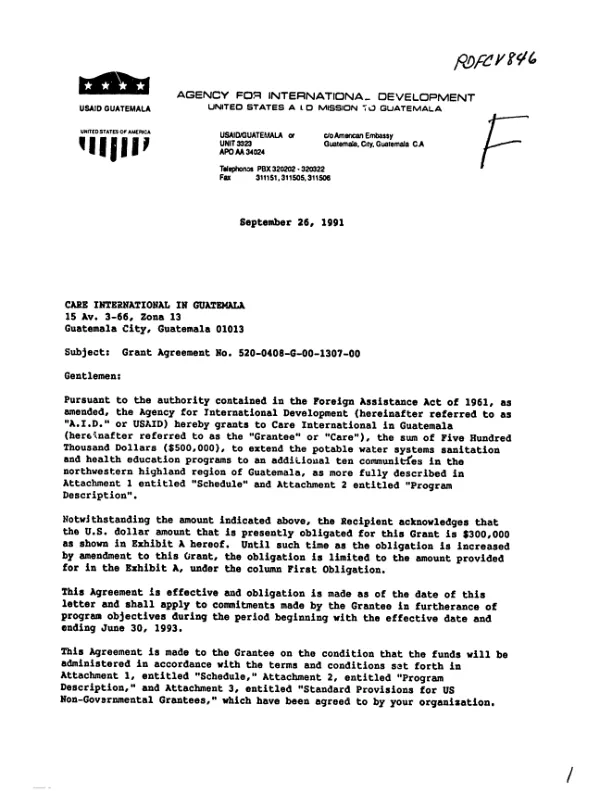
Project activities were executed through local CRS counterparts, including Social Pastorate of the Verapaz; San Pedro Apostol Parish, El Estor; Apostolic Vicariate of Izabal; Caritas of Zacapa/Chiquimula; Social Pastorate of the Ixcan; and Santa Cruz Parish, Chiquimulilla. Specifically, the project: (1) organized and signed formal contracts with community groups; (2) purchased and distributed cooking and hygiene articles to 2,592 families in 64 communities; (3) distributed 13,564 water containers with 1.22 million doses of chlorine; (4) rehabilitated 39 water systems, reaching 3,137 families in 40 communities; (5) disinfected, reinforced, or constructed 175 wells, reaching 615 families in 15 communities; (6) rehabilitated or constructed 2,078 latrines, reaching 2,078 families in 53 communities; and (7) distributed over $35,000 worth of medicines including oral and topical antibiotics, analgesics, oral rehydration therapy, and expectorants to 5 counterparts" clinics. The project also collaborated with Medicos del Mundo to distribute medicines in Ixcan and Panzos. Additionally, two CRS water and sanitation specialists conducted workshops on hygiene and water management in the home to community health promoters; and CRS and counterpart personnel participated in a 3-day course on prevention and mitigation of disasters for water and sanitation projects facilitated by the Guatemalan Association of Sanitary and Environmental Engineering (AGISA). This project was a great opportunity for CRS to provide improved water and sanitation in many communities. Because of funds from the Office of Foreign Disaster Assistance (OFDA), CRS was able to generate more Mitch rehabilitation funding from USAID"s Mitch Recuperation and Disaster Preparedness Program. An outcome of this project was the strengthening of CRS local counterpart organizations in the area of water and sanitation activities. It was important to include health education along with infrastructure repair of water and sanitation systems to more effectively reduce and mitigate health problems in communities caused by unclean water and poor hygiene. Future projects of this kind should try as much as possible to program infrastructure activities in the months when there is no rain. The rainy season in Guatemala, which lasts 6 months, delayed the project and made many activities more difficult. It is important to find out and coordinate with other organizations in the geographic regions where activities are being executed to optimize efforts, reduce duplicity, and achieve higher quality in the work. Technical recommendations are as follows: (1) The use of the dry composting latrine, which separates solid from liquid waste, is a good technical solution and is financially feasible. Latrine construction should always be accompanied by hygiene and sanitary education for the beneficiaries -- including use, maintenance, and advantages. (2) A ventilation pipe should be used in the dry composting latrine as well as the traditional pit-style latrine. The vent can be made of PVC 1-2 inches in diameter. (3) When distributing 5-gallon water containers, it is extremely helpful to provide prepackaged packets of chlorine. In this project, CRS had specially manufactured packets of powdered chlorine (calcium hypochloride) pre-measured to use with 5 gallons of untreated water. The amount of chlorine per packet maintained a chlorine residual of between 0.4 and 0.8 mg/liter and facilitated the application and educational process to the beneficiaries. (4) The use of pipe filtration systems as part of the water catchment in ground water sources such as rivers considerably improved water quality. (These systems use PVC pipe with filtration holes to allow only water to enter.) (5) Rainwater catchment systems (with gutters channeling rainwater runoff from the roof) proved an excellent water source system in communities where wells and water systems were not feasible, e.g., communities located on beaches of the Caribbean Sea. These systems are economically feasible, relatively inexpensive at approximately $20-$35 per system, and are a good alternative solution.
Related documents
![Technical assistance [evaluation] report : village level water and sanitation (VLWS) project](https://covers.devme.ai/gen/22495.webp)