CATHOLIC RELIEF SERVICES ORGANIZATION
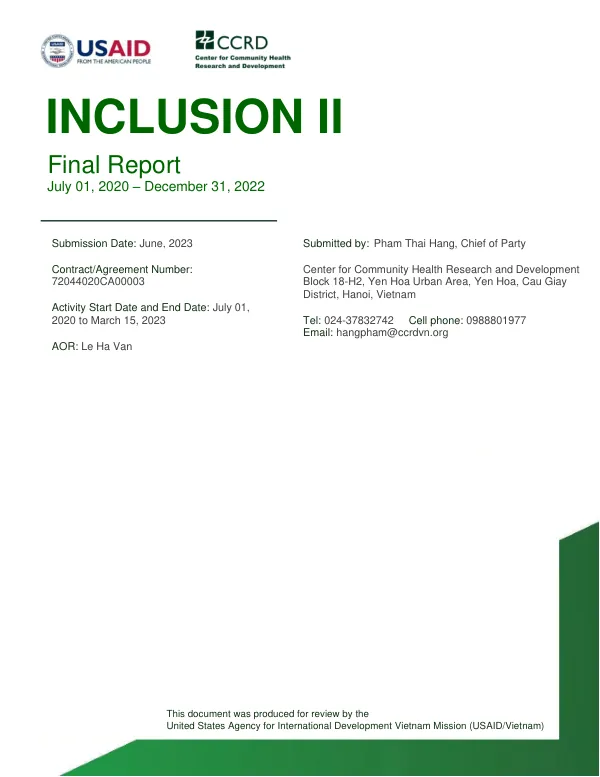
Final Report: Inclusion II Project
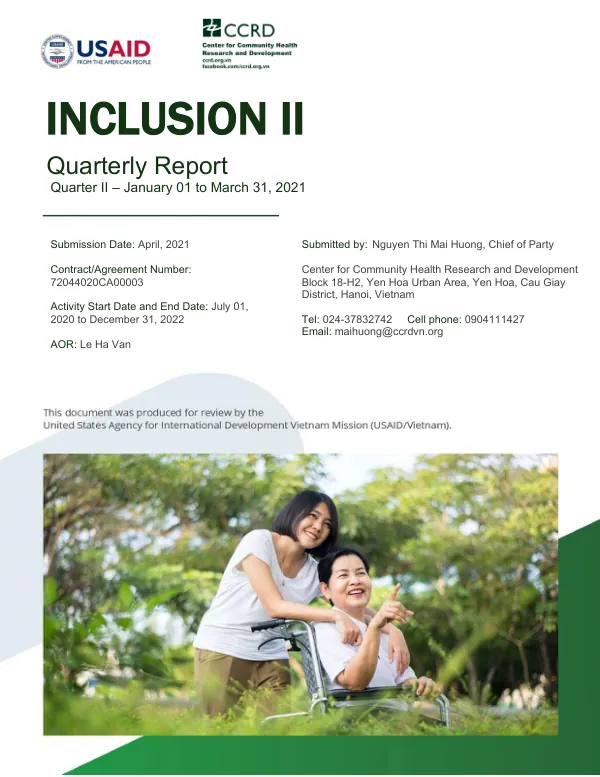
The Inclusion II project aimed to improve the quality of life of persons with disabilities, particularly Agent Orange victims, in Kon Tum and Binh Dinh provinces.
2023 · 68 pages
Sign in to readA free account is required to download.
Abstract
The project was implemented by the Center for Community Health Research and Development (CCRD) from July 2020 to March 2023, with funding from the U.S. Agency for International Development (USAID). The project focused on three main objectives: expanding rehabilitation services, expanding social services, and improving disability policy. To achieve these objectives, the project implemented various interventions, including strengthening rehabilitation facilities and systems, developing rehabilitation human resources, improving quality of rehabilitation service delivery, providing social support and social inclusion services, and enhancing participation of persons with disabilities in social and programming activities. The project also aimed to develop an enabling social and policy environment for persons with disabilities. CCRD contracted with several sub-awardees to implement the project, including Hanh Tam Medical One Member Company Limited, The International Center, Medical Committee Netherlands – Vietnam, Action to the Community Development Institute, and TAJ Vietnam Joint Stock Company. These sub-awardees were responsible for implementing specific objectives and interventions, such as strengthening rehabilitation services, developing multidisciplinary rehabilitation facilities, and improving disability policy. Despite the time constraint, the project achieved significant results, including expanding rehabilitation services, improving quality of rehabilitation service delivery, and enhancing participation of persons with disabilities in social and programming activities. The project also strengthened the capacity of provincial key stakeholders, including the Department of Health, Department of Labor, Invalid and Social Affair, and Organizations of Persons with Disabilities. The project's achievements were notable, particularly in terms of quality of services. For example, 97.2% of beneficiaries reported improvement in performing Activities of Daily Living, and 95.3% of persons with disabilities reported improved care outcomes. The project also trained 207 health workers in physical therapy, occupational therapy, speech therapy, and assistive technology to increase human resources for rehabilitation in the provinces. The project's success was also attributed to the participation and support of provincial government at all levels, including the Department of Health, Department of Labor, Invalid and Social Affair, and district and commune staff. Co-implementation between projects and provinces created opportunities for capacity building and transfer of knowledge and skills to provincial staff, thus improving their ownership and ensuring sustainability. The project's achievements were highly appreciated by provincial authorities, and the project's results were considered a significant contribution to the overall Inclusion Program. The project's success demonstrated the importance of collaboration and coordination between stakeholders to achieve meaningful outcomes for persons with disabilities.
Related documents
Documents in this collection
 2021
2021USAID DEC
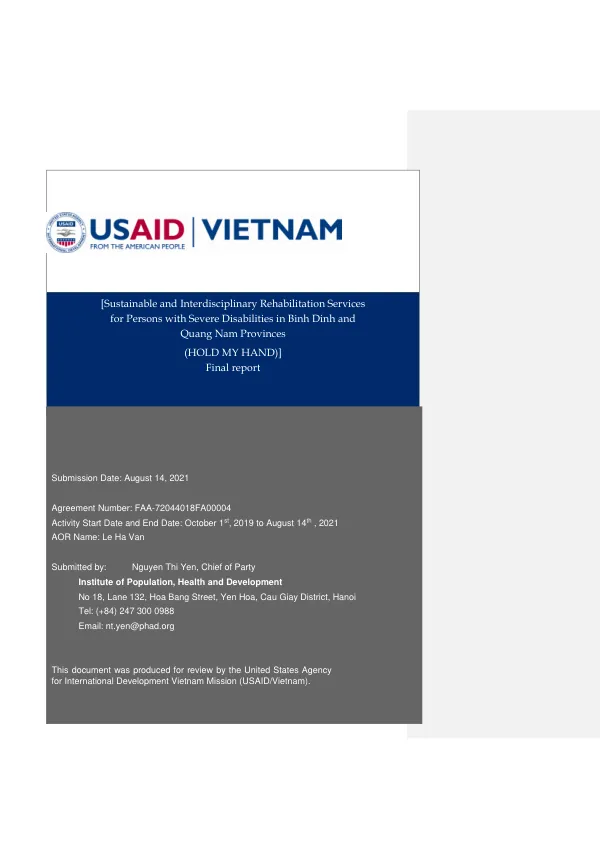
Sustainable and Interdisciplinary Rehabilitation Services for Persons with Severe Disabilities in Binh Dinh and Quang Nam Provinces (HOLD MY HAND)
Open record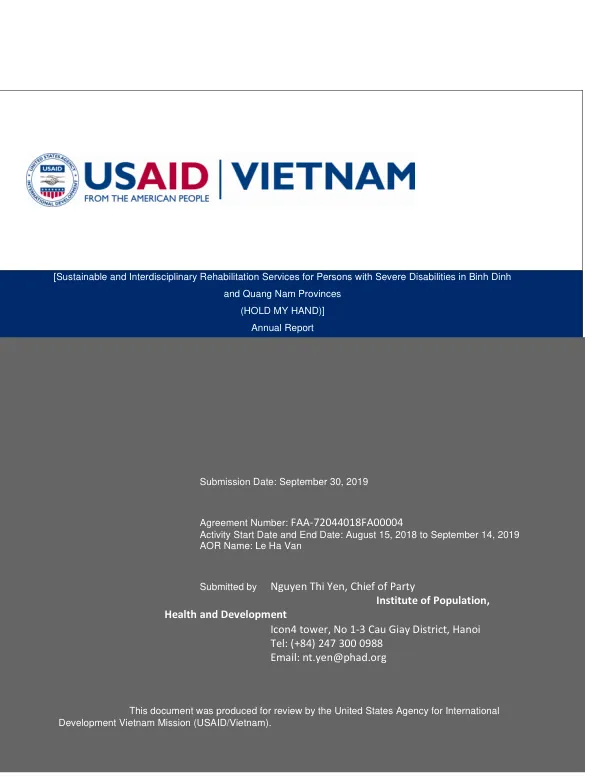 2021
2021USAID DEC