CHECCHI AND CO. CONSULTING, INC. (CCCI)
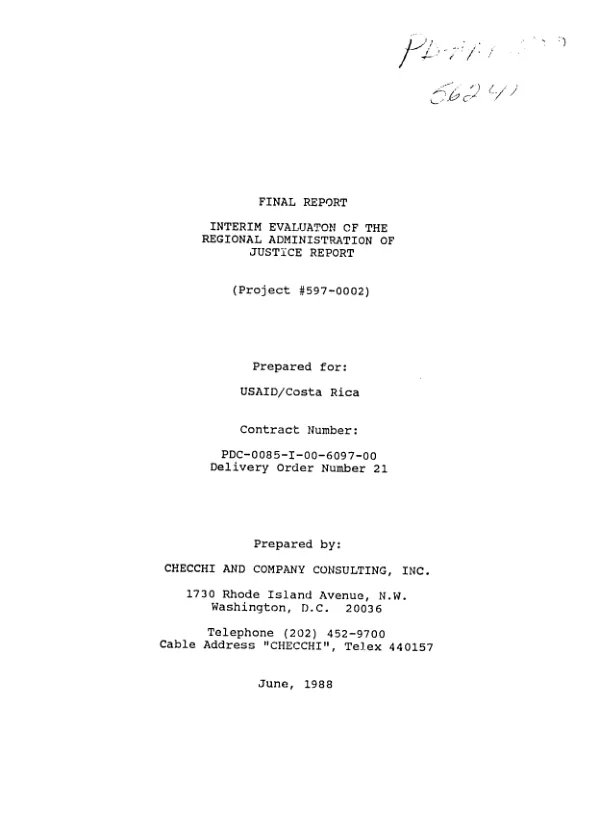
Final report : interim evaluation of the regional administration of justice report
Evaluates project to improve the administration of justice in Latin America and the Caribbean.
1988
Sign in to readA free account is required to download.
Abstract
First interim evaluation covers 3/85-4/88 and is based largely on interviews. This complex and ambitious project is operating in all target countries and has made significant progress. The Latin American Institute for the Prevention of Crime and Treatment of the Offender (ILANUD), the implementing agency, has doubled its staff and taken important steps to improve its ability to handle A.I.D. funds and meet its project responsibilities. National criminal justice commissions have been established in all core countries except El Salvador. All but one of the core countries and three of the South American countries have undertaken or are planning bilateral programs to improve their criminal justice systems. By the end of 1988, ILANUD will have exceeded training and substantially fulfilled TA targets and supplied all core countries with basic criminal justice libraries. By mid-1988, six country judicial sector assessments will have been completed and national workshops held to discuss them. Shortfalls and problems are not lacking, however. ILANUD"s major TA program is behind schedule and its provision of TA in response to national requests lacks focus and clear impact. The national commissions need much more assistance than anticipated. Sector assessments have not been used to prepare strategies and programs. ILANUD"s training program lacks a follow-up mechanism and an evaluation system, does not focus on national problems to the extent desirable, and is not coordinated with related efforts (e.g., the Harvard Law School Project in Guatemala). Also, Mission bilateral programs have not relied on the project to the extent expected, partly because there is no system of coordination among participating entities and partly because of the overwhelming responsibility placed on the Regional Administration of Justice Office by both the project design and the circumstances of implementation. The main challenge now is further strengthening of ILANUD, especially in management areas - policy, planning, evaluation, role definition, setting of staff responsibilities, and forging of client relationships. Assistance in these areas needs to be increased. The magnitude and nature of this assistance will depend on whether the project is expanded to include South America in all activities and whether A.I.D. includes ILANUD in bilateral programs. It is likely that by the PACD the project, while achieving its minimum objectives, will have little significant impact on the actual operations of judicial systems or on public perception of the fairness of these systems. Moreover, ILANUD will probably be unable to sustain its current activity level unaided. Reasons to continue support to ILANUD and other regional institutions conclude the report.