SAVE THE CHILDREN FUND
Final Report: Mureke Dusome
Mureke Dusome, a cooperative agreement between Save the Children and the United States Agency for International Development, aimed to foster partnerships between schools and communities to improve children's literacy outcomes in Rwanda.
2021 · 77 pages
Sign in to readA free account is required to download.
Abstract
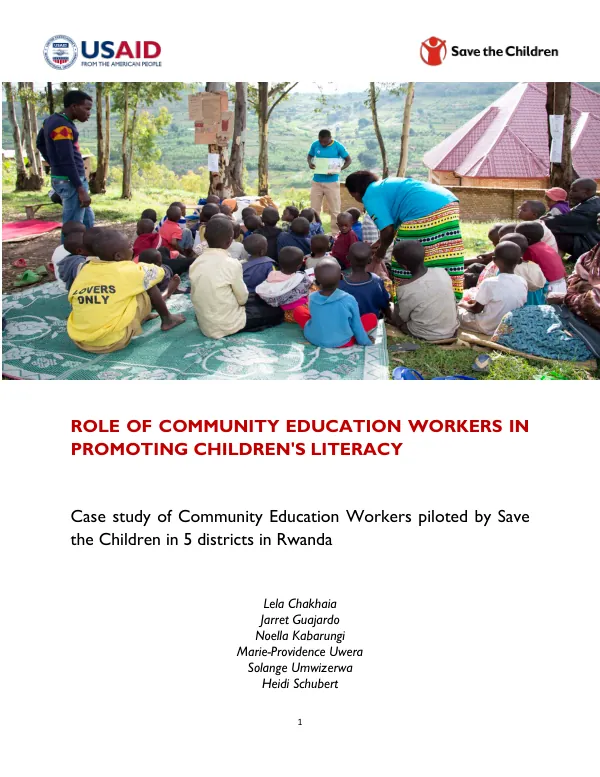
The project was implemented from January 2016 to July 2021. The project addressed gaps in the education sector, including a lack of guidance from the Ministry of Education and the Rwanda Education Board on how schools should work with parents and communities to support children's reading and learning. Baseline results showed that only 6% of surveyed children reported having places in the community where they could go to read or borrow Kinyarwanda storybooks, and only 59% of surveyed parents/caregivers reported supporting children's literacy learning at home. To address these gaps, Mureke Dusome collaborated with the Rwanda Education Board and other partners to develop the National Parent School Partnership Standards and accompanying self-study modules for Head Teachers and School General Assembly Committee leaders. The project supported District Education Officers and Sector Education Officers to guide local-level school leaders in the learning and implementation of key concepts from the modules. Through a phased approach, over 2,476 Head Teachers and 4,835 School General Assembly Committee leaders in every government-supported school-community in all 30 districts of Rwanda were supported to complete the six self-study modules. In the last years of the project, peer learning circles were embedded into the Sector Level Education Council meetings to ensure that school leaders learned from and inspired each other to more fully adopt the home-school strengthening practices and find home-grown solutions to challenges. Mureke Dusome also collaborated with the Ministry of Education and other education partners to iteratively develop and collaboratively revise a National Literacy Policy, which emphasizes the need for lifelong learning and support for literacy across schools, homes, and communities. The policy presents a multi-ministerial approach to ensuring all Rwandans learn to read. The project mobilized communities to recruit local volunteer Literacy Champions, who were trained to conduct community literacy activities for children, such as weekly reading clubs, Umuganda Literacy, lending books to children, supporting reading festivals/competitions, and spreading literacy messaging with parents at local meetings. Over 5,100 Literacy Champions were trained, and more than 75% continued to demonstrate commitment to lead literacy activities in the community by the end of the project. Umuhuza, a local partner of Mureke Dusome, also collaborated with the National Itorero Commission to engage youth volunteers in supporting Literacy Champions and parents' engagement of children in reading. The project reached over 290,000 children in FY2019 alone, before COVID-related lockdown measures reduced the numbers of children who could meet together in group activities. Over the life of the project, 899,172 children participated in community literacy activities. Starting in 2020, Mureke Dusome collaborated with the Ministry of Education and the Rwanda Education Board to pilot an adaptation of the Literacy Champion model, a Community Education Worker model, in 5 model districts. The CEW model expanded the role of Literacy Champions to include school drop-out prevention, supporting children with disabilities, and other learning issues prioritized by education leaders.
Related documents