GEORGIA INSTITUTE OF TECHNOLOGY. SCHOOL OF INDUSTRIAL AND SYSTEMS ENGINEERING. ENGINEERING EXPERIMENT STATION. OFC. OF INTERNATIONAL PROGRAMS
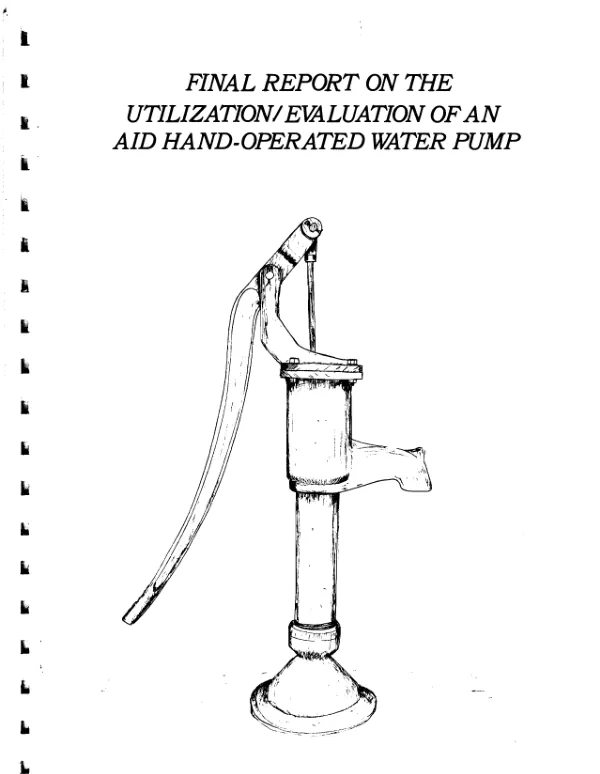
Final report on the utilization/evaluation of an AID hand - operated water pump
The Georgia Institute of Technology, in collaboration with the Central American Research Institute for Industry (ICAITI) performed a final evalution of the AID-developed hand-operated water pump.
Potts, Phillip W.|Moh, Kermit C. · 1978
Sign in to readA free account is required to download.
Abstract
This paper summarizes their findings on the performance and acceptability of the AID product and other comparable pumps (Dempster, "Marumby," Japanese "Lucky" pump, and a Canadian pump), based on 61 field tests in Costa Rica and Nicaragua. Field test data, cost comparisons, observations, conclusions, and recommendations are included. Various design and manufacture problems were found with the AID pump during field tests in both countries. Casting and component defects, breakage, and excessive friction complicated the pump's field performance. Despite these problems, results indicate that the AID pump can be manufactured with a high degree of quality at cost competitive prices, given adequate quality control and manufacturing facilities (foundries, pattern makers, machine shops, skilled machinists, raw materials). Rural village acceptance of the pump has been good at test sites. General observations stemming from the evaluation include: (1) Proper local governmental infrastructure must exist for an effective rural water system program. (2) Careful pump testing must be done before expansion to large scale operational programs. (3) The advantages and benefits of a local pump manufacturing capability should not be underestimated, in light of its contribution to employment generation, transportation savings, design flexibility, lower purchasing costs, and reduced foreign exchange requirements. Engineering designs for both shallow and deep well varieties of the AID pump, and for component parts of the pump, are included.