MANAGEMENT SYSTEMS INTERNATIONAL, INC. (MSI)
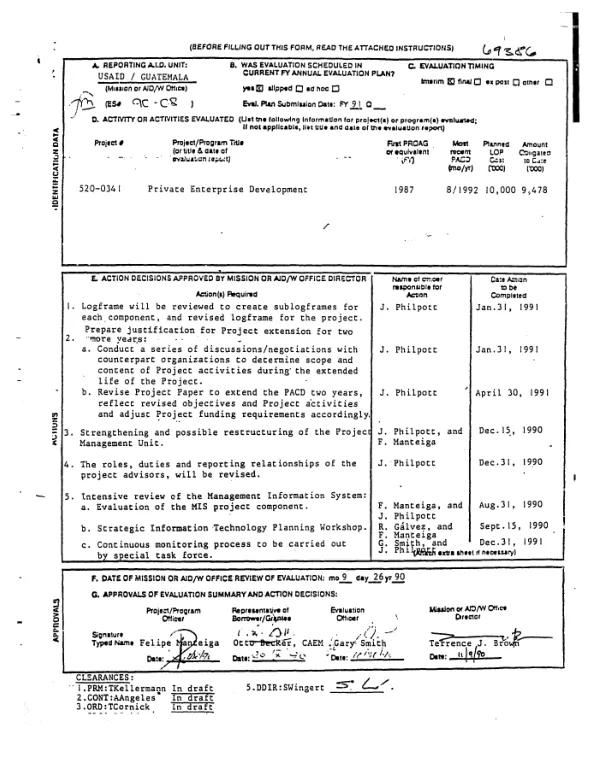
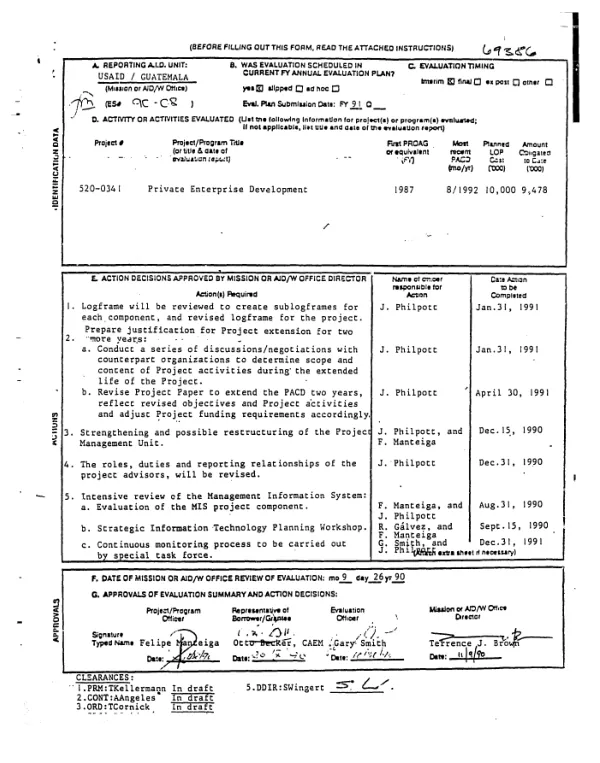
Final report : PED project evaluation -- USAID/Guatemala
External mid-term (FY87-4/90) evaluation of a project to support private enterprise development in Guatemala.
1989
Sign in to readA free account is required to download.
Abstract
Though behind schedule and chaotically managed, the project has strengthened USAID/G's policy leverage and it has promoted the institutional development of participating Guatemalan agencies. Moreover, three of its four components have been quite successful to date. (1) The Guatemalan Management Association (AGG) has organized a center to provide training and TA to the small and medium enterprise (SME) sector. To date, training has been provided to 1,760 persons. However, since few trainees avail themselves of TA offered by the center, only 46 have received the complete training/TA package, against a target of 1,000. (2) The export development component is making good progress. The Nontraditional Product Exporters Guild (Gremial) has produced manuals on 18 nontraditional agricultural exports, helped improve export performance by a number of firms, and improved its own income-raising capacity and its targeting of technical support. The Chamber of Entrepreneurs (CAEM) has played a key role in the passage of Free Zone and Maquila legislation and the actual development of free zones, three of which are being constructed or planned with A.I.D. support. CAEM has also established the planned Free Trade Production Facilities (FTPF) Investors Services Center, though aggressive promotion has not yet begun and an FTPF strategy remains to be formulated. The Ministry of Economy (MOE) has established a technical unit in the National Export Promotion Council (CONAPEX) which has proven to be a dynamic forum for debate and action on issues vital to Guatemala's private sector. Plans to establish an Export Promotion Fund (FODEX) in the Central Bank appear stalled, however, at least until after the elections. (3) The MOE is also succeeding in creating a supportive public policy environment for SME's among the Direccion de Politica Industrial and other export-related agencies. (4) The financial markets component is not succeeding, however. The planned loan guaranty fund for SME's has been delayed due to reluctance among bankers to extend loans to SME's. A second activity, to promote financial market research by the Chamber of Finance has made no meaningful progress. The project's approach of supporting but not directing private sector initiatives is well founded. The indirect approach promotes a sense of ownership of project elements on the part of participating institutions, and contributes to sustainability. Nonetheless, the informal operating style of the Project Management Unit (part of CAEM), should not continue. Development of a dedicated managerial staff is a key need. The project timeframe is unrealistic, given the complexity of its activities. Contributing to this problem is the fact that the project is the first major private sector effort for USAID/G. The project is in fact a program and should be renamed and reorganized to reflect this reality. A 2-year extension is also recommended. For lessons learned, see abstract of PD-ABC-152.
![Lessons from experience[, volume I] : the design and implementation of commercial lending projects by AID"s Bureau for Private Enterprise](https://covers.devme.ai/gen/37680.webp)