CHIANG MAI UNIVERSITY. RESEARCH INSTITUTE FOR HEALTH SCIENCES
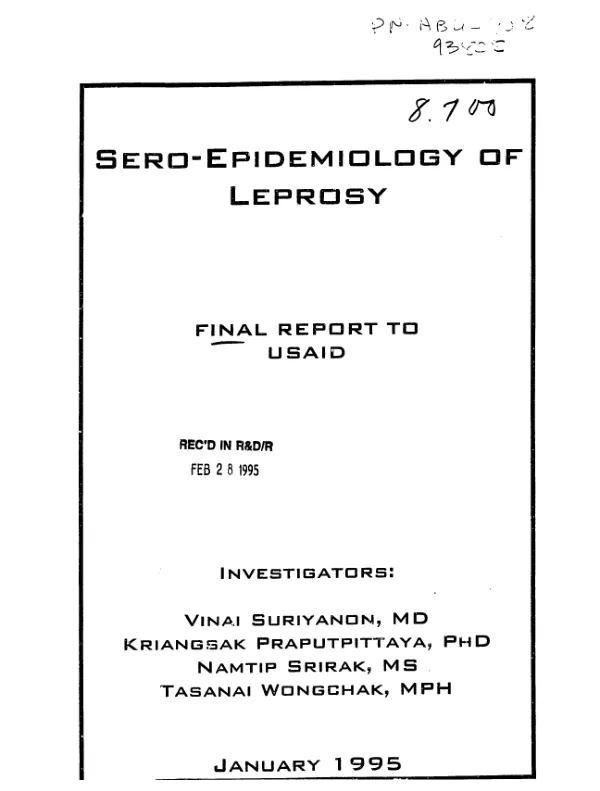
Final report period covered 01/08/88 to 30/06/94 : sero-epidemiology of leprosy
Delay in diagnosis and treatment of leprosy is one of the main reasons why the disease has not been eradicated.
Suriyanon, Vinai; Praputpittaya, Kriangsak · 1995
Sign in to readA free account is required to download.
Abstract
However, recent advances in understanding the biochemical structure of M. leprae and human serological responses to infection have raised the possibility of using serologic methods for early detection of leprosy. This longitudinal study conducted in Thailand from 8/88 to 12/93 of 1,340 household contacts of persons with leprosy evaluates the efficacy of an ELISA test for antibodies to the M. leprae-specific antigen NT-O-BSA. The study found the test to be highly specific (94.4%), although it was not sensitive (36.4%) and had low predictive value (5.1%). Seropositive contacts had a 9.1-fold higher risk of developing the disease than seronegatives. A few contacts were found to be seropositive several months before recognition of the disease. These findings suggest that even though the ELISA test is not sensitive and has low predictive value, it might still be useful, especially where prevalence of leprosy is higher than in Thailand. In endemic areas, the predictive value of the test could be higher than was observed in this study. By testing household contacts of leprosy cases or other risk groups periodically for the antibodies and by close observation of the seropositive persons, leprosy might be detected earlier, and thus treated earlier, which would help to prevent further transmission. The study also found that those who came in contact with multibacillary leprosy cases were at higher risk for the disease than whose who came into contact with paucibacillary patients, and that antibody levels in blood collected on filter paper by fingerstick correlated very well with antibody levels collected by venepuncture; the former method might be used to measure antibody levels of small children. Includes bibliography.
Related documents
Documents in this collection
 1997
1997USAID DEC
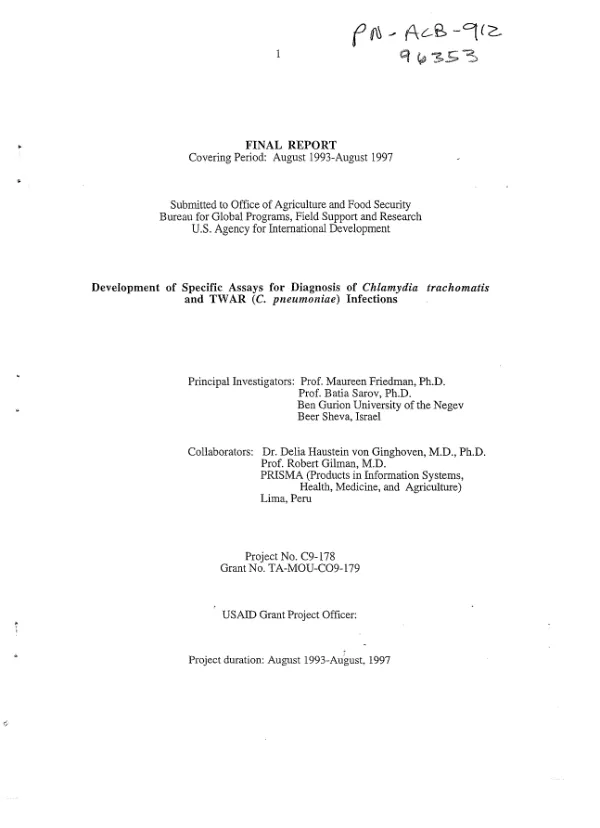
Final report covering period August 1993-August 1997 : development of specific assays for diagnosis of Chlamydia trachomatis and TWAR (C. pneumoniae) infections
Open record 1970
1970USAID DEC