USAID DEC
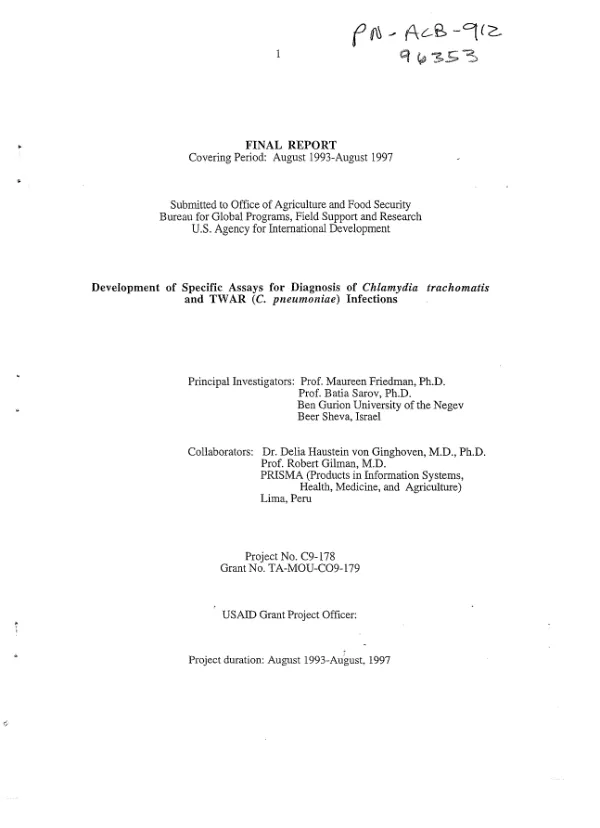
Final report covering period August 1993-August 1997 : development of specific assays for diagnosis of Chlamydia trachomatis and TWAR (C. pneumoniae) infections
Sign inBEN GURION UNIVERSITY OF THE NEGEV
Final report covering period August 1993-August 1997 : development of specific assays for diagnosis of Chlamydia trachomatis and TWAR (C. pneumoniae) infections
The purpose of this project was to develop, through collaboration between Israeli and Peruvian scientists, simple laboratory techniques for the detection and differentiation of infections due to Chlamydia trachomatis and Chlamydia pneumoniae, and to begin to apply these techniques in Lima and surrounding areas.
Friedman, Maureen; Haustein von Ginghoven, Delia · 1997
Sign in to readA free account is required to download.
Abstract
These two chlamydial species are known to be responsible for a variety of pathologies in the United States and in Europe, including sexually transmitted, ocular, and respiratory tract diseases. Two different types of serologic assays capable of differentiating between antibodies to the two organisms were developed, one of which was used by Maritza Calderone (Peru) and Israeli scientists to test some 1,400 sera originating in Israel and in Peru for antibodies to the two organisms. Subsequently, Maritza trained other Peruvian scientists and technicians in the use of the assay, with control sera and antigen brought back from Israel. Many of the serum and clinical specimens used either for the development of the techniques or for prevalence estimation were collected. Advanced techniques were also developed for sensitive detection of the organisms in clinical specimens. Important contributions were made in this field by Dr. Guillermo Madico, visiting the Israeli laboratories, and further refinements were subsequently made in Peru by him and scientists whom he trained. The study found serologic evidence that C. pneumoniae infection is extremely common in the population groups tested, ranging to 80% and even 100% in certain groups. C. trachomatis infection was found to be quite common in certain groups, while rare in others. Although the study did not succeed in bringing the antigen detection system to a very simple format, the system is capable of detecting chlamydia in easily obtainable urine specimens, and there is now no doubt of the necessity for such detection systems. The full collaboration achieved in this project demonstrates the capabilities of the young Peruvian scientists involved and has led to an awareness of the apparently strong contribution of chlamydial infection to morbidity in this developing region. (Author abstract, modified)
Related documents
Documents in this collection
 1995
1995USAID DEC
Final report : cysticercosis -- new opportunities for targeting detection and treatment using ELISA technology
Open record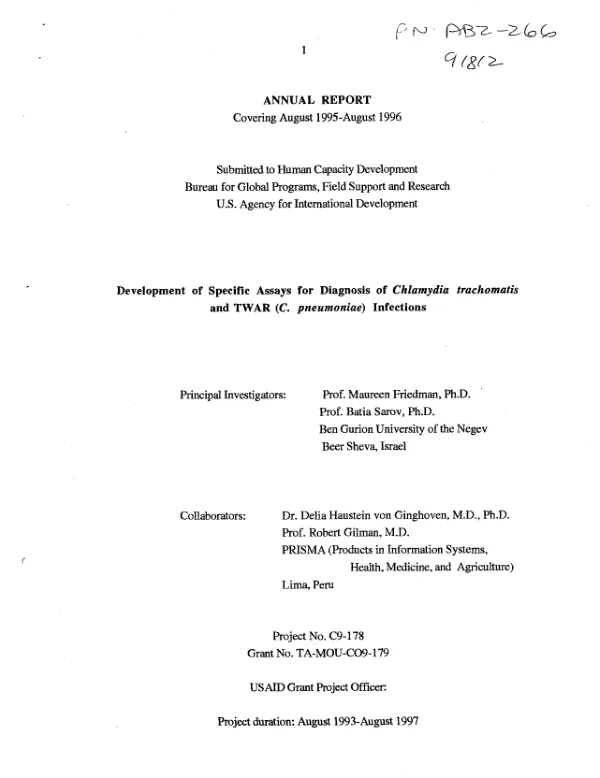 1996
1996USAID DEC