DAI
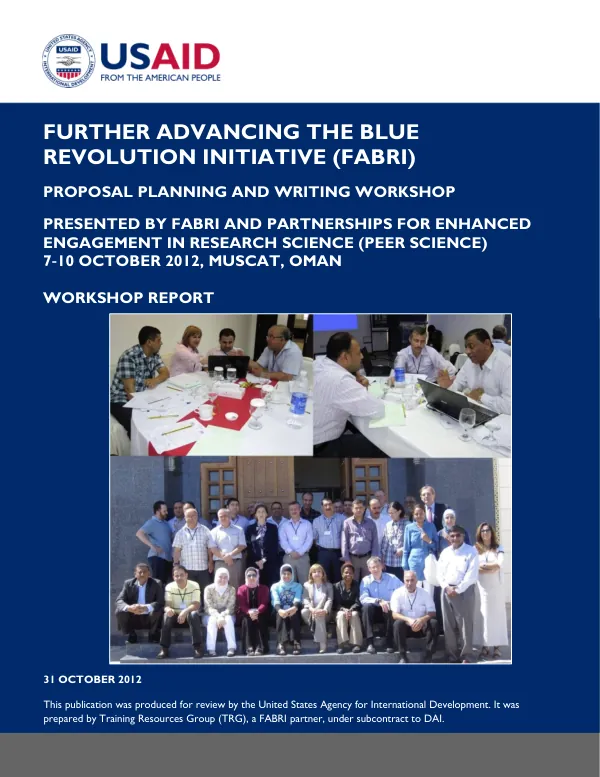
Final Report: Proposal Planning and Writing Workshop
The Proposal Planning and Writing Workshop, co-sponsored by MENA NWC and PEER Science, was convened at MERDC in Oman on October 7-9, 2012.
2012 · 16 pages
Sign in to readA free account is required to download.
Abstract
The workshop included 35 participants from 29 institutions and 12 countries. The training and facilitation team consisted of Ken Ludwa, P.E., Grant Program Manager, FABRI, Dr. Annica Wayman, Program Officer, Office of Science and Technology, USAID, Dr. Jagath Kaluarachchi, Senior Associate Dean, College of Engineering, Utah State University, Lina Sheqem, FABRI Technical Consultant, EcoConsult, Amman, Jordan, and Jawara Lumumba, Senior Organizational Development Consultant, Training Resources Group. The interrelated and reinforcing goals for the workshop were to increase scientists' planning and grant writing skills, particularly in water and environmental research, to help them become more competitive applicants for local and international sources of research funding, especially USAID-sponsored programs, and to facilitate a regional support network among the scientist participating in the workshop. The participants identified potential research topics as part of the pre-workshop preparation, and the fundamental methodology for the workshop was a combination of interactive plenary sessions and participatory small working groups to facilitate the real-life application of insights to initial work in developing a PEER Science or FABRI proposal. On Day One, the workshop began with an introduction to PEER Science and FABRI, followed by an identification of regional challenges, brainstorming, and assessing potential solutions. Dr. Jagath Kaluarachchi provided insightful and practical observations on planning and writing competitive proposals, while Dr. Annica Wayman and Mr. Ken Ludwa provided instructive overviews of PEER Sciences and FABRI. The participants were engaged in identifying priority regional challenges and potential responsive solutions, focusing on one of four thematic areas: Water Use Efficiency and Productivity, Groundwater, Non-Conventional Water, and Food/Energy/Water Nexus. The participants brainstormed to identify regional problems and gaps within each thematic area, selected a problem, and brainstormed research ideas to generate solutions. For the selected solution, the participants had an analytical discussion of trade-offs (pros/cons) and relevant factors that need to be considered and understood in order to achieve the selected solution. The outputs from the small group discussions included suggested solutions such as trans-boundary water cooperation, desalination, use of brackish water, wastewater re-use, and water quality analysis and planning. On Day Two, the participants applied the guidance on Problem Formulation and Research Objectives (Module I) and Research Methodology (Module II) to their respective research proposals. The participants were divided into two subgroups based on the intention to submit either a PEER Science or FABRI proposal, and were facilitated and mentored by two members of the training team. Applying the guidance, the participants did initial work on their research proposals, shared their draft products within small peer groups for feedback, and presented and critiqued select drafts within the larger FABRI or PEER subgroups. On Day Three, Dr. Kaluarachchi led an interactive discussion of practical strategies for successful Program Management, and the participants applied the insights to their respective research proposals. The participants were given an opportunity to review their total draft proposal for further refinements, and two participants presented their refined drafts for plenary review and feedback critique. The participants and the Training Team were asked to determine whether the proposal sufficiently addressed a regional water problem and considered relevant factors, and whether there were any ways that the proposal could be strengthened in its impact on the regional water issues. On Day Four, the workshop culminated with a plenary discussion of outstanding questions and issues, documentation of lessons learnt to be used in developing final proposal submissions, and completion of program evaluation. The participants documented key take away messages and further support needs, and the workshop was concluded with a sense of accomplishment and a renewed commitment to advancing the Blue Revolution Initiative.
Related documents