USAID DEC
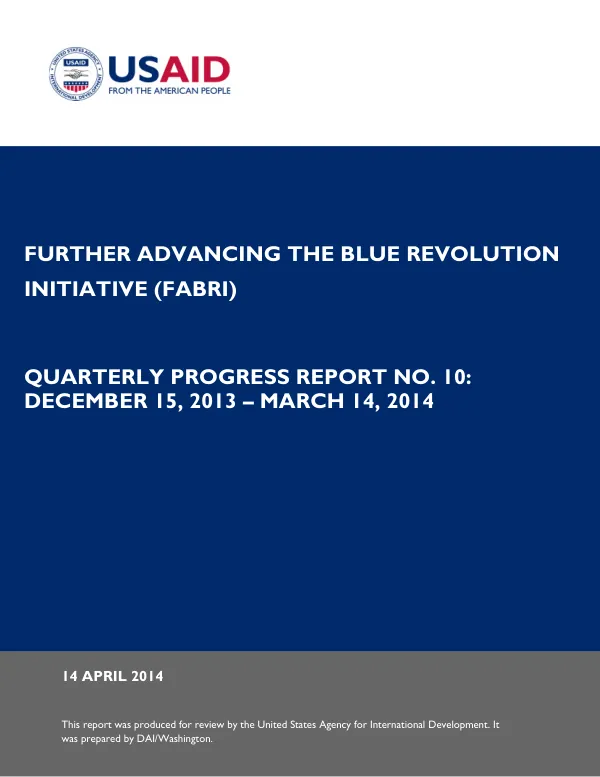
Further Advancing the Blue Revolution Initiative (FABRI) Quarterly Progress Report No. 10
Sign inCALIFORNIA INSTITUTE OF TECHNOLOGY
Further Advancing the Blue Revolution Initiative (FABRI) Quarterly Progress Report No. 10
The Middle East and North Africa Network of Centers of Excellence was established and operating as of the tenth Quarterly Progress Report.
2014 · 86 pages
Sign in to readA free account is required to download.
Abstract
The Policy, Research, and Development (PR&D) Grants Program awarded grants for ten collaborative projects, totaling over $3 million. Research teams completed grant negotiations, held project start-up meetings, and commenced research activities. Two U.S.-Network Research Partnerships held start-up meetings: Combatting the Emerging Impacts of Harmful Algal Blooms on Desalination Plants and Radar Probing of Groundwater in Hyper-Arid Environments. The Young Water Scientist Partnership (YWSP) Small Grants Program and Water Innovation Fellowships (WIF) Program continued to receive proposals, with FABRI extending the proposal deadlines to July 31, 2014. FABRI also started planning for a joint Assembly of Governing Members and Thematic Partnerships Conference to be held in Marrakech, Morocco on June 22-25, 2014. Integrated Water Resources Management (IWRM) programming was strengthened through the research team for the IWRM project, Mitigating Environmental Risks of Wastewater Reuse for Agriculture, which completed grant negotiations and held a project start-up meeting. The African Water Association (AfWA) convened its annual AfWA Congress event, for which FABRI designed and led a panel on non-revenue water and gave a Small Grants Program workshop targeted to African Young Water Professionals (AfYWP). FABRI released a Request for Proposals (RFP) for the design of an AfWA website, which will provide technical resources to its members. FABRI also began preparing for the 5th Africa Water Week (AWW) to be held in Dakar, Senegal in May. Research and development capacities in irrigation, groundwater management, and drought risk assessment and mitigation were strengthened through various projects and partnerships. Transboundary water cooperation was strengthened in key river basins through FABRI's efforts. The technical and outreach capacity of USAID staff in water and sanitation programming was enhanced through training and capacity-building activities. Project management updates and major issues faced by FABRI were also addressed in the report. The Middle East Desalination Research Center outside Boston, MA, and the California Institute of Technology in association with the Jet Propulsion Laboratory in Muscat, Oman, led two U.S.-Network Research Partnerships. The research teams completed grant negotiations, held project start-up meetings, and commenced research activities. The research focused on combatting the emerging impacts of harmful algal blooms on desalination plants and radar probing of groundwater in hyper-arid environments. FABRI's efforts in strengthening integrated water resources management programming included the research team for the IWRM project, Mitigating Environmental Risks of Wastewater Reuse for Agriculture. The team completed grant negotiations and held a project start-up meeting. The project aimed to mitigate environmental risks associated with wastewater reuse for agriculture. FABRI's activities in improving access to clean water and sanitation in target countries included convening the African Water Association (AfWA) Congress event and designing and leading a panel on non-revenue water. FABRI also gave a Small Grants Program workshop targeted to African Young Water Professionals (AfYWP). The organization released a Request for Proposals (RFP) for the design of an AfWA website, which will provide technical resources to its members. FABRI's research and development capacities in irrigation, groundwater management, and drought risk assessment and mitigation were strengthened through various projects and partnerships. The organization's efforts in transboundary water cooperation were also highlighted, with a focus on strengthening cooperation in key river basins.
Related documents