USAID DEC
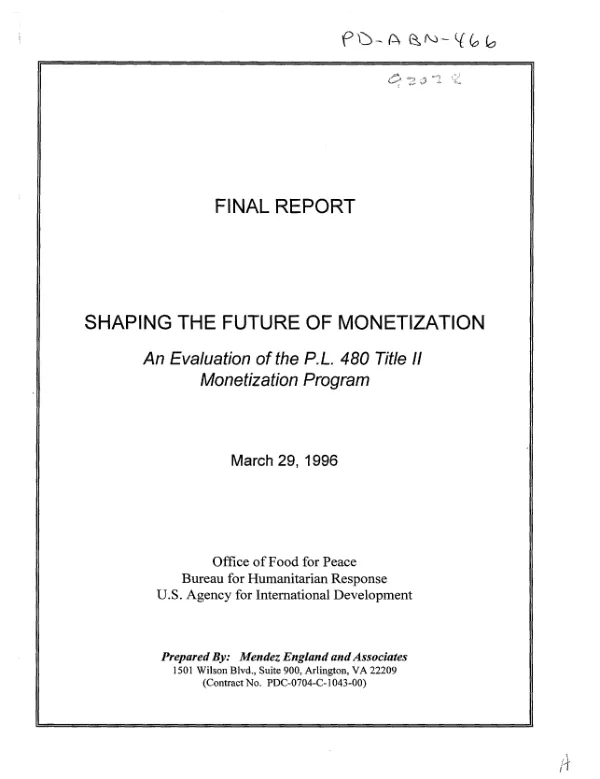
Final report : shaping the future of monetization -- an evaluation of the PL 480 Title II monetization program
Sign inMENDEZ ENGLAND AND ASSOCIATES
Final report : shaping the future of monetization -- an evaluation of the PL 480 Title II monetization program
Evaluates the P.L.
Royston, Sheila|Scanlon, Tom · 1996
Sign in to readA free account is required to download.
Abstract
480 Title II Monetization Program, in which U.S. agricultural commodities are sold in developing countries by PVOS and other cooperating sponsors (CSs) to generate local currency for use in USAID-sponsored development and emergency food aid activities. Evaluation covers the period 1986-95. Since 1986, there has been a dramatic growth in Title II monetization. In 1987, $21 million in monetized commodities supported 21 projects in 19 countries; by 1994, the program was valued at over $80 million and supported 43 projects in 24 countries. Africa has received the bulk of this support and its share is likely to increase. The Asia and Near East region has also seen increases in monetization, primarily due to the growth of monetization in Bangladesh. The use of monetization in the Latin America and Caribbean region, as well as food aid in general, has declined steadily due to food security improvements. Although the use of proceeds has evolved and expanded beyond the logistical costs of food distribution, the funds still primarily support food distribution and related development activities. The use of monetization proceeds for emergencies has been limited due to the difficulties of conducting commodity sales in an emergency environment, and to the fact that funds for the logistical costs of food delivery and distribution are often available from other sources. Recently, USAID has paid heightened attention to the impact of food aid on food security. A February, 1995 Food Aid and Food Security Policy Paper notes that food aid in general and monetization proceeds in particular should be integrated with other USAID assistance resources to support the program priorities of increased agricultural productivity and improved household nutrition. In the field, many developments have improved the effectiveness and efficiency of monetization. For example, umbrella monetizations, in which one CS monetizes on behalf of all CSs in the country, have proven effective and efficient in several countries. More careful commodity selection, with consideration of local market preferences, has improved cost recovery. Improved financial management has helped to maintain the value of the proceeds generated. Yet numerous challenges continue to confront CSs, which view monetization as an important financial resource. These include the decline in the availability of P.L. 480 commodities compared to rising needs; the increased pressure on USAID and the CSs to demonstrate concrete progress toward food security goals; and the continuing debate over whether the distribution of food or the monetization of the commodities for use in projects serving needy populations is the most effective use of the food aid resources. The fact is that USAID monetization policy has evolved as a programmatic response to issues encountered since the start of the program. A new and more definitive set of policies and guidelines is now required so that monetization can contribute more directly to food security objectives. (Author abstract, modified)