USAID DEC
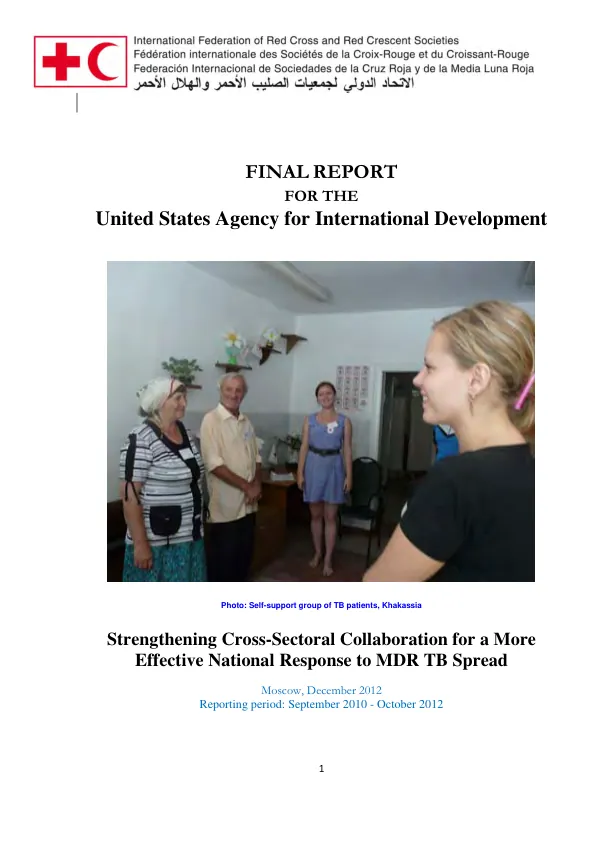
Final Report: Strengthening Cross-Sectoral Collaboration for a More Effective National Response to MDR TB Spread
Sign inINTERNATIONAL FEDERATION OF THE RED CROSS AND THE RED CRESCENT SOCIETIES
Final Report: Strengthening Cross-Sectoral Collaboration for a More Effective National Response to MDR TB Spread
In the Russian Federation, the TB situation remains alarming despite efforts by the Russian Government and international TB community.
2012 · 66 pages
Sign in to readA free account is required to download.
Abstract
TB-related epidemiological data show a decrease in the number of TB cases in 2009, but an alarming 21.2% increase in MDR TB was experienced during the same period, with an increase from 3.3 to 4.0 per 100,000 people. This reflects the still modest achievements of the Russian TB service in most regions of the Russian Federation. The official data provided by the Central Scientific Research Institute of Information and WHO demonstrates the dynamics of a reduced TB morbidity and mortality that can be considered as a positive indicator of the overall TB control situation. However, the situation with MDR TB is still alarming. According to statistical data, in 2011 the TB morbidity rate in Russia was 73 per 100,000, and mortality – 14 per 100,000. The number of MDR TB patients accrues and in 2011 made about 40,000 people. The IFRC closely collaborated with the Russian Health Care Foundation (RHCF), as a Principal Recipient (PR) of Global Fund grants in the Russian Federation, continued an implementation of Grant for Tuberculosis Round 4 aimed to assist the country to meet its main goals in reducing mortality and morbidity from TB in 26 regions of Russia that finished in November 2010. Unfortunately, in 2010, the Ministry of Health and Social Development of the Russian Federation (MoHSD) as a member of the Country Coordination Mechanism (CCM) in its letter to the Head of Country Coordination Mechanism (CCM) of Global Fund (GFATM) expressed its official opinion regarding to the participation of the Russian Federation in the Application to the Global Fund as a recipient, where it refused receipt of funds for Round 10 of the GF for tuberculosis prevention in Russia. The Program "Strengthening Cross-Sectoral Collaboration for a More Effective National Response to MDR TB Spread" was implemented in 11 regions of the Russian Federation, including Adygeya, Buryatia and Khakassia Republics, Khabarovsk Kray, and Belgorod, Kaluga, Kostroma, Nizhni Novgorod, Jewish Autonomous, Pskov, and Vologda Oblasts. The program aimed to strengthen cross-sectoral collaboration with Russian national and regional authorities, civilian and penitentiary health services to provide more effective and sustainable national response to MDR TB spread, based on internationally recognized approaches integrated to the Russian national normative base. The program was implemented from September 2010 to October 2012, but upon decision of the Russian Government, the USAID–Russia Office terminated all types of its activities from 1st October 2012 with a closure of the programs until 31st December 2012. The final report covers the period September 2010-December 2012.