PAN AMERICAN WORLD HEALTH ORGANIZATION
Promoting the Quality of Medicines
The Promoting the Quality of Medicines (PQM) initiative was established in 2009 by the United States Pharmacopeial Convention (USP) in collaboration with the U.S.
2012 · 2 pages
Sign in to readA free account is required to download.
Abstract
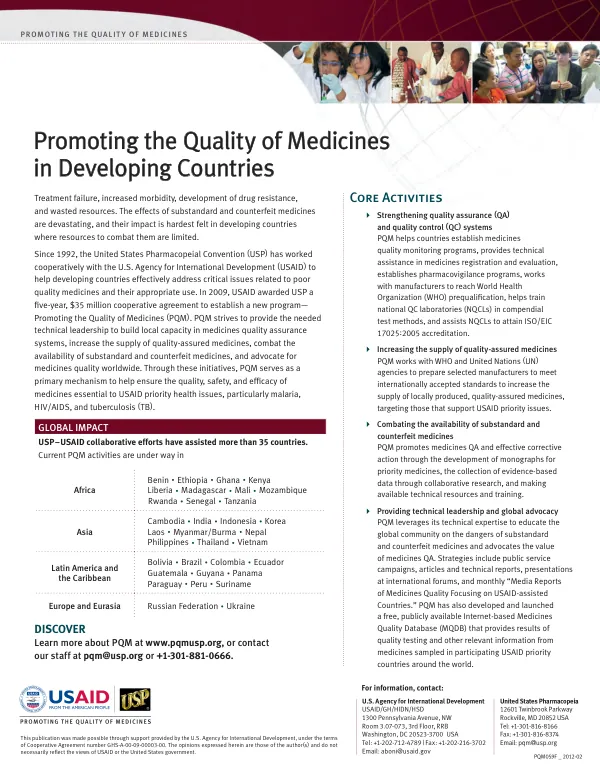
Agency for International Development (USAID). The program aims to provide technical leadership to build local capacity in medicines quality assurance systems, increase the supply of quality-assured medicines, combat the availability of substandard and counterfeit medicines, and advocate for medicines quality worldwide. PQM focuses on four core activities: strengthening quality assurance and quality control systems, increasing the supply of quality-assured medicines, combating the availability of substandard and counterfeit medicines, and providing technical leadership and global advocacy. The program works with countries to establish medicines quality monitoring programs, provides technical assistance in medicines registration and evaluation, and helps train national quality control laboratories in compendial test methods. PQM has assisted more than 35 countries in promoting medicines quality, with current activities underway in over 20 countries. The program has achieved significant successes, including the attainment of ISO/IEC 17025:2005 accreditation by the Ethiopia Product Quality Assessment Directorate and the Mali Centre National de Pharmacovigilance. PQM has also supported the development of a laboratory safety and chemical waste disposal training module for the region and has leveraged financing from the Global Fund for AIDS, TB, and Malaria to support medicines quality monitoring sites in the Greater Mekong Subregion. In Africa, PQM has worked with countries to establish medicines quality monitoring programs, provide technical assistance in medicines registration and evaluation, and help train national quality control laboratories in compendial test methods. In Asia, PQM has informed Chinese manufacturers of second-line anti-tuberculosis medicines on how the program can help them meet requirements of the WHO Prequalification Programme. In Latin America and the Caribbean, PQM has provided technical assistance to official medicine control laboratories, resulting in the prequalification of labs in Bolivia and Peru and the achievement of ISO/IEC 17025:2005 accreditation by the Peru OMCL. PQM has also conducted outreach workshops and training programs for manufacturers and regulatory authorities in various regions. For example, PQM conducted a three-day Outreach Workshop in Moscow for Russian manufacturers of second-line anti-tuberculosis medicines, providing information on the WHO Prequalification Programme for medicines. The program has also hosted delegations from regulatory authorities and provided training on laboratory safety and chemical waste disposal. The effects of substandard and counterfeit medicines are devastating, and their impact is hardest felt in developing countries where resources to combat them are limited. PQM's efforts aim to address these challenges and ensure the quality, safety, and efficacy of medicines essential to USAID priority health issues, particularly malaria, HIV/AIDS, and tuberculosis (TB). Through its initiatives, PQM serves as a primary mechanism to help ensure the quality, safety, and efficacy of medicines in developing countries.
Related documents