USAID DEC
Final report summary, Population Communication Services, Johns Hopkins University project LA-COS-01 : alternative educational radio for Costa Rican women
Sign inJOHNS HOPKINS UNIVERSITY. CENTER FOR COMMUNICATION PROGRAMS. POPULATION INFORMATION PROGRAM
Final report summary, Population Communication Services, Johns Hopkins University project LA-COS-01 : alternative educational radio for Costa Rican women
Summarizes final report (PD-AAU-875) of the contractor, Johns Hopkins University (JHU), on a 1/83-3/85 project to help Costa Rica"s Centro de Orientacion Familiar (COF) improve Dialogo, a daily radio program aimed at providing development-related information to low-income women.
1970
Sign in to readA free account is required to download.
Abstract
With JHU"s help, COF enhanced the quality, quantity, and national recognition of Dialogo programs and laid a solid institutional base for the future. New emphasis was placed on themes - family planning and women in development - appropriate to the target audience of 300,000 rural and urban women and consistent with the government"s development strategy. The success of this remarkably problem-free project is indicated by: (1) the selection of Dialogo as the first recipient of a government-sponsored prize in the field; (2) transmission through five regional stations of more than twice as many Dialogo programs as had been aired during a comparable, pre-project period; (3) an increase of over 50% in letters received from listeners despite a doubling of postal rates; (4) publication of 114 letters in the press on issues raised by Dialogo; (5) publication and distribution of 5,000 copies each of booklets on the condom, female sexuality, natural family planning, and the sharing of family household tasks; (6) improved production values through voice training for announcers, equipment repair and replacement, and improved engineering techniques; (7) improvement in format, style, content, and responsiveness to women"s needs through focused group discussions and internal procedures to review themes and programs before airing; (8) training in formative evaluation and communications research techniques to strengthen COF"s continuing efforts in media communications for women. Several lessons were learned. (1) As in this case, TA should be provided on the basis of a careful analysis of the needs of the organization to be helped and should address each problem with the appropriate expertise. (2) Audience participation is important in reviewing, evaluating, and developing messages. (3) Collaborating with other social development agencies to develop program content and encourage feedback can generate political and financial support - in this case, the Centro de Integracion Familiar of the Catholic Church helped to design one of the booklets and is using it in counseling sessions. (4) Encouraging the participation of other national agencies engaged in similar IEC work - in the present case, the Asociacion Demografica Costarricense and the Ministry of Health - can help enhance the capabilities of these agencies as well.
Related documents
Documents in this collection
1985
USAID DEC
Alternative educational radio for Costa Rican women project : final report
Open record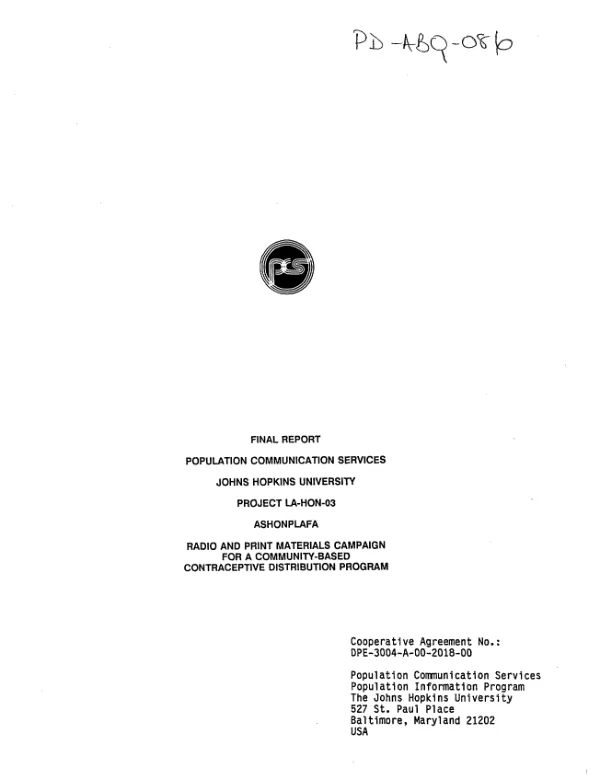 1990
1990USAID DEC