ACADEMY FOR EDUCATIONAL DEVELOPMENT, INC. (AED)
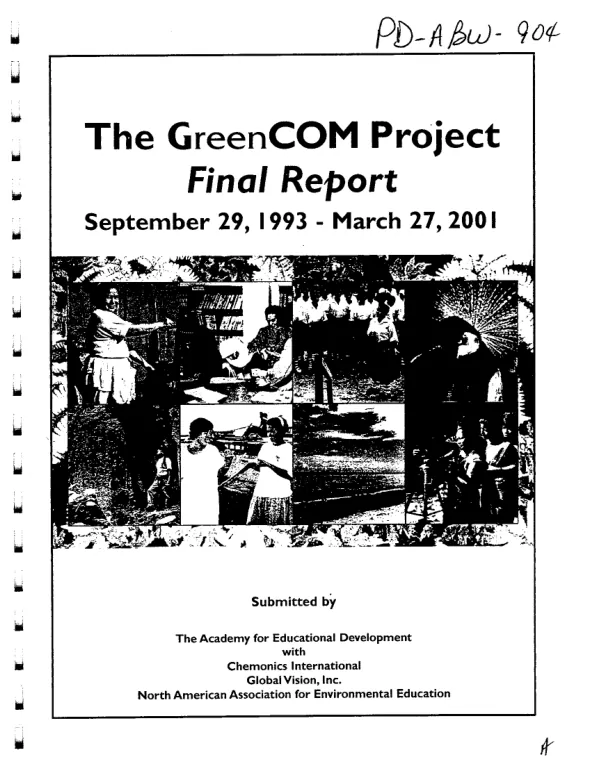
GreenCOM project, September 29, 1993-March 27, 2001 : final report
Final report by the Academy for Educational Development (AED) on a project (9/93-3/01) to use environmental education and communication (EE&C) tools to address the knowledge, attitudes, and behaviors behind many environmental problems (GreenCOM project).
1970
Sign in to readA free account is required to download.
Abstract
GreenCOM provided a wide variety of services to USAID in more than 30 countries and produced a number of publications (listed in an appendix to this report) that summarize different aspects of its work and the methods it developed. This report focuses on the deliverables required by the core contract, described by country, and briefly reviews the work done under 30 buy-ins to the requirements contract. The GreenCOM project design involved what USAID called the "heating up" process: putting issues on the public agenda, engaging key institutions, and moving through several stages of awareness and knowledge toward action. GreenCOM laid a broad foundation for critical problemsolving and long-term resource planning and management by addressing the human behavior components of environmental issues. It promoted more rapid and more targeted behavior change through communication and social marketing, addressed gender roles in natural resource management, and worked toward long-term sustainability through the introduction of education and communication capacities within local institutions. Key methods used in project implementation included: audience research through surveys, focus groups, and direct observation; involving beneficiary communities through use of a participatory approach to learning, monitoring, and evaluation; use of social marketing to promote environmental behavior change; and promotion of professional development and a change of behavior through provision of training to groups ranging from teachers to policymakers to project staff. Achievements in the four major project components were as follows: (1) Field support. The most significant component of GreenCOM"s work was to provide EE&C support to the environmental programs of USAID"s regional bureaus and missions. GreenCOM provided expertise to ongoing environmental projects in more than 30 countries, including El Salvador, Egypt, The Gambia, Nicaragua, Nepal, Haiti, Jordan, and the Philippines. (2) Applied research. Practical, field-driven research was central to the entire range of GreenCOM activities. In working with people, GreenCOM research emphasized understanding the audience"s knowledge, attitudes, beliefs, and behavioral characteristics. Qualitative and quantitative research using a mix of methodologies were key to helping program managers design, implement, and understand effective EE&C strategies. (3) Information exchange. To bridge gaps created by geography and uneven distribution of technical resources, GreenCOM established an EE&C resource center containing over 4,700 volumes of environmental education resource materials, newsletters, reports, videos, and curricula from around the world. The center is accessible online through the GreenCOM website and through the EE-Link website from the University of Michigan. (4) Information synthesis and dissemination. GreenCOM sponsored two international symposia that brought together international professionals from a variety of innovative and successful EE&C projects. The first workshop resulted in a commercially published book, "What Works: A Guide to Environmental Education and Communication Projects for Practitioners and Donors." GreenCOM"s own reports and documents are made available to interested organizations and individuals around the world. GreenCOM also convened five technical advisory group (TAG) meetings. The project also worked with USAID missions, bureaus, and host countries to address a wide range of environmental concerns such as municipal waste disposal, greenhouse gas reduction, water and biodiversity conservation, community management of forest and coastal resources, environmental policy formulation, training, and advocacy. In USAID"s four "emphasis countries" - El Salvador, Egypt, The Gambia, and the Philippines - GreenCOM"s applied research activities include formative (operations) research studies and impact evaluation studies.