USAID DEC
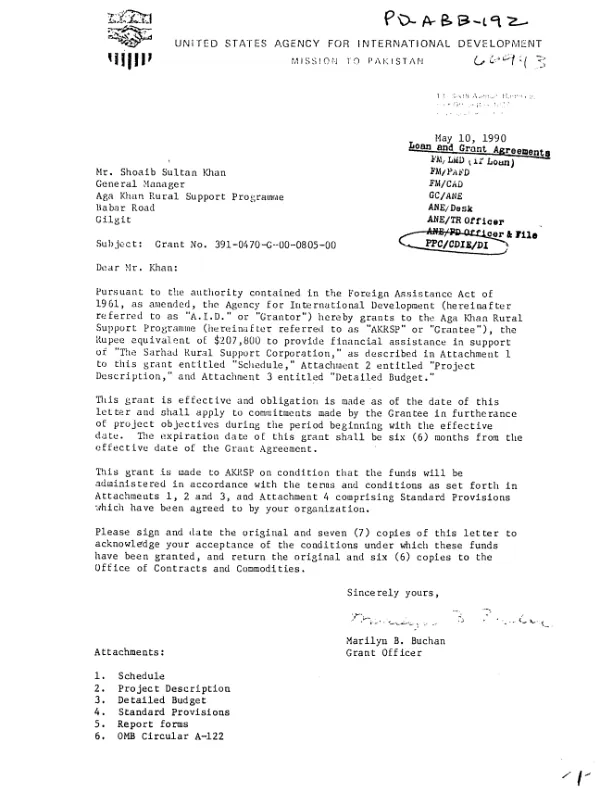
Final report to Agency for International Development on matching grant for Aga Khan rural support programme, 1985-1988
Sign inAGA KHAN FOUNDATION U.S.A.
Final report to Agency for International Development on matching grant for Aga Khan rural support programme, 1985-1988
Final report of the Aga Khan Foundation, U.S.A.
1988
Sign in to readA free account is required to download.
Abstract
(AKF) on a 1985-88 matching grant to promote rural development in select areas of Pakistan"s Gilgit District and the Indian State of Gujarat. The project"s greatest successes have been in village-level institutional and physical infrastructure. Replicable packages in agricultural development, resource management, and business development are evolving more slowly. Development finance activities have met with good success; they are now firmly anchored in the savings of village organizations (VO"s), and recovery rates for short-term credit have been excellent. Skill development, on the other hand, has met with mixed results, with VO para-veterinarians performing better than those trained as paraprofessional plant protectors and poultry managers. Replicable women in development (WID) packages with an agricultural focus have been slow to emerge, although strategies for reducing women"s workload have been developed. The project"s work in Pakistan teaches several important lessons. For one thing, differences between the project areas and the rest of the country were greatly underestimated; agricultural technology thought to be suitable for the area was not as readily available as expected, so more emphasis has been placed on adaptive research and on changing training courses. For another, the project began with the notion that increased agricultural marketing was simply a matter of selling surplus crops that would otherwise be wasted, when in fact very little salable product was being wasted. As a result, marketing has occasionally been unprofitable. Marketing should begin with the identification of potential demand, working back to providing quality products to meet the demand. Inadequate attention to socioeconomic realities severely impaired the effectiveness of initial WID activities; more realistic approaches are now being tried. In India, quantitative achievements have been hampered by the difficult ecological conditions of the last 3 years, which have also caused some change project activities. The continuing drought has forced emphasis to switch from purely land and water access activities to the establishment of percolation tanks, check dams, biogas, and cattle camps. Relations between AKA and village institutions (VI"s) have been troubled by disagreements over land procurement and water use, and VI"s are not yet in a position to take major responsibility for project implementation. Yet AKF has proved capable of overcoming these obstacles and adapting planned activities to local needs, thereby winning the respect of government and villagers alike. The project"s most lasting effect has been to spread the conviction that villagers can manage their resources collectively and shape their own future. The task of the years to come is to translate this conviction into concrete projects.
Related documents
Documents in this collection
![Rural economic development initiative (REDI)[/Lebanon] : cooperative agreement no. HNE-A-97-00061-00 [i.e. HNE-A-00-97-00061-00] -- final performance report : reporting period September 1, 1997-December 31, 2002](https://covers.devme.ai/gen/35875.webp) 2003
2003USAID DEC
Rural economic development initiative (REDI)[/Lebanon] : cooperative agreement no. HNE-A-97-00061-00 [i.e. HNE-A-00-97-00061-00] -- final performance report : reporting period September 1, 1997-December 31, 2002
Open record 2018
2018USAID DEC