USAID
Financial Management Capacity Development Initiative Final Report – November, 2016
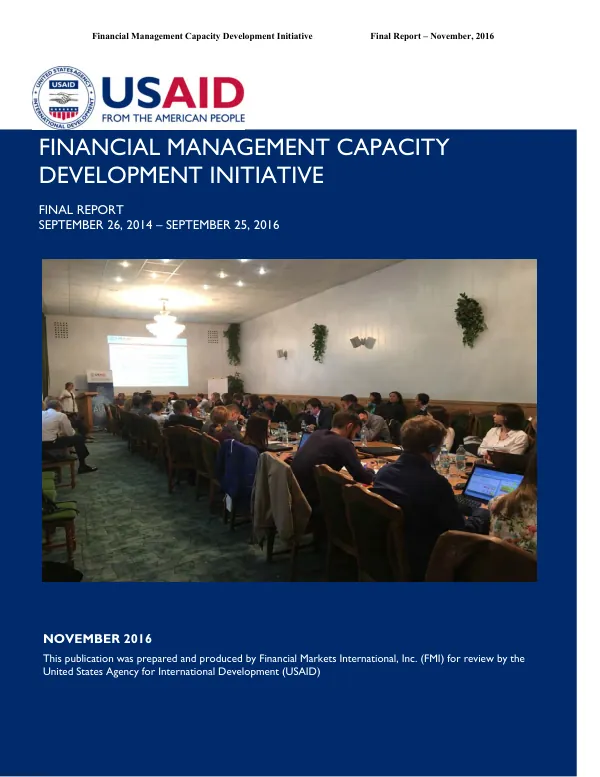
The USAID Financial Management Capacity Development Initiative (FMCDI) commenced operations in October 2014 with the stated purpose of building the financial and operational capacity of local partners to improve their ability to manage awards and implement USAID programs.
2016 · 36 pages
Sign in to readA free account is required to download.
Abstract
The method for achieving this goal was through improvement of the quality and range of services available in the local markets for financial management and operational capacity development by intermediaries, in this case, audit firms. In the years leading up to the FMCDI Project, USAID/Ukraine worked to build the organizational and technical capacity of NGOs in various ways. Local audit firms assisted USAID by providing three basic services: General Audit Services, Non-US Organization Pre-Award Surveys (NUPAS), and Consulting Engagements to help local NGOs improve their internal control and financial management systems. However, local audit firms had limited experience working with USAID-funded projects and lacked sufficient knowledge and skills, as well as training. Professionals in the audit firm industry lacked an understanding of the need for consulting services by the NGO community, and within the NGO community, there was no concept for use of services that could be offered by audit firms. The FMCDI Project addressed these weaknesses in two fundamental ways: by providing training to both local audit firms and NGO staff, and by using Memorandums of Understanding (MOU consulting engagements) to assist NGOs with actual financial control problems. FMCDI thus provided practical experience in improving financial management and operational capacity by helping NGOs solve their internal control and financial management problems through MOU consulting engagements. As outlined in FMCDI's two annual reports, the project achieved all program goals in both its training efforts and MOU program. FMCDI conducted a total of 25 separate training events for auditors and/or NGO staff, and assisted NGOs with actual financial control problems through MOU consulting engagements. The project's success was attributed to the provision of training to both local audit firms and NGO staff, as well as the use of MOU consulting engagements to provide practical experience in improving financial management and operational capacity. The FMCDI Project's achievements were significant, with local audit firms demonstrating improved capacity to assist local implementing partners to develop and implement financial and organizational policies, procedures, and related tools. The project also helped to establish a competitive market for audit and other financial advisory services, and improved the understanding of USAID's strict financial management and reporting requirements among all market participants. The project's success was also reflected in the improved financial management and operational capacity of NGOs, with many NGOs demonstrating improved internal control and financial management systems. The project's achievements were also attributed to the strong partnerships established between FMCDI and local audit firms, as well as the effective use of MOU consulting engagements to provide practical experience in improving financial management and operational capacity. Overall, the FMCDI Project was successful in achieving its program goals and objectives, and made significant contributions to the improvement of financial management and operational capacity of local partners in Ukraine.