MANAGEMENT SCIENCES FOR HEALTH (MSH)
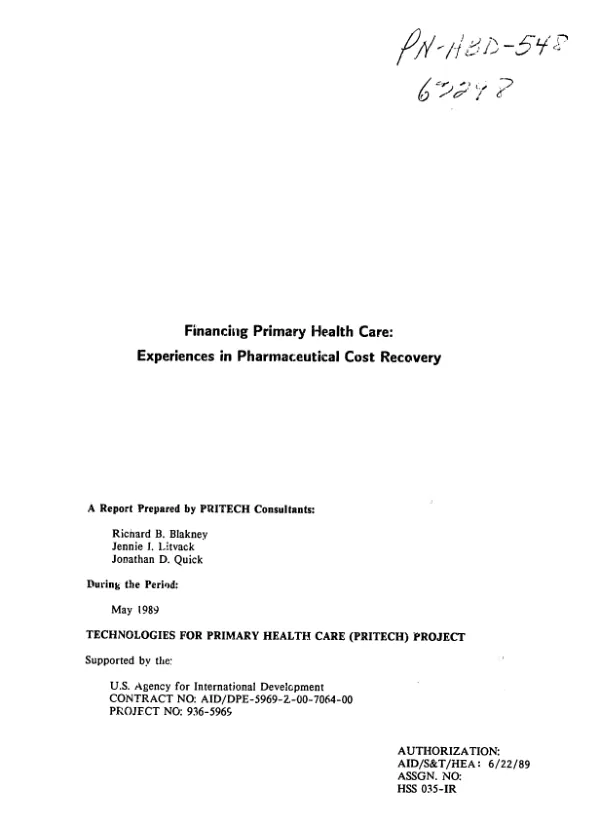
Financing primary health care : experiences in pharmaceutical cost recovery
Many developing countries are turning to pharmaceutical cost recovery (PCR) - programs in which donors establish a revolving fund to purchase drugs and consumers pay the cost of the drugs received - as a method for financing primary health care.
Blakney, Richard B.; Litvack, Jennie I. +1 more · 1989
Sign in to readA free account is required to download.
Abstract
This paper examines PCR experience in eight countries: Ghana, Haiti, Liberia, Mali, Nepal, Nigeria, Thailand, and Zaire. Key findings are as follows. (1) PCR programs have varied in success, from a recovery of 272% of drug costs in Liberia to little or no recovery in Mali. (2) Successful programs are those which involve the community deeply, are flexible and decentralized, and are managed by those with the requisite financial skills. Also, despite the inevitable and necessary tension between financial and public health goals in PCR programs, successful programs are those which treat the patient as a consumer. (3) Success is ultimately determined by cost and consumer willingness to pay, not by government policy. Even those willing to pay for drugs can be dissuaded by significant price increases. (4) Most programs include mechanisms (e.g., government subsidies) to protect vulnerable groups. (5) PCR should be explored within a full range of financing options. (6) PCR is not a substitute for government health financing. Nor should it be made a precondition for programs that provide primary health care or essential drugs. (7) Many questions remain unaswered regarding PCR"s effect on health care patterns and the political and administrative environments required for its success.
Related documents