USAID DEC
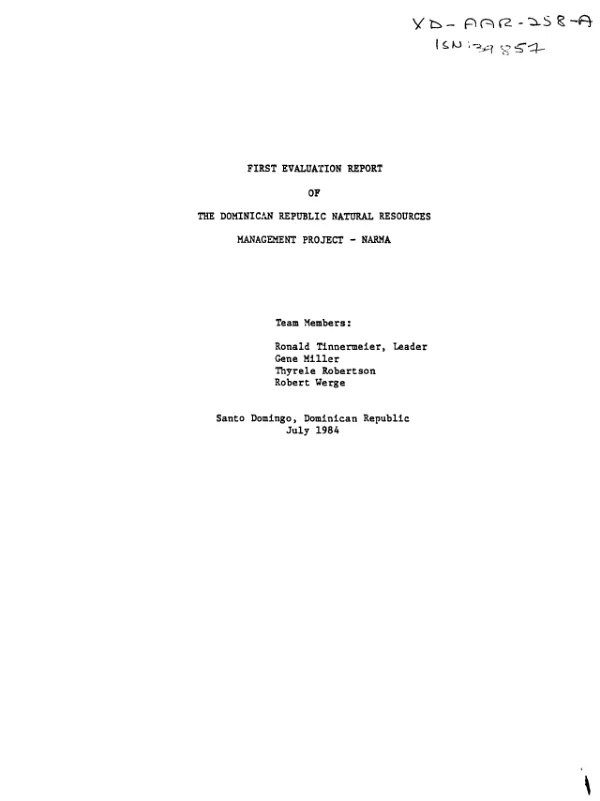
First evaluation report of the Dominican Republic natural resources management project - NARMA
Sign inUSAID. MISSION TO DOMINICAN REPUBLIC
First evaluation report of the Dominican Republic natural resources management project - NARMA
Evaluates project to strengthen the Government of the Dominican Republic (GODR) in developing the country's natural resources and establishing a soil and water conservation model.
Tinnermeier, Ronald|Miller, Gene · 1984
Sign in to readA free account is required to download.
Abstract
Special evaluation covers the period 10/82-7/84 and is based on document review, site visits, and interviews with personnel of the GODR and the Ocoa watershed office, farmers, and community leaders. The project has contributed significantly to the GODR's capability to collect and interpret natural resource data and to develop long-term resource plans. Stress has been laid on the need to select technically qualified staff, and coordination among the central office, watershed office, and the local community is good. Project staff at all levels are, for the most part, quite enthusiastic. In the Ocoa watershed, substantial progress has been made on the aerial photo and mapping work and the soil, water, and forestry program is proceeding mostly according to plan - some 140 farmers have received loans for conservation improvements and nurseries have been established and 42,000 seedlings planted. The environmental education program is very active and much in demand by farmer groups. Major constraints exist, however, the most serious of which is the inability of the GODR to provide the specified counterpart funds, which may necessitate a scaling down of planned activities. A further concern is that little erosion/agronomic and economic research is being done to support the recommended conservation and cropping practices. In providing incentives for farm conservation, too much stress is laid on formal credit; not all farmers need credit, dependence on loans should not be encouraged, and alternative incentives should be available. Project coordination with groups within the GODR Subsecretariat of Natural Resources is mostly satisfactory, but more effort is needed to cooperate with other institutions. The information flow on the technical aspects of the watershed is progressing well, but data collection relative to human resources must be improved for long-term measurement of local and household-level impacts. Also, the project's farm conservation improvements should be viewed as long-term investments in the environment, i.e., not merely as means of increasing crop yields.
![Mid-term evaluation of the shared control of natural resources [SCOR] sub-project, Sri Lanka](https://covers.devme.ai/gen/7067.webp)