INTERNATIONAL FOOD AND POLICY RESEARCH INSTITUTE
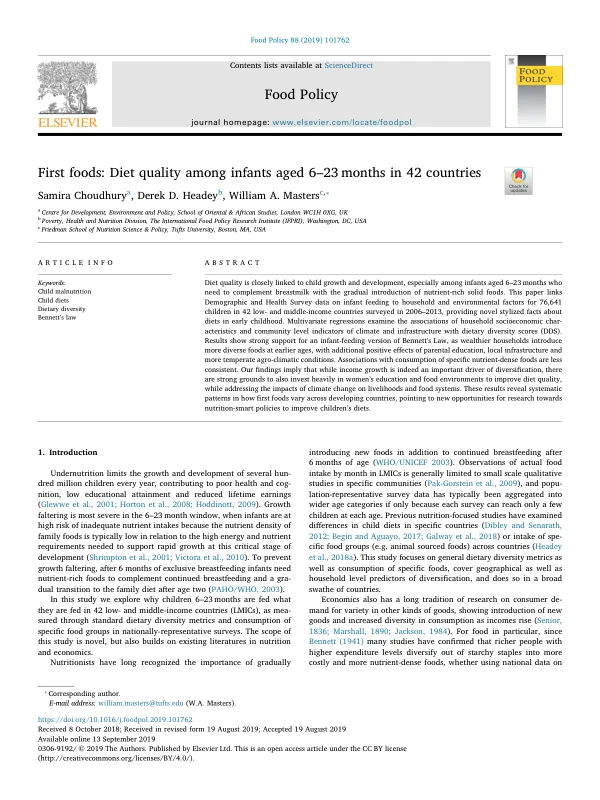
First foods: Diet quality among infants aged 6–23 months in 42 countries
The relationship between household wealth and dietary diversity among infants aged 6-23 months in 42 low- and middle-income countries is explored in a recent study.
2019 · 11 pages
Sign in to readA free account is required to download.
Abstract
The study uses Demographic and Health Survey data on infant feeding to household and environmental factors for 76,641 children in 42 countries surveyed between 2006 and 2013. The study provides novel stylized facts about diets in early childhood and examines the associations of household socioeconomic characteristics and community-level indicators of climate and infrastructure with dietary diversity scores. The study finds strong support for an infant-feeding version of Bennett's Law, which suggests that wealthier households introduce more diverse foods at earlier ages. The study also finds positive effects of parental education, local infrastructure, and more temperate agro-climatic conditions on dietary diversity scores. However, associations with consumption of specific nutrient-dense foods are less consistent. The study's findings imply that while income growth is an important driver of diversification, there are strong grounds to also invest in women's education and food environments to improve diet quality, while addressing the impacts of climate change on livelihoods and food systems. The study uses recent Demographic and Health Surveys from 42 countries, combined with geographic data about the locations of DHS survey clusters. The study documents infant feeding patterns in the sample, including differences across major developing regions, and presents econometric models that account for inter-child differences in dietary diversity scores, minimum dietary diversity, and the consumption of eight nutrient-rich food groups. The study provides various extensions to explore the relationship between household and community-level factors, to account for regional heterogeneity, and to contrast the results with findings from the existing literature, with potential policy implications and areas for future research.