USAID DEC
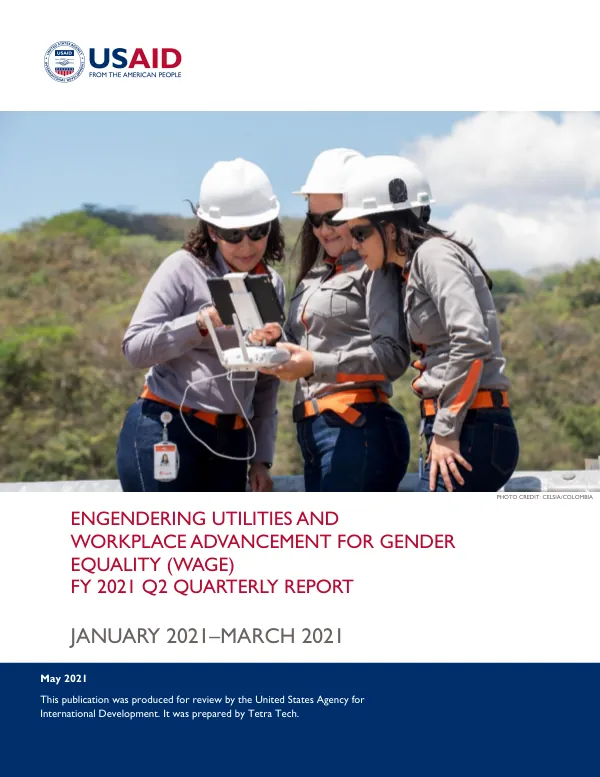
Engendering Utilities and Workplace Advancement for Gender Equality (WAGE) FY 2021 Q2 Quarterly Report
Sign inJOHNS HOPKINS UNIVERSITY
Engendering Utilities and Workplace Advancement for Gender Equality (WAGE) FY 2021 Q2 Quarterly Report
Engendering Utilities and Workplace Advancement for Gender Equality (WAGE) is a program implemented by Tetra Tech, funded by the USAID Scaling Up Renewable Energy (SURE) and Workplace Advancement for Gender Equality (WAGE) activities.
2021 · 35 pages
Sign in to readA free account is required to download.
Abstract
The program aims to increase gender equality in the energy and water sectors, contributing to the sectors' overall strength and resilience. By partnering with 29 utilities across 21 countries, Engendering Utilities improves gender equality and business performance outcomes in utilities by implementing organizational change management interventions throughout the employee life cycle (ELC). The program builds the capacity of utility leaders to implement gender equality interventions in their organizations through customized best practices, demand-driven coaching, and a Gender Equity Executive Leadership Program (GEELP). The GEELP is a key component of the program, which provides training and coaching to utility leaders to develop their skills and knowledge in implementing gender equality interventions. In 2019, USAID awarded the WAGE contract to build upon and expand the work under Engendering Utilities. WAGE incorporates additional activities, including establishing a partnership with Johns Hopkins University (JHU) to implement the Self- Empowerment and Equity for Change (SEE Change) Initiative. The SEE Change Initiative aims to empower employees in the energy sector to drive change and promote gender equality. The initiative includes three pillars: evidence, practice, and innovation. The program has made significant progress in implementing gender equality activities across partner utilities. In the current quarter, the 22 utilities from Cohort 2 and 3 implemented a total of 77 gender equality activities across the 12 ELC phases, including drafting, reviewing, adopting, or implementing nine policies related to gender equality. The utilities trained a total of 307 people (108 women and 199 men) on gender equality. The program has also made significant progress in promoting gender equality through various activities. The JHU team, COR, and WAGE COP further articulated the SEE Change Initiative strategic approach, including finalizing language describing the "challenge" the initiative is designed to address, the initiative vision, mission, and goal, and the description of the three pillars: evidence, practice, and innovation. The team further developed the format and arrangements to offer the Empowered Employee Training Program (EETP) training content to all Electricidade de Moçambique (EDM) employees via EDM trainer pairs who underwent the Training of Trainers (ToT). The program has also published two WiAP newsletters this quarter, reaching 490 readers. The March newsletter featured content related to the International Women's Day #ChooseToChallenge campaign and in recognition of the International Day of Women and Girls in Science, WiAP published blogs on three internship programs available to women in the African energy sector. The program has also made significant progress in selecting new partners for Cohort 4, with nine utilities (two water and seven energy) confirming participation and the project in discussion with four additional utilities to fill the remaining three slots. The program has also made significant progress in implementing the Accelerated Program, which is planned to be delivered virtually in 2021 with four partners: Kenya/KenGen, Vietnam/Fulbright University Vietnam, Colombia/La Universidad de los Andes, and Nigeria/Lagos Business School. Thirty-five partner faculty staff were selected to join the virtual Training of Trainers (ToT) program that will be held between May and July 2021. The program has also made significant progress in promoting gender equality through various activities, including the publication of knowledge products that support Best Practices Framework application. The program has also made significant progress in implementing the TAILORED COACHING FOR PARTNER UTILITIES, which continued for Cohorts 2 and 3, with a focus on completion of Cohort 2 capstone projects, grant submissions, and finalization of grant agreements for Cohort 2 utilities, and continued data collection and support of integration of the GEELP learning for Cohort 3. The CMCs also held 8 virtual Focus Group Discussions with Cohort 3 utilities during this period. Cohort 1 utilities were provided with coaching on demand, which was mainly used for closing activities before transition into the alumni network, orientation on the alumni network benefits and requirements, as well as support for grant submissions and finalization of grant agreements.